
Optimizing Rank for High-Fidelity Implicit Neural Representations
Abstract
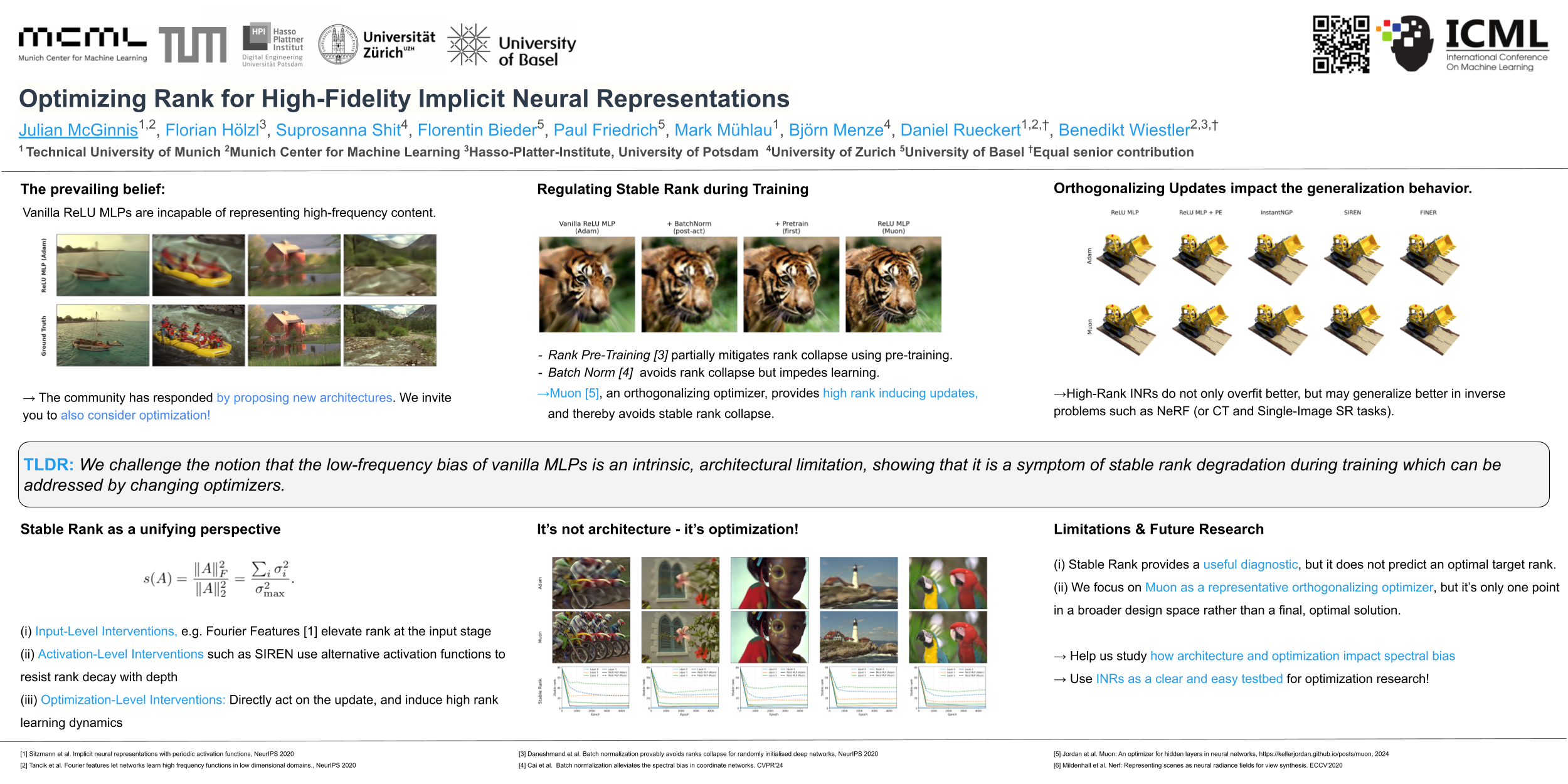
Implicit Neural Representations (INRs) based on vanilla Multi-Layer Perceptrons (MLPs) are widely believed to be incapable of representing high-frequency content. This has directed research efforts towards architectural interventions, such as coordinate embeddings or specialized activation functions, to represent high-frequency signals. In this paper, we challenge the notion that the low-frequency bias of vanilla MLPs is an intrinsic, architectural limitation to learn high-frequency content, but instead a symptom of stable rank degradation during training. We empirically demonstrate that regulating the network’s rank during training substantially improves the fidelity of the learned signal, rendering even simple MLP architectures expressive. Extensive experiments show that using optimizers like Muon, with high-rank, near-orthogonal updates, consistently enhances INR architectures even beyond simple ReLU MLPs. These substantial improvements hold across a diverse range of domains, including natural and medical images and novel view synthesis, with up to +9 dB PSNR over the samearchitecture. Code is available here.
Lay Summary
Neural networks are increasingly used to represent various signals like images, audio or medical data such as CTs. But the simplest networks have long been thought incapable of capturing fine details, directing years of research into specialized architectures to overcome this. We show that this core belief is mistaken: the real problem isn't the architecture but the training procedure. During standard training, the network's internal representations collapse into a narrow set of directions, which limits what it can express. By switching to a training method that keeps these directions spread out, even the simplest networks can capture fine detail faithfully, and the same fix also improves specialized architecture we tested, across images, medical scans, audio, 3D shapes, and 3D scene reconstruction as well.