
Cello: A Universal Cell-wise Feature Aggregation framework for Reliable Pathology Images Analysis
Abstract
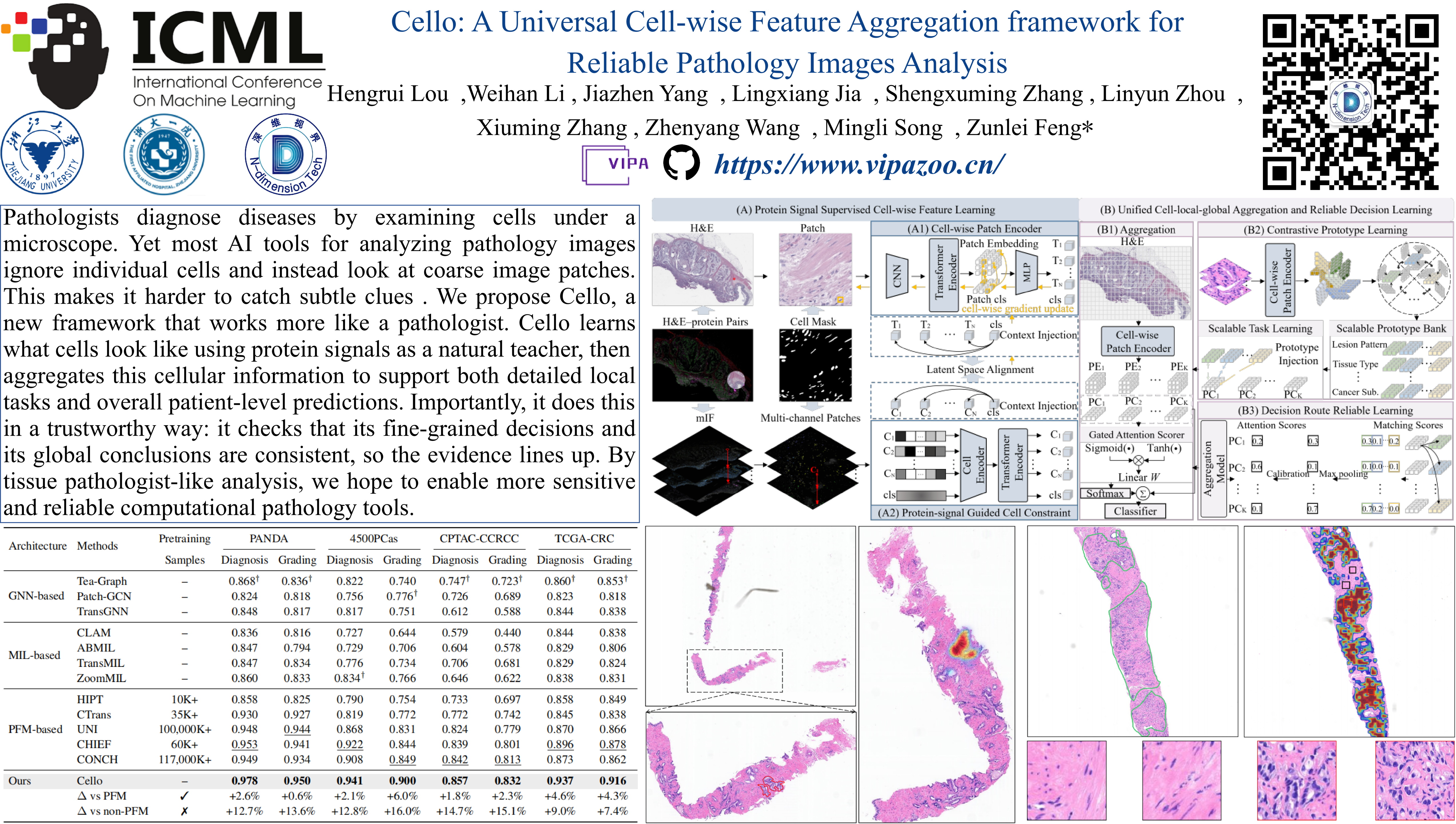
Computational pathology has made progress in diagnosis and prognosis prediction from whole slide images (WSIs), yet pipelines still rely on patch-level feature extraction and aggregation, departing from the cell-centric reasoning used by pathologists. This gap limits sensitivity to micro-lesions and subtle changes, and current methods rarely provide a unified solution that supports both local and global tasks with trustworthy evidence. We propose Cello, a universal cell-wise feature aggregation framework for reliable pathology image analysis. Cello integrates cell-level representations into WSI modeling via protein-signal–supervised cell-wise learning, preserving fine-grained cellular cues under gigapixel constraints. For local tasks, Cello introduces a flexible prototype-based contrastive module for scalable, task-adaptive representation learning. For global tasks, Cello adopts a weakly supervised gated aggregation that can widely leverage WSI labels. Finally, a cell–local–global decision-route consistency objective dynamically aggregates cellular evidence and aligns local predictions with global outcomes, improving reliability and faithfulness. Trained with only hundreds to thousands of samples, Cello achieves performance gains of 3.0%~7.6% and outperforms SOTA pathology foundation models pretrained on tens of thousands of samples. Code is available at https://github.com/HengruiLou/Cello.
Lay Summary
Pathologists diagnose diseases by examining cells under a microscope. Yet most AI tools for analyzing pathology images ignore individual cells and instead look at coarse image patches. This makes it harder to catch subtle clues like tiny lesions. We propose Cello, a new framework that works more like a pathologist — it builds its analysis from the level of single cells. Cello learns what cells look like using protein signals as a natural teacher, then aggregates this cellular information to support both detailed local tasks and overall patient-level predictions. Importantly, it does this in a trustworthy way: it checks that its fine-grained decisions and its global conclusions are consistent, so the evidence lines up. Even when trained on just hundreds to thousands of samples, Cello delivers clear improvements of 3 to 7.6 percent over previous methods and outperforms systems that were pre-trained on tens of thousands of samples. By making AI see tissue like a pathologist does, we hope to enable more sensitive and reliable computational pathology tools.