
Sampling and Identity-Testing Without Approximate Tensorization of Entropy
Abstract
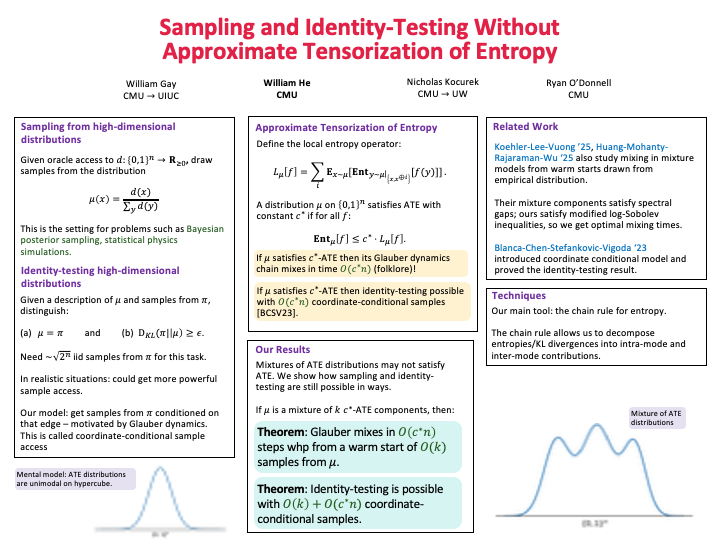
We study the problems of approximate sampling from and distribution testing of \emph{mixture models}, where the modes satisfy a functional inequality called \emph{approximate tensorization of entropy} (ATE). While it is known that ATE makes these tasks more efficient in the unimodal setting, mixtures of few distributions satisfying ATE do not necessarily satisfy ATE overall, leading to a lack of theoretical guarantees for multimodal distributions, which are a key challenging case of modern generative models. We show this gap can be overcome by establishing the following pair of results for mixtures of ATE distributions: 1) We show fast mixing of Glauber dynamics from a \emph{data-based initialization}, with \emph{optimal} sample complexity, for mixtures of distributions satisfying modified log-Sobolev inequalities, building on similar results in (Koehler et al., 2024, Huang et al., 2024) for mixtures satisfying the weaker Poincaré inequality. 2) Answering an open question from (Blanca et al., 2023), we give efficient identity-testers for mixtures of ATE distributions in the coordinate-conditional sampling access model.
Lay Summary
Generative modeling, producing observables (text, images, etc.) resembling an underlying data set, is one of the most exciting tasks in modern machine learning, but a sound theoretical framework is lacking. We refine and simplify a model for this task, and mathematically prove that commonly employed processes succeed at generating proper observables. This opens the door for a deeper understanding of frontier level techniques in mixture models.