
BiRQA: Bidirectional Robust Quality Assessment for Images
Aleksandr Gushchin ⋅ Dmitriy Vatolin ⋅ Anastasia Antsiferova
Abstract
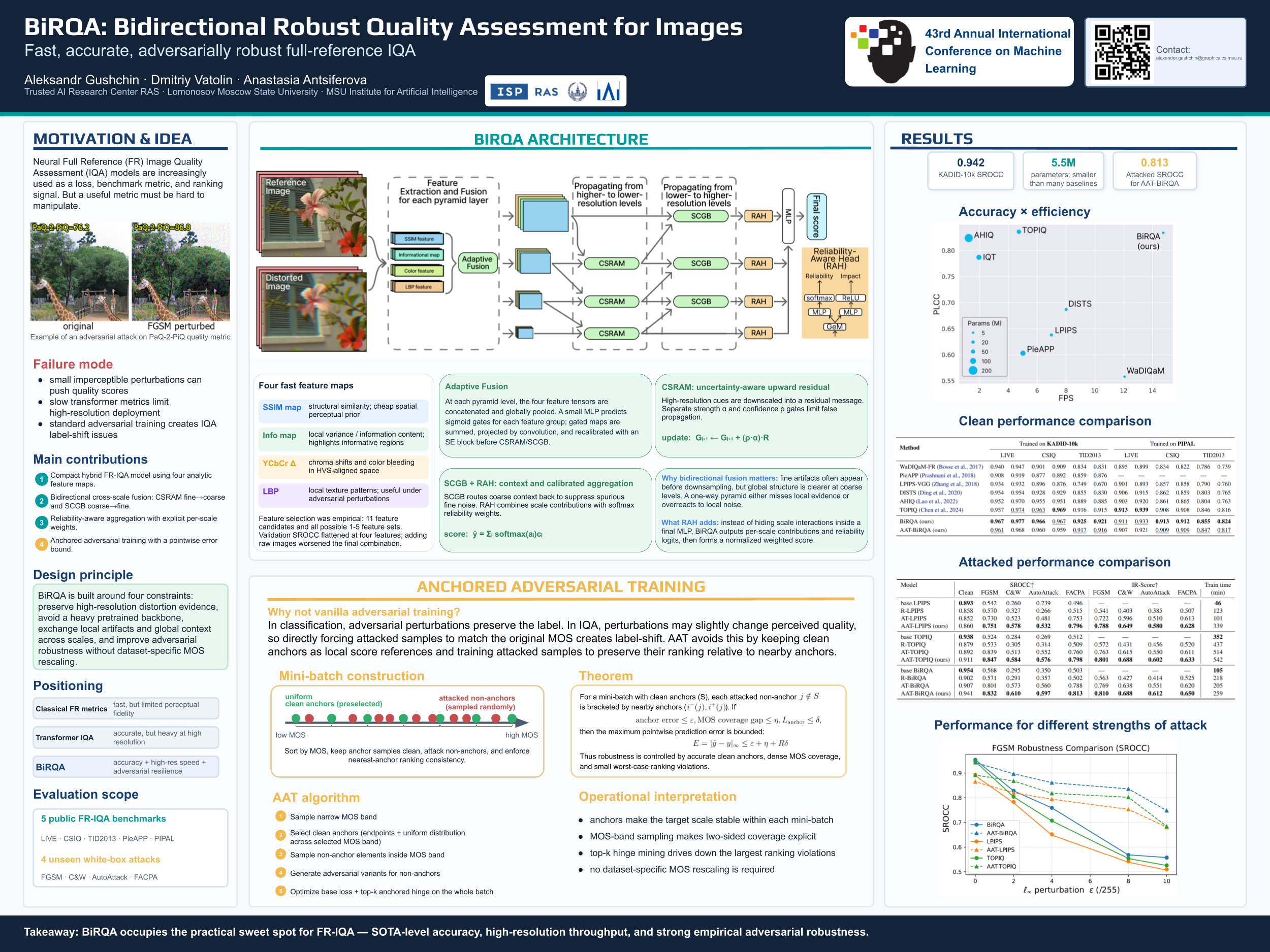
Full-Reference image quality assessment (FR IQA) is important for image compression, restoration and generative modeling, yet current neural metrics remain slow and vulnerable to adversarial perturbations. We present BiRQA, a compact FR IQA metric model that processes four fast complementary features within a bidirectional multiscale pyramid. A bottom-up attention module injects fine-scale cues into coarse levels through an uncertainty-aware gate, while a top-down cross-gating block routes semantic context back to high resolution. To enhance robustness, we introduce Anchored Adversarial Training, a theoretically grounded strategy that uses clean "anchor" samples and a ranking loss to bound pointwise prediction error under attacks. On five public FR IQA benchmarks BiRQA outperforms or matches the previous state of the art (SOTA) while running $\sim 3 \times$ faster than previous SOTA models. Under unseen white-box attacks it lifts SROCC from 0.30-0.57 to 0.60-0.84 on KADID-10k, demonstrating substantial robustness gains. To our knowledge, BiRQA is the only FR IQA model combining competitive accuracy with real-time throughput and strong adversarial resilience.
Lay Summary
BiRQA is a fast and robust method for measuring image quality by comparing a distorted image with its original version. Unlike many existing neural quality metrics, it remains reliable even when images are intentionally manipulated with tiny adversarial perturbations. The method combines lightweight visual features with a compact multi-scale neural network and a new training strategy that uses clean reference examples as anchors during learning. Experiments on several public benchmarks show that BiRQA achieves competitive accuracy, runs efficiently, and substantially improves robustness under adversarial attacks.
Video
Chat is not available.
Successful Page Load