
ECSEL: Explainable Classification via Signomial Equation Learning
Abstract
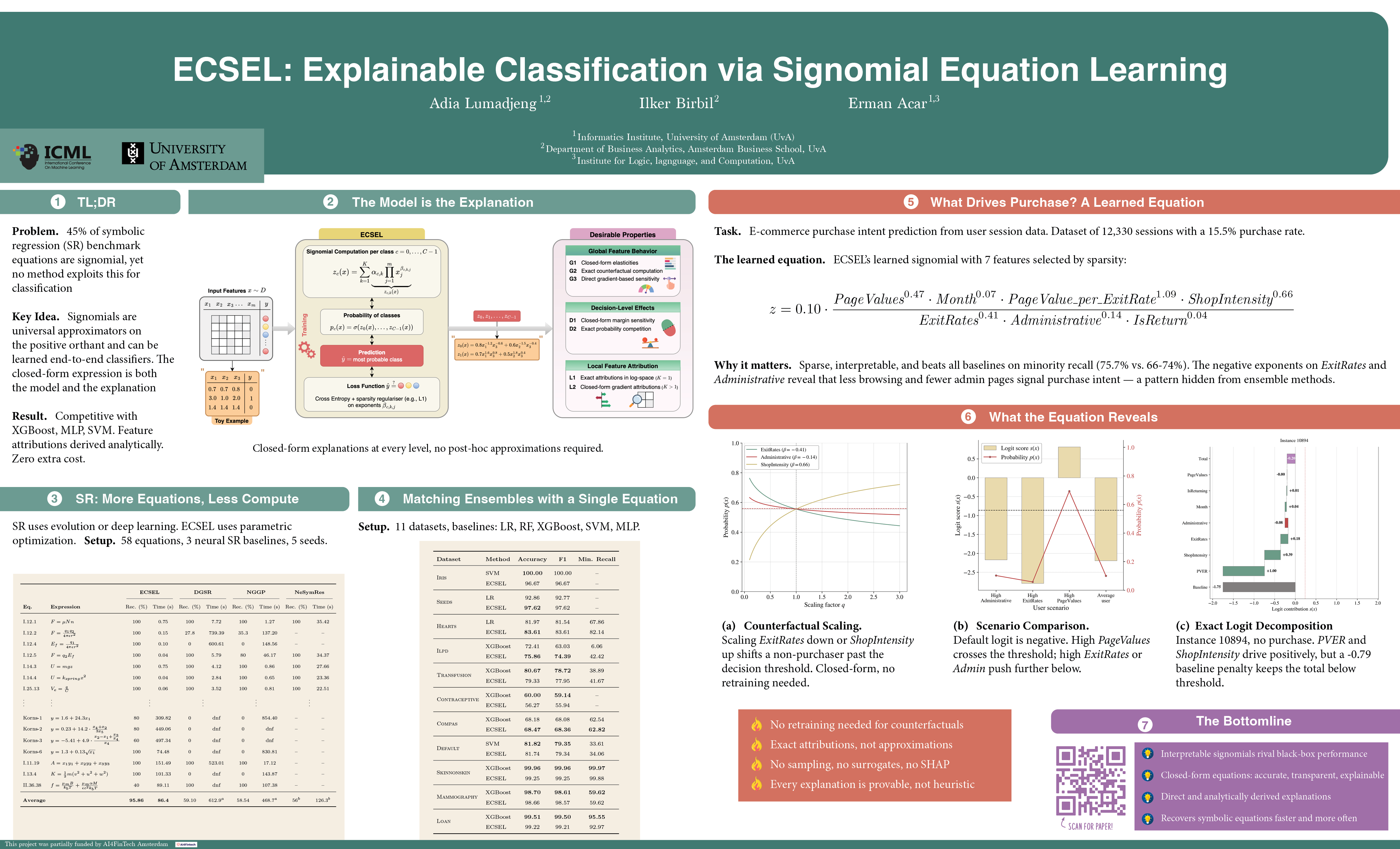
We introduce ECSEL, an explainable classification method that learns formal expressions in the form of signomial equations, motivated by the observation that many symbolic regression benchmarks admit compact signomial structure. ECSEL directly constructs a structural, closed-form expression that serves as both a classifier and an explanation. On standard symbolic regression benchmarks, our method recovers a larger fraction of target equations than competing state-of-the-art approaches while requiring substantially less computation. Leveraging this efficiency, ECSEL achieves classification accuracy competitive with established machine learning models without sacrificing interpretability. Further, we show that ECSEL satisfies some desirable properties regarding global feature behaviour, decision-boundary analysis, and local feature attributions. Experiments on benchmark datasets and two real-world case studies i.e., e-commerce and fraud detection, demonstrate that the learned equations expose dataset biases, support counterfactual reasoning, and yield actionable insights.
Lay Summary
Most AI systems that make high-stakes decisions, like diagnosing diseases or detecting fraud, are "black boxes": they give answers but cannot explain why. Tools that try to explain these models after the fact require additional computation and can be unreliable. We introduce ECSEL, a machine learning method that learns compact mathematical formulas directly from data. Instead of a black box, you get a human-readable equation that describes exactly how each input feature influences the prediction, by construction and not as an afterthought. The key ingredient is a class of functions called signomials, which are expressive enough to capture complex patterns yet simple enough to write down and inspect. We show that ECSEL recovers mathematical equations from scientific benchmarks more accurately and faster than state-of-the-art methods, while achieving predictive accuracy on par with established models like random forests and gradient boosting. In case studies on e-commerce and financial fraud detection, the learned formulas revealed interpretable patterns, such as fraudsters disproportionately targeting high-value accounts, that black-box models cannot surface on their own.