
Adversarial Latent Embedding Repair for LLM Continual Learning
Xilin Xia ⋅ Xialiang Tong ⋅ Jie Wang ⋅ Chi Ma ⋅ Shengxue Li ⋅ 白 寅岐 ⋅ Yuhang Jiang ⋅ Xing Li ⋅ Jianye Hao ⋅ Mingxuan Yuan ⋅ Feng Wu
Abstract
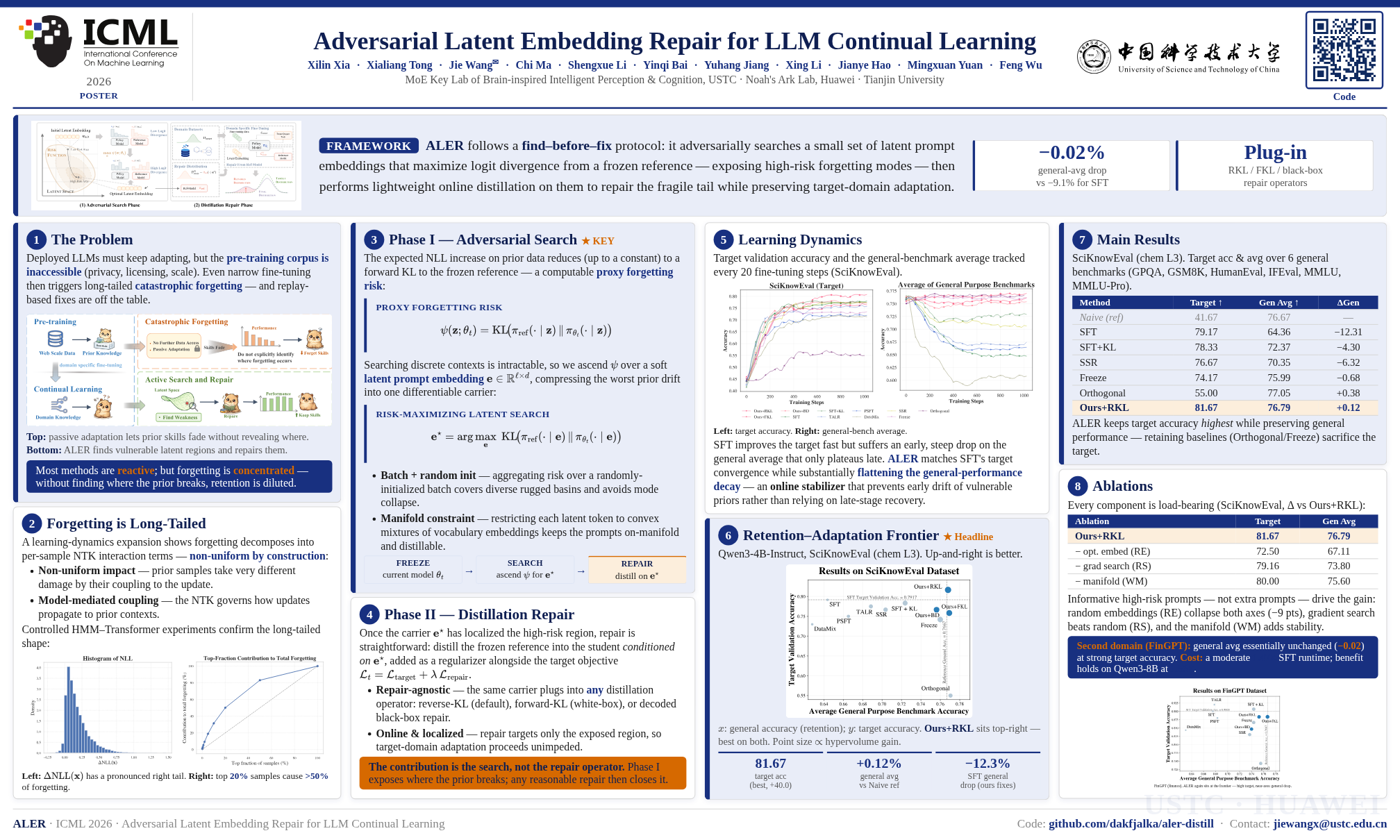
Research on continual learning for LLMs seeks to acquire new skills without catastrophic forgetting of established prior knowledge. However, domain-specific fine-tuning still triggers severe, long-tailed forgetting issues even under narrow updates, particularly when the pre-training data is inaccessible. To tackle this challenge, we propose **ALER**, a data-free continual learning framework that adversarially searches for a small set of latent prompt embeddings to maximize logit divergence from a frozen reference model, proactively exposing high-risk forgetting modes at each step. It then performs online distillation from the frozen reference using the discovered embeddings to retain prior behaviors while preserving target-domain adaptation. We provide theoretical guarantees on the efficiency of our targeted repair, and extensive experiments demonstrate consistent improvements in the retention–adaptation frontier over representative baselines across $2$ domain-specific fine-tuning datasets and $6$ general-purpose benchmarks, suggesting a more proactive approach for LLM continual learning.
Lay Summary
Large language models often need to learn new knowledge for specialized areas such as science or finance, but this updating process can make them forget useful general abilities. We introduce ALER, a method that first looks for the situations where a model is most likely to forget, and then uses the original model to guide focused repair during training. This helps models adapt to new domains while better preserving broad skills such as knowledge, reasoning, instruction following, and coding.
Video
Chat is not available.
Successful Page Load