
GraphP-FL: Personalized Federated Graph Learning via Dynamic Structure Awareness and Fisher Information Elastic Alignment
Abstract
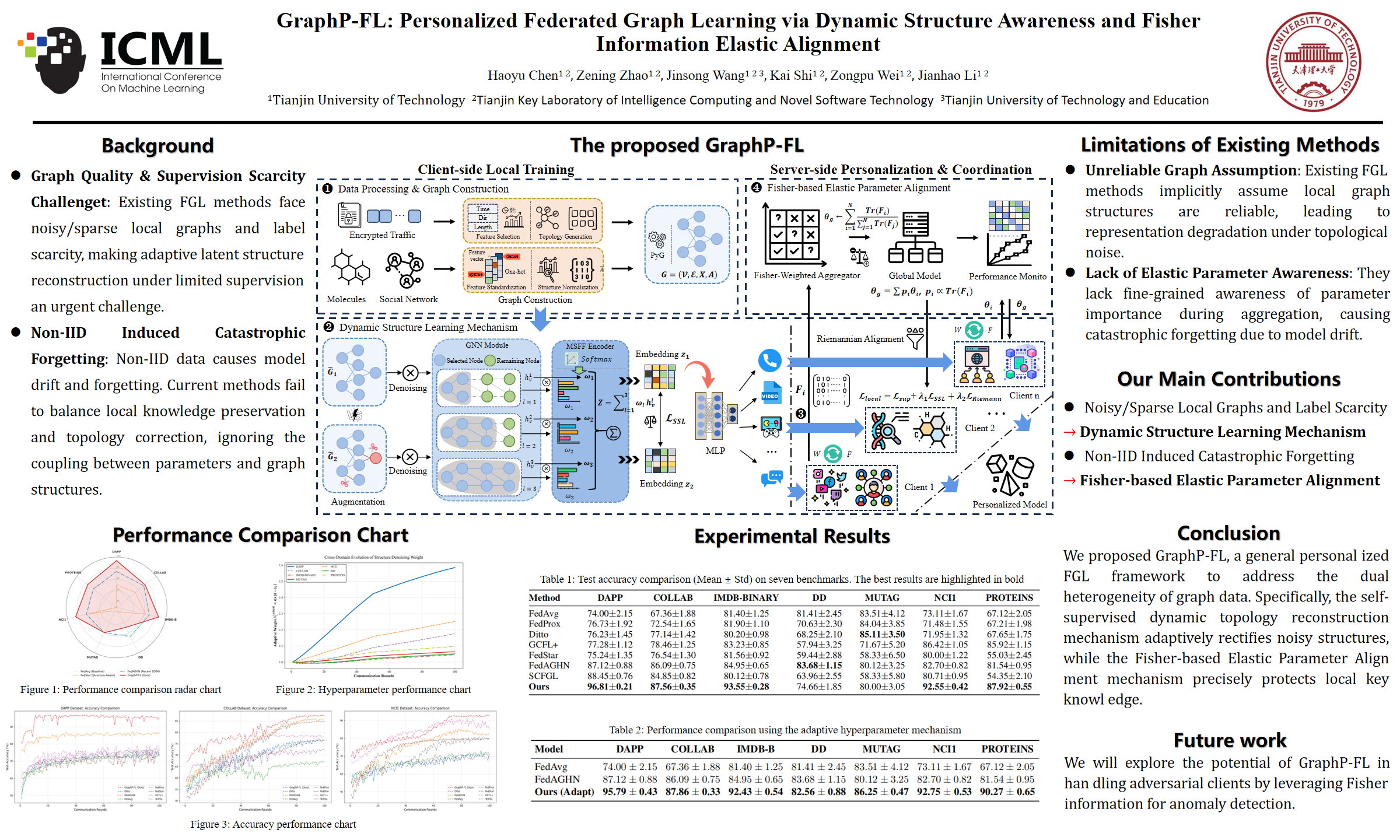
Federated Graph Learning (FGL) enables distributed clients to collaboratively train graph neural networks while strictly preserving data privacy. However, existing FGL methods implicitly assume the reliability of local graph structures and lack elastic awareness of parameter importance during model aggregation, leading to representation degradation under topological noise and catastrophic forgetting caused by model drift. To address these challenges, we propose GraphP-FL, a general personalized FGL framework. (1) Specifically, we design a self-supervised dynamic topology reconstruction mechanism on the client side. This mechanism mines implicit dependencies to adaptively rectify noisy topologies, effectively suppressing topological noise propagation and capturing precise structural relationships for high-quality representations. (2) Additionally, we introduce a Fisher-based Elastic Parameter Alignment (FRPA) algorithm. FRPA imposes anisotropic regularization constraints in the parameter space to precisely quantify parameter importance, enabling the model to strictly preserve critical local knowledge while flexibly aligning with the global model, thus effectively overcoming catastrophic forgetting. Extensive experiments on seven benchmarks (including biochemical molecules, social networks, and large-scale encrypted traffic) demonstrate that GraphP-FL significantly outperforms state-of-the-art methods, improving accuracy by up to 8.6% while exhibiting superior generalization and robustness.
Lay Summary
Artificial intelligence has shown immense potential in understanding complex networks such as social relationships, biological molecules, and internet traffic. To protect user privacy, a technology called Federated Learning allows multiple organizations to collaboratively train a shared AI model without ever exchanging their sensitive raw data. However, in real-world scenarios, this collaborative approach faces two major hurdles. First, the data on individual devices is often noisy or broken, which can easily mislead the AI. Second, forcing highly unique local data to fit a single universal model often leads to catastrophic forgetting, where the AI loses the valuable personalized knowledge it originally learned. To address these challenges, we introduce GraphP-FL, a new collaborative AI framework. It equips each device with a self-cleaning mechanism that automatically filters out misleading data connections on the fly, ensuring the AI learns only from true patterns. Additionally, we developed an elastic memory system that precisely identifies and protects the most critical personalized knowledge on each device, preventing it from being overwritten by the global model. Our extensive tests demonstrate that GraphP-FL significantly outperforms existing methods, offering a highly accurate, robust, and privacy-conscious AI solution for complex network environments.