
Sparse Bayesian Deep Functional Learning with Structured Region Selection
Abstract
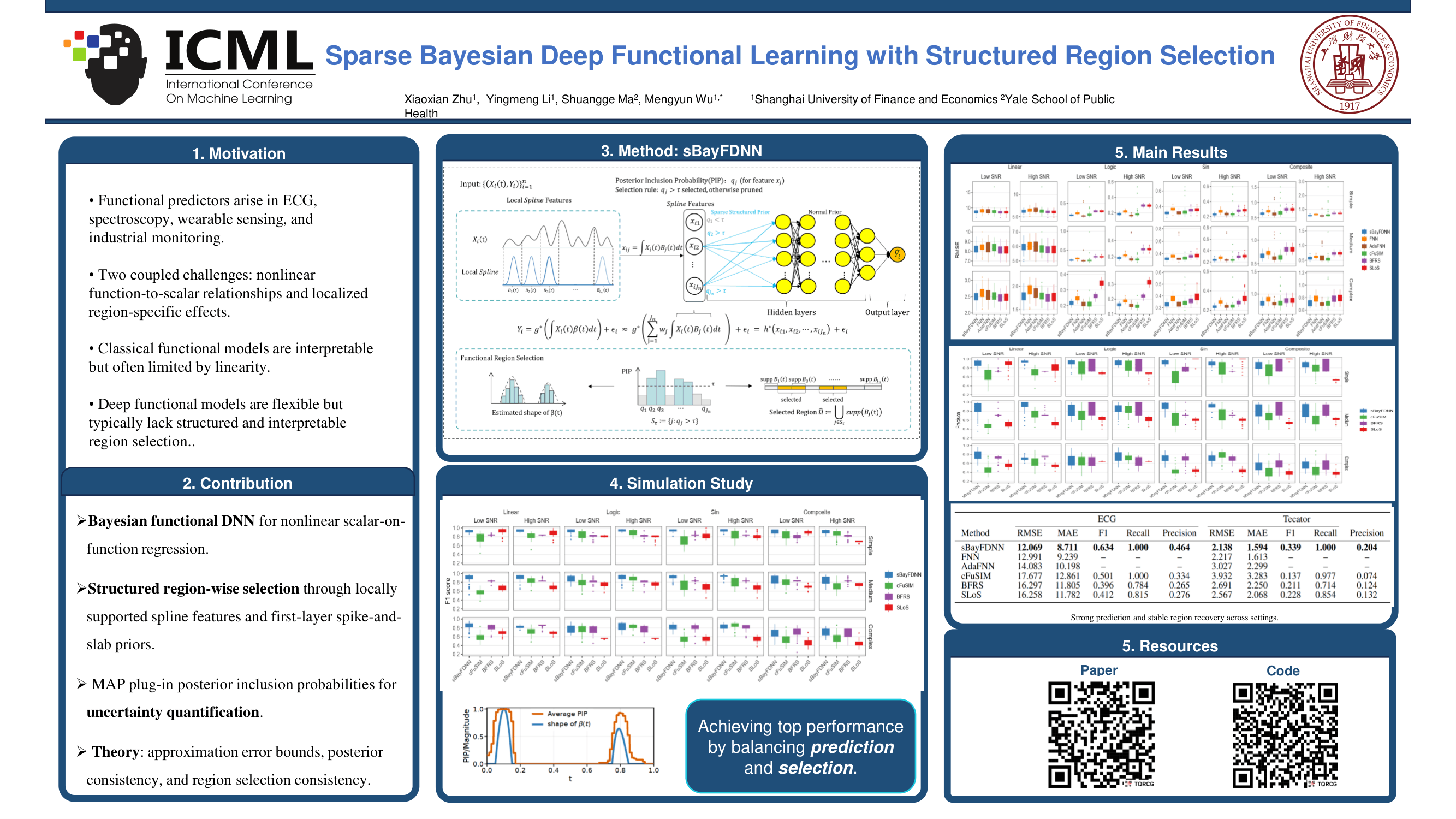
In modern applications such as ECG monitoring, neuroimaging, wearable sensing, and industrial equipment diagnostics, complex and continuously structured data are ubiquitous, presenting both challenges and opportunities for functional data analysis. However, existing methods face a critical trade-off: conventional functional models are limited by linearity, whereas deep learning approaches lack interpretable region selection for sparse effects. To bridge these gaps, we propose a sparse Bayesian functional deep neural network (sBayFDNN). It learns adaptive functional embeddings through a deep Bayesian architecture to capture complex nonlinear relationships, while a structured prior enables interpretable, region-wise selection of influential domains with quantified uncertainty. Theoretically, we establish rigorous approximation error bounds, posterior consistency, and region selection consistency. These results provide the first theoretical guarantees for a Bayesian deep functional model, ensuring its reliability and statistical rigor. Empirically, comprehensive simulations and real‑world studies confirm the effectiveness and superiority of sBayFDNN. Crucially, sBayFDNN excels in recognizing intricate dependencies for accurate predictions and more precisely identifies functionally meaningful regions, capabilities fundamentally beyond existing approaches.
Lay Summary
Many modern datasets are recorded as curves, such as ECG signals, spectra, or daily activity patterns. In these problems, we often want not only accurate prediction, but also to know which parts of the curve are important. This paper proposes sBayFDNN, a deep learning method for functional data that keeps this interpretability goal in mind. The method uses local basis functions to divide the continuous domain of a curve into small overlapping regions, so that each local region can be evaluated and selected separately. A sparse Bayesian mechanism is then used to identify which regions are likely to be important, while the deep neural network captures nonlinear relationships between the curve and the outcome. This allows the model to make accurate predictions and highlight meaningful regions of the functional domain. Experiments on simulations and real datasets, including ECG signals and near-infrared spectra, show that the method performs well in both prediction and region selection.