
CalPro: Prior-Aware Evidential Conformal Prediction with Structure-Aware Sensitivity Bounds for Protein Structures
Abstract
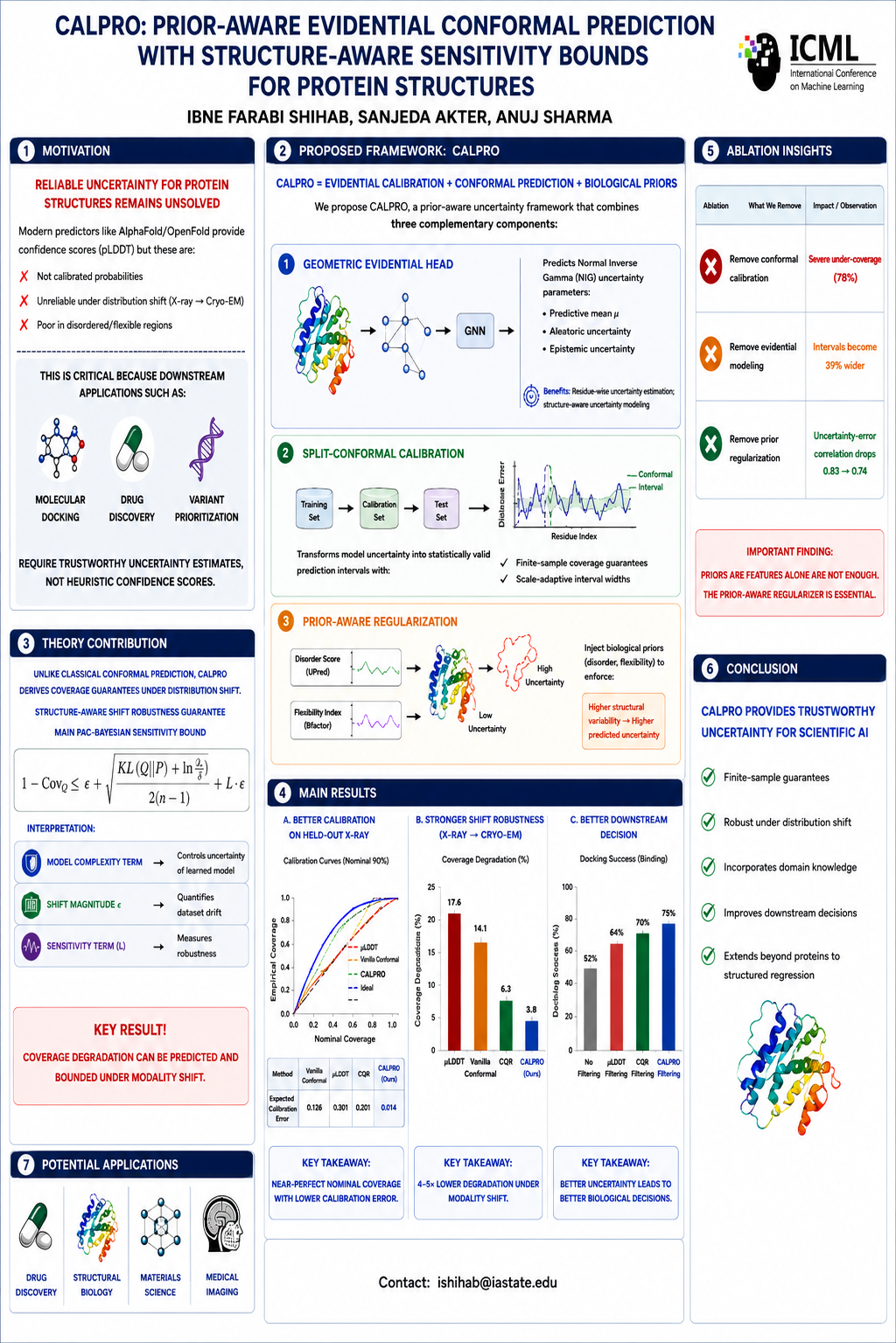
Deep protein structure predictors such as AlphaFold provide confidence estimates (e.g., pLDDT) that are not calibrated and degrade under distribution shifts across experimental modalities, temporal changes, and disordered regions. We introduce \textbf{CalPro}, a prior-aware evidential conformal framework for shift-robust uncertainty quantification. CalPro combines three components: (i) a geometric evidential head outputting Normal Inverse Gamma distributions via graph neural networks; (ii) a differentiable calibration surrogate that shapes representations during training, followed by split-conformal calibration for finite-sample coverage; and (iii) domain priors (disorder, flexibility) encoded as soft constraints on predicted uncertainty. Theoretically, we derive structure-aware \emph{sensitivity bounds} for coverage degradation under distribution shift using PAC-Bayesian control over ambiguity sets, quantifying how miscoverage increases with model complexity and shift magnitude. Empirically, CalPro achieves at most 5 percentage points coverage degradation across modalities compared to 15 to 25 points for baselines, reduces calibration error by 30\% to 50\%, and improves downstream docking success from 52\% to 75\% when filtering by uncertainty. The framework extends beyond proteins to structured regression tasks where priors encode local reliability.
Lay Summary
Artificial intelligence tools such as AlphaFold can predict the three dimensional shapes of proteins, the molecular machines behind almost every process in living cells, with remarkable accuracy. These tools also report a "confidence score" meant to tell scientists how far to trust each prediction. Unfortunately, those scores are often unreliable. They can be overconfident, and they become especially untrustworthy when a tool is used on proteins or experimental data that differ from what it saw during training. We developed CalPro, a method that turns these rough scores into honest, well calibrated estimates of uncertainty. CalPro adds a lightweight layer on top of an existing predictor. That layer learns where the predictor is likely to be wrong, draws on biological knowledge about which parts of a protein tend to be flexible or disordered, and then applies a statistical technique that comes with mathematical guarantees about how often the true answer falls within the reported range. We also prove how much these guarantees can weaken when the method meets unfamiliar data, so users know what to expect before they deploy it. In our experiments, CalPro stayed reliable even when moving between different experimental techniques, while standard approaches lost far more accuracy. When we used its uncertainty estimates to screen out untrustworthy predictions before a downstream drug docking task, the success rate rose substantially. Because knowing when not to trust a prediction matters as much as the prediction itself, CalPro can make AI a safer tool in high stakes settings like drug discovery, and the same recipe extends to other scientific problems where dependable confidence estimates are essential.