
Fleet: Few Shots Lead Effective AI-generated Image Detection
Abstract
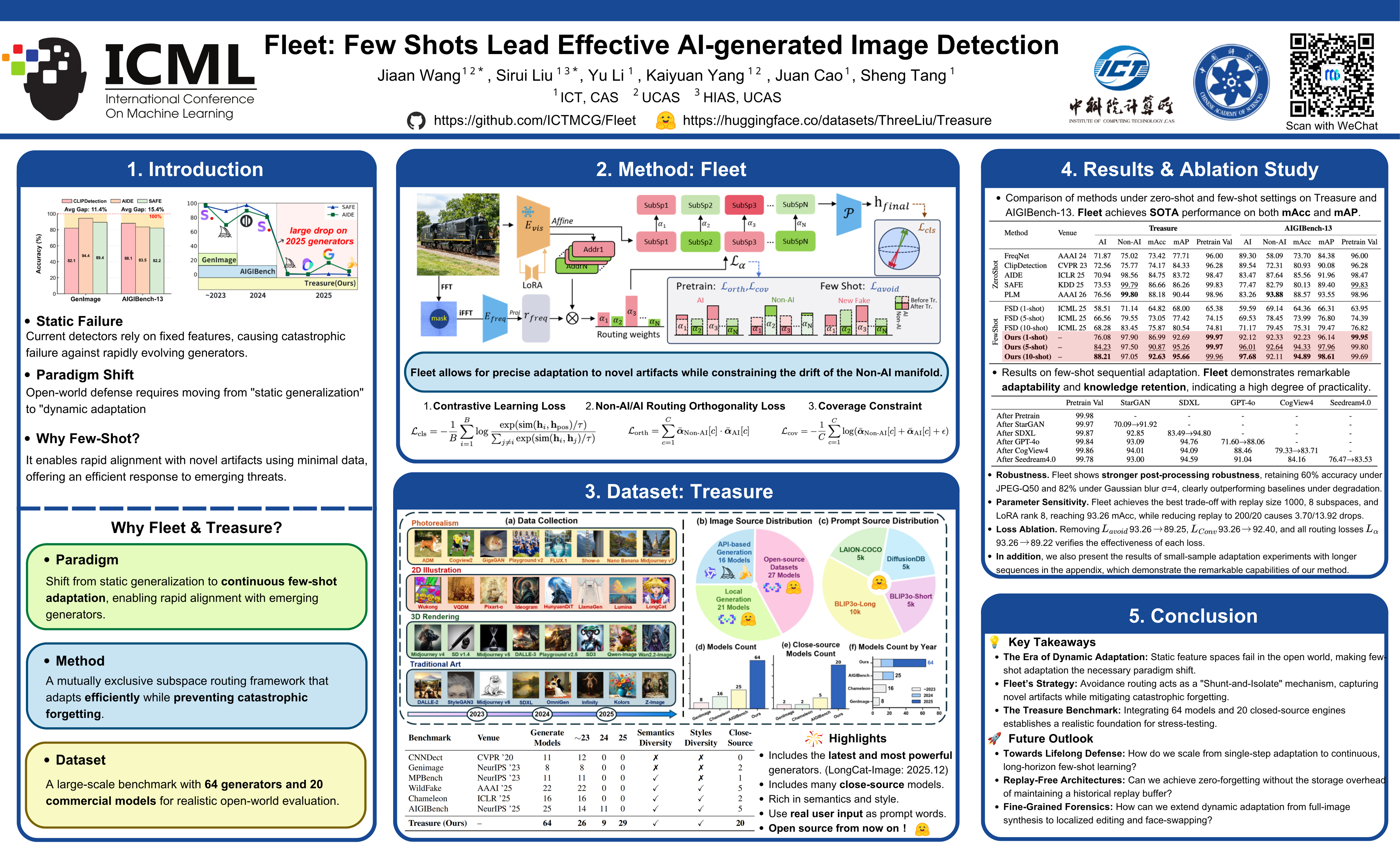
AI-generated image (AIGI) detection is undergoing a critical transition from laboratory benchmarks to open-world adversarial defense. The prevalent paradigm focuses on finding static feature spaces, assuming that some invariant artifacts learned from historical data can achieve universal zero-shot generalization. While achieving saturation on several AIGI benchmarks, this static hypothesis suffers a severe performance drop against rapidly evolving generators (e.g., SD3, Nano Banana Pro). To address these limitations, we propose that the field should expand beyond "static generalization" to a new paradigm of "dynamic adaptation". We introduce Fleet, a framework that pioneers a dynamic paradigm of continuous few-shot evolution, enabling rapid alignment with emerging generative threats. Fleet improves few-shot adaptation by replacing unconstrained feature updates with constrained routing correction, where avoidance routing redirects novel AI samples away from Non-AI-dominated routes within decoupled subspaces. To validate this, we present Treasure, a benchmark spanning 64 models and 360k images, featuring diverse architectures and 20 closed-source commercial engines. Experiments reveal that while static SOTA methods fail catastrophically on modern generators, Fleet restores performance from 20.4\% to 73.1\% with only 10-shot adaptation on "Doubao Seedream 4.0". Code and data are available at https://github.com/ICTMCG/Fleet .
Lay Summary
As AI image generators rapidly improve, fake images are becoming harder to detect. Most existing detection systems are built on a simple assumption: artifacts learned from older generators will continue to work for future ones. We show that this assumption is breaking down. While many state-of-the-art detectors achieve near-perfect accuracy on older benchmarks, they can collapse to almost random guessing on modern commercial generators. We propose Fleet, a new AI-generated image detection framework designed for continuous adaptation rather than static generalization. Instead of trying to find one universal fingerprint for all fake images, Fleet learns how to quickly adjust to newly emerging generators using only a few example images. Its design separates authentic-image features from forgery-related features, allowing the detector to learn new attack patterns while preserving its existing knowledge. To evaluate this setting, we build Treasure, a benchmark containing 360,000 images generated by 64 different models, including many recent closed-source commercial systems. Our experiments show that Fleet can dramatically recover detection accuracy on modern generators with only a small number of adaptation samples. This work argues that future forensic systems should evolve together with generative AI, rather than relying on fixed detection rules.