
Native Active Perception as Reasoning for Omni-Modal Understanding
Abstract
Lay Summary
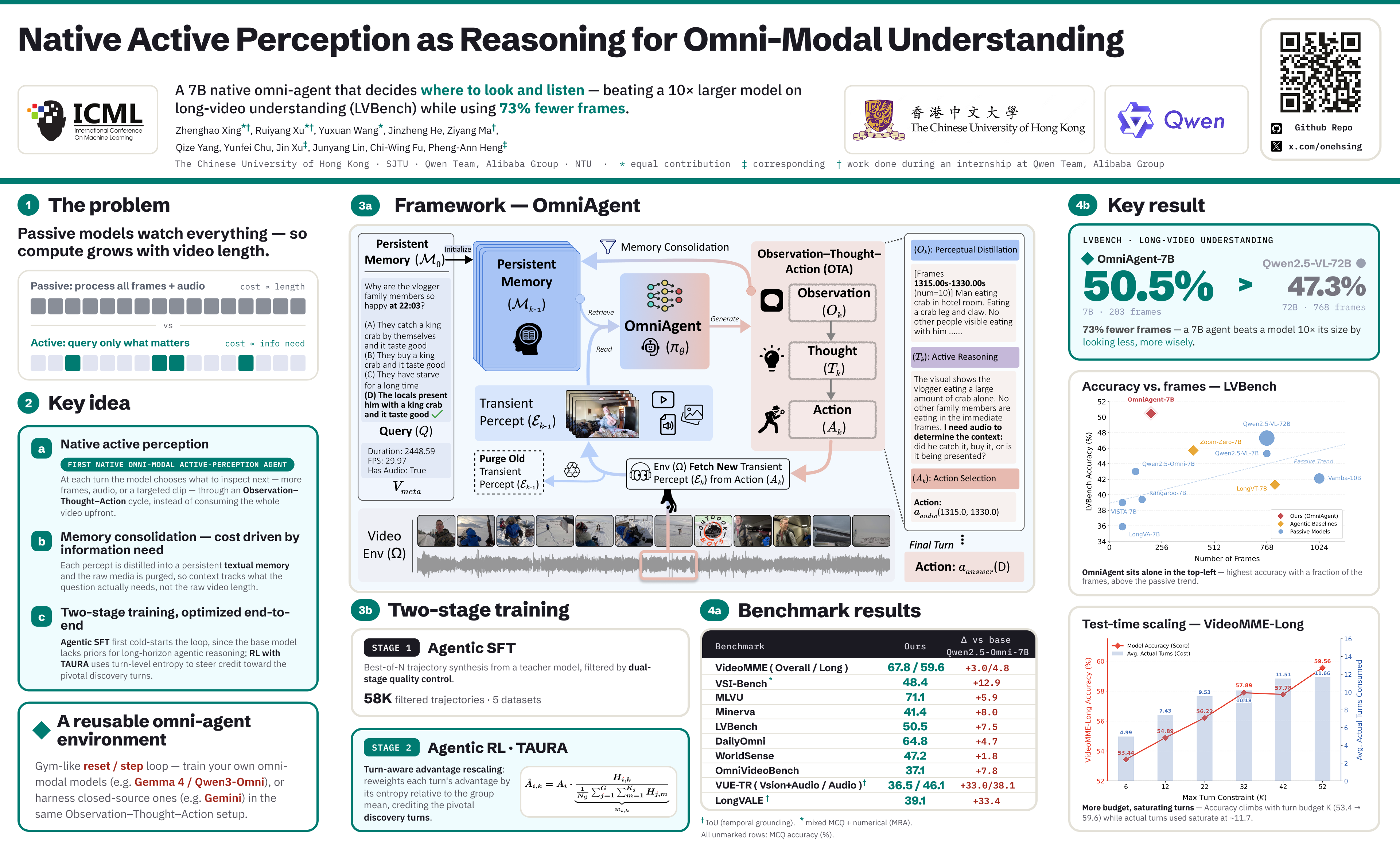
When AI systems need to answer a question about a video — say, finding who appears in the opening scene of a two-hour film — they typically process the entire video from start to finish. For long videos, this demands enormous computational resources, and by treating every moment equally, these systems can overlook key details hidden in a brief instant. We present OmniAgent, an AI agent that watches videos the way people do: instead of processing everything, it actively decides where to look and what to listen for based on the question asked. Step by step, it skims through clips, listens to relevant audio, and takes notes until it gathers enough evidence to answer — skipping irrelevant content. This active approach makes video understanding far more efficient. Our agent — despite being relatively small — outperforms AI models ten times its size while examining far fewer video frames. By making it practical for AI to reason over hour-long videos without watching every second, this work can improve applications such as video search, media accessibility, and content analysis.