
Mind-Omni: A Unified Multi-Task Framework for Brain-Vision-Language Modeling via Discrete Diffusion
Abstract
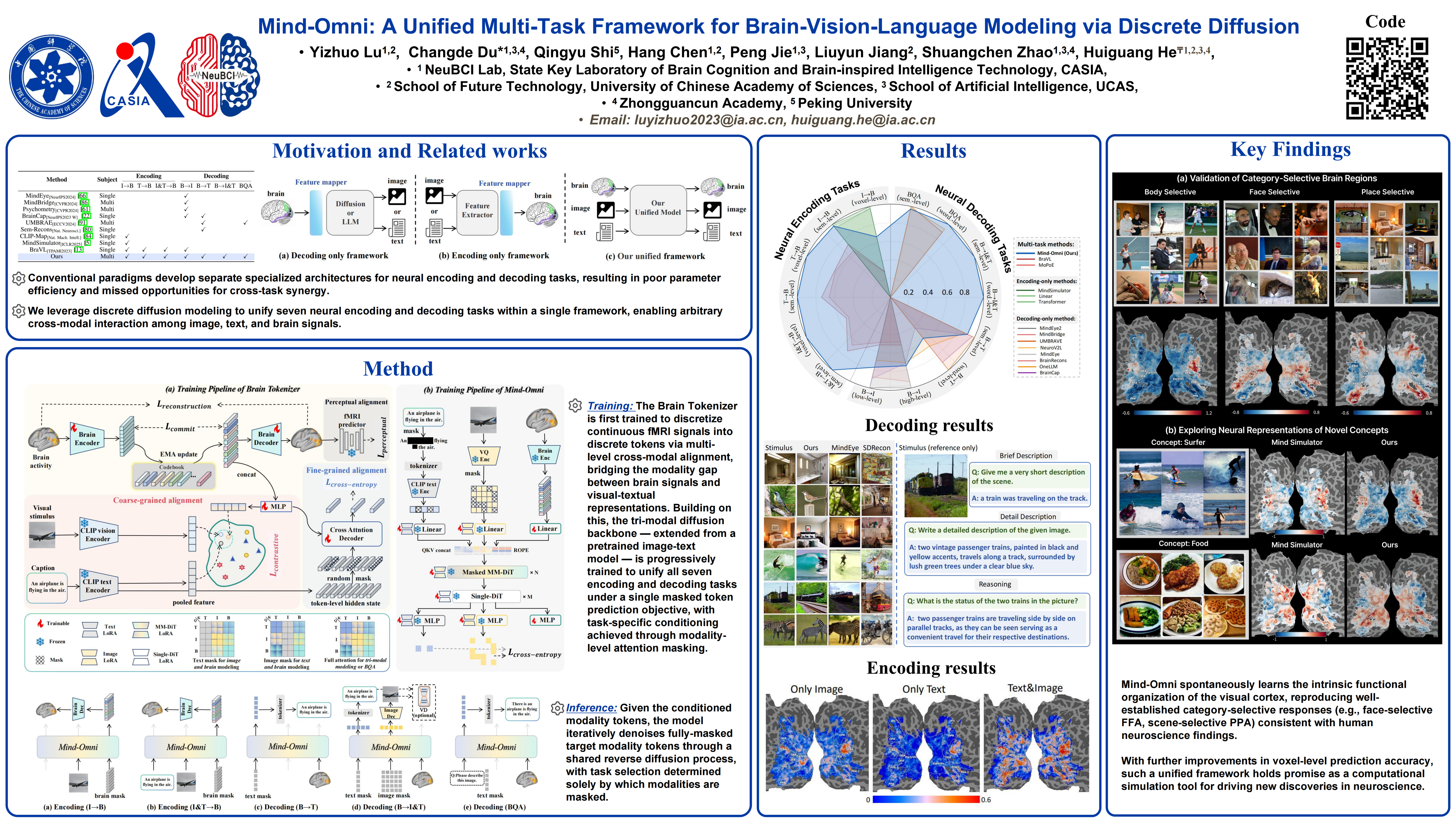
Modeling the interplay between external stimuli and internal neural representations is a pivotal research area for Brain-Computer Interfaces (BCIs). A major limitation of prior work is the prevailing paradigm of specialized, single-task models, which curtails versatility and neglects inter-task synergies. To address this, we propose Mind-Omni, the first versatile framework that unifies seven distinct encoding and decoding tasks through a discrete diffusion paradigm. At its core is a novel Brain Tokenizer that transforms heterogeneous, continuous brain signals into standardized, discrete tokens. This enables direct, token-level interactions for mutual understanding and generation between any two or more modalities within a shared semantic space. To unlock advanced reasoning capabilities, we further curate a specialized Brain Question Answering (BQA) instruction-tuning dataset. Our model not only establishes a new state-of-the-art among multi-task unified frameworks but also provides strong evidence for multi-task synergy. By demonstrating performance competitive with, and at times superior to, larger specialized models, our work offers a powerful new paradigm for neural modeling and paves the way for foundation models of neural activity.