
MechVQA: Benchmarking and Enhancing Multimodal LLMs on Comprehensive Mechanical Drawing Understanding
Abstract
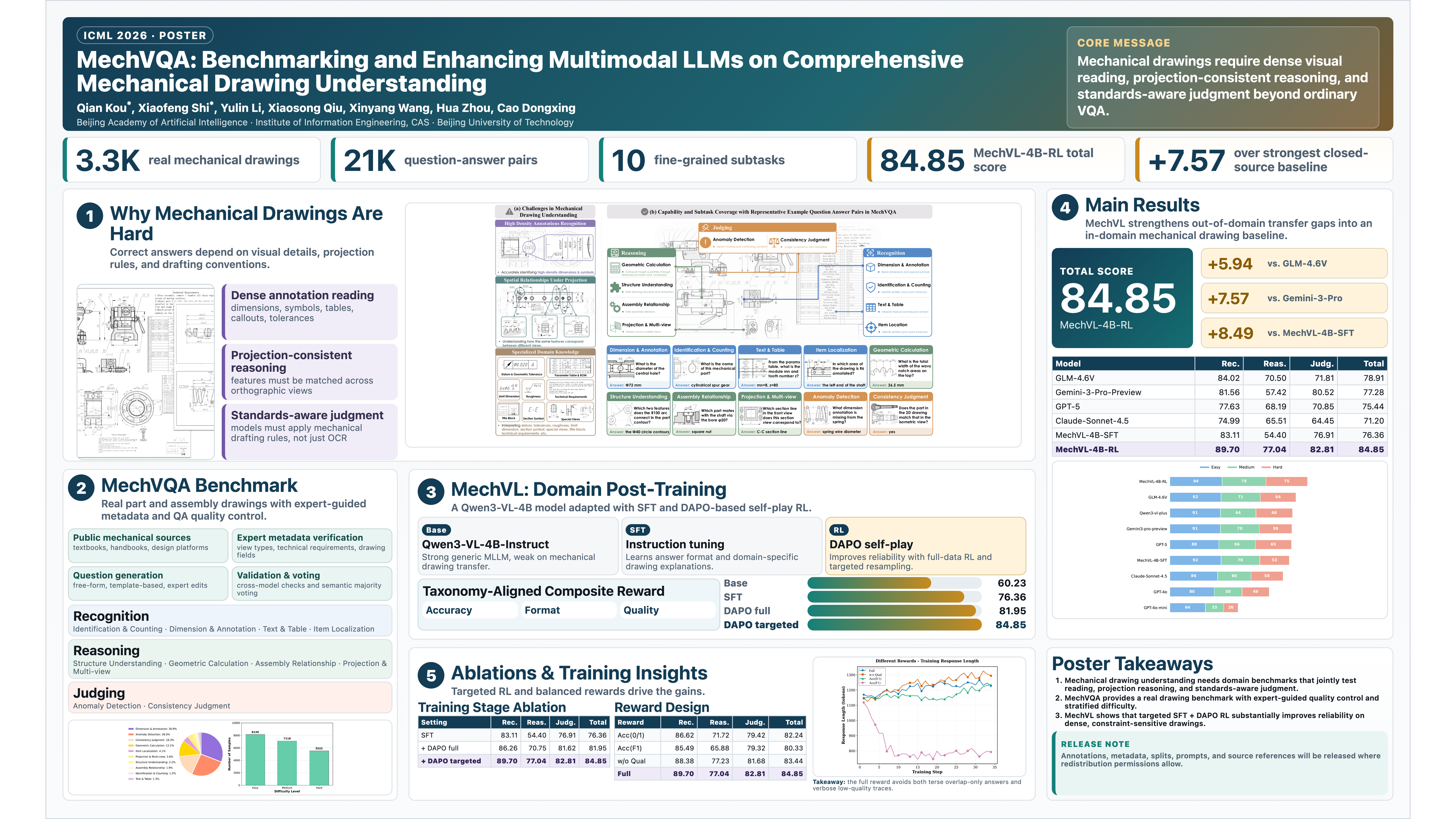
Multimodal Large Language Models (MLLMs) have demonstrated significant achievements in general visual question answering (VQA) tasks. However, they remain brittle on mechanical en- gineering drawings, where high annotation den- sity and weak domain knowledge, compounded by unreliable spatial relation reasoning under strict projection rules and geometric constraints, make decisive cues easy to miss and frequently lead to wrong answers. To bridge this gap, we introduce the first comprehensive mechani- cal drawing understanding dataset, MechVQA, created through a semi-automated construction and quality-control pipeline. MechVQA con- tains 3.3k high-density pictures with 21K ques- tion–answer pairs, spanning 10 different fine- grained tasks across three capability levels: Recognition, Reasoning, and Judging, provid- ing a testbed to evaluate and improve MLLM understanding on real-world mechanical draw- ings. On top of MechVQA, we then develop the MechVL model through a multi-stage training paradigm, building a strong domain-specialized baseline. Extensive experimental results demon- strate that MechVL outperforms the strongest closed-source baseline by 7.57 percentage points on the MechVQA total score, significantly en- hancing mechanical drawing understanding abil- ity and providing a reusable foundation for deploy- ing MLLMs in mechanical design and inspection scenarios.
Lay Summary
Mechanical drawings are widely used in engineering to describe the shape, size, structure, and manufacturing requirements of parts and assemblies. However, today’s multimodal AI systems often struggle with these drawings because important information is packed into dense annotations, multiple views, symbols, tables, and engineering conventions. This paper introduces MechVQA, a new benchmark for testing whether AI systems can understand real mechanical drawings through questions about recognition, reasoning, and judgment. We also build MechVL, a model adapted for this domain, and show that targeted training improves its ability to read drawings, reason across views, and detect inconsistencies. The benchmark and model provide a step toward more reliable AI assistance for mechanical design, inspection, and education, while still requiring human oversight for high-stakes engineering decisions.