
Bias-Spectrum Neural Processes for Parametric PDEs: Architecture Priors Meet PDE Constraints
Abstract
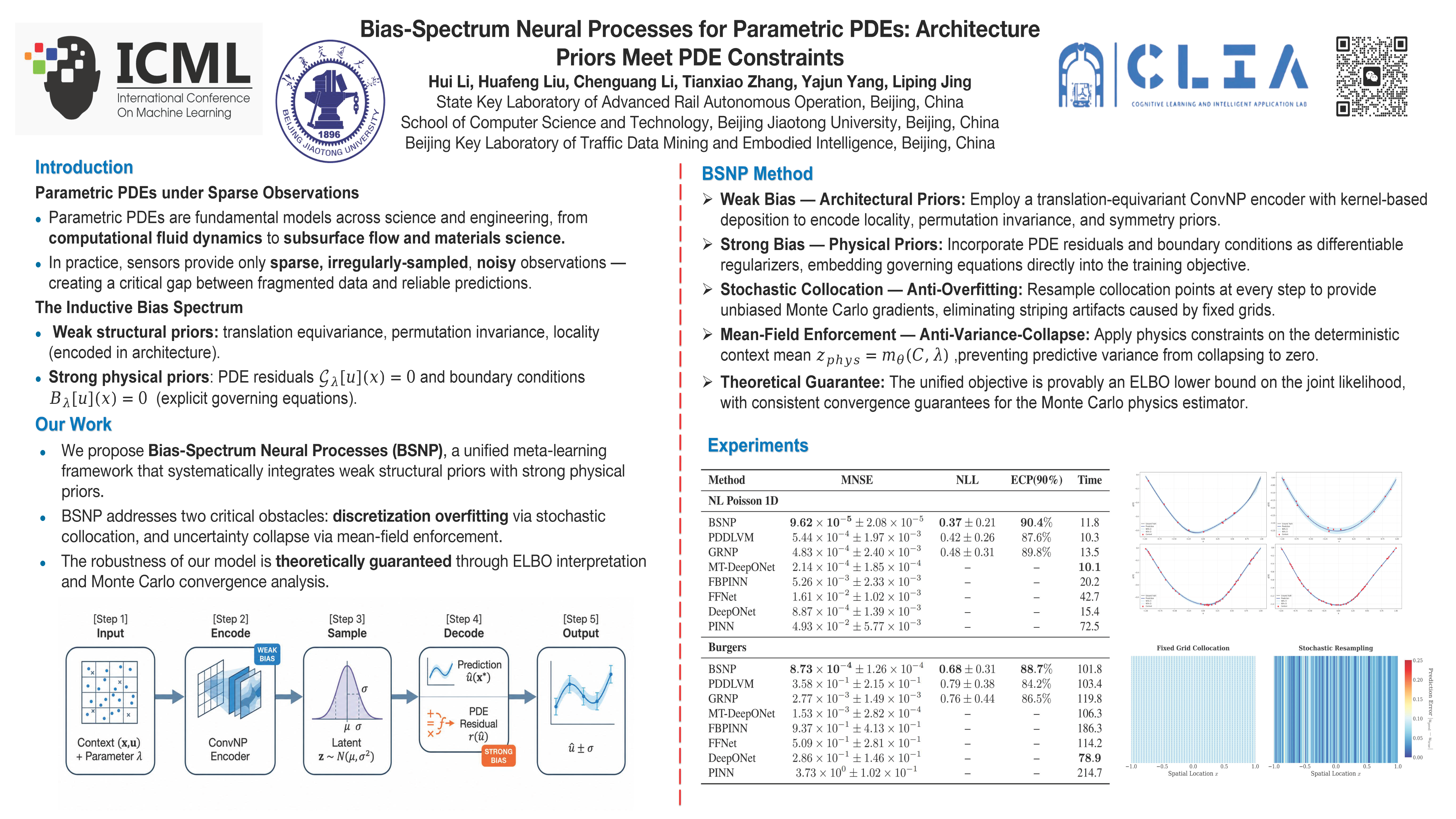
Parametric partial differential equations (PDEs) serve as fundamental models across science and engineering, yet constructing fast and accurate surrogate models from sparse, irregularly sampled observations with reliable uncertainty quantification remains challenging. Existing approaches struggle to simultaneously handle variable observation patterns, preserve physics consistency, and provide well-calibrated predictive uncertainty. We introduce Bias-Spectrum Neural Processes (BSNP), a unified meta-learning framework that systematically integrates weak structural priors (translation equivariance, locality) with strong physical priors (governing equations and boundary conditions). BSNP addresses two critical obstacles: discretization overfitting through stochastic collocation that resamples residual evaluation points, and uncertainty collapse through mean-field enforcement that applies PDE constraints only to predictive means while preserving learned uncertainty. Comprehensive experiments on nonlinear Poisson equations, Burgers dynamics, and Navier-Stokes flows demonstrate that BSNP achieves superior accuracy and well-calibrated uncertainty quantification in sparse-data regimes.
Lay Summary
Many problems in science and engineering — from predicting how fluids flow to how heat spreads — are described by mathematical equations called partial differential equations (PDEs). Solving these equations from scratch is slow, and in the real world we often only have a handful of scattered, noisy measurements to work with. We wanted to build a fast, reliable predictor that can handle this messy reality while honestly telling us how confident it is. Our method, called BSNP, combines two kinds of knowledge: general structural rules baked into the model's design (like the fact that physics behaves the same everywhere in space), and specific physical laws expressed as equations. Naively combining them causes two surprising problems — the model either memorizes where we checked the physics, or it becomes falsely overconfident. We solve both by randomly resampling where we check the equations, and by applying physical laws only to the model's average prediction, leaving its uncertainty estimates untouched. Across several benchmark problems, BSNP makes more accurate predictions and gives more trustworthy confidence estimates than existing methods, especially when data is scarce.