
Dual-View Predictive Diffusion: Lightweight Speech Enhancement via Spectrogram-Image Synergy
Abstract
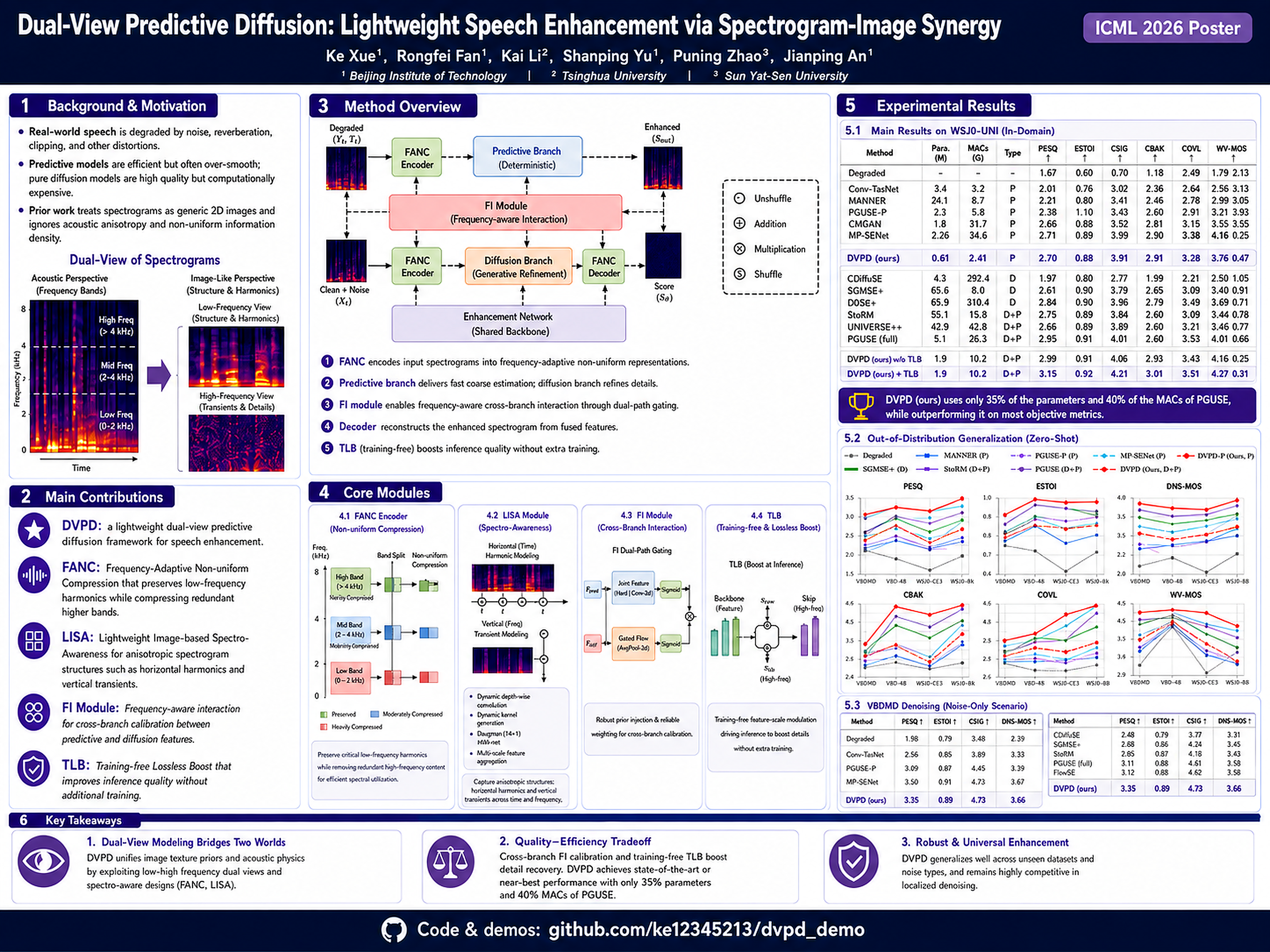
Diffusion models have recently set new benchmarks in Speech Enhancement (SE). However, most existing score-based models treat speech spectrograms merely as generic 2D images, applying uniform processing that ignores the intrinsic structural sparsity of audio, which results in inefficient spectral representation and prohibitive computational complexity. To bridge this gap, we propose DVPD, an extremely lightweight Dual-View Predictive Diffusion model, which uniquely exploits the dual nature of spectrograms as both visual textures and physical frequency-domain representations across both training and inference stages. Specifically, during training, we optimize spectral utilization via the Frequency-Adaptive Non-uniform Compression (FANC) encoder, which preserves critical low-frequency harmonics while pruning high-frequency redundancies. Simultaneously, we introduce a Lightweight Image-based Spectro-Awareness (LISA) module to capture features from a visual perspective with minimal overhead. During inference, we propose a Training-free Lossless Boost (TLB) strategy that leverages the same dual-view priors to refine generation quality without any additional fine-tuning. Extensive experiments across various benchmarks demonstrate that DVPD achieves state-of-the-art performance while requiring only 35% of the parameters and 40% of the inference MACs compared to SOTA lightweight model, PGUSE. These results highlight DVPD's superior ability to balance high-fidelity speech quality with extreme architectural efficiency. Code and audio samples are available at https://github.com/ke12345213/dvpd_demo
Lay Summary
This paper presents a lightweight method for improving the quality of noisy speech. Clear speech is important for applications such as online meetings, hearing aids, voice assistants, and automatic speech recognition. Many recent methods can produce high-quality enhanced speech, but they often require heavy computation and are difficult to deploy on practical devices. Our approach uses two complementary views of speech to help the model recover cleaner and more natural audio while keeping the system efficient. Experiments show that the proposed method improves speech quality with lower computational cost, making advanced speech enhancement more practical for real-world use.