
Genome-Factory: A Library for Tuning, Deploying, and Interpreting Genomic Foundation Models
Abstract
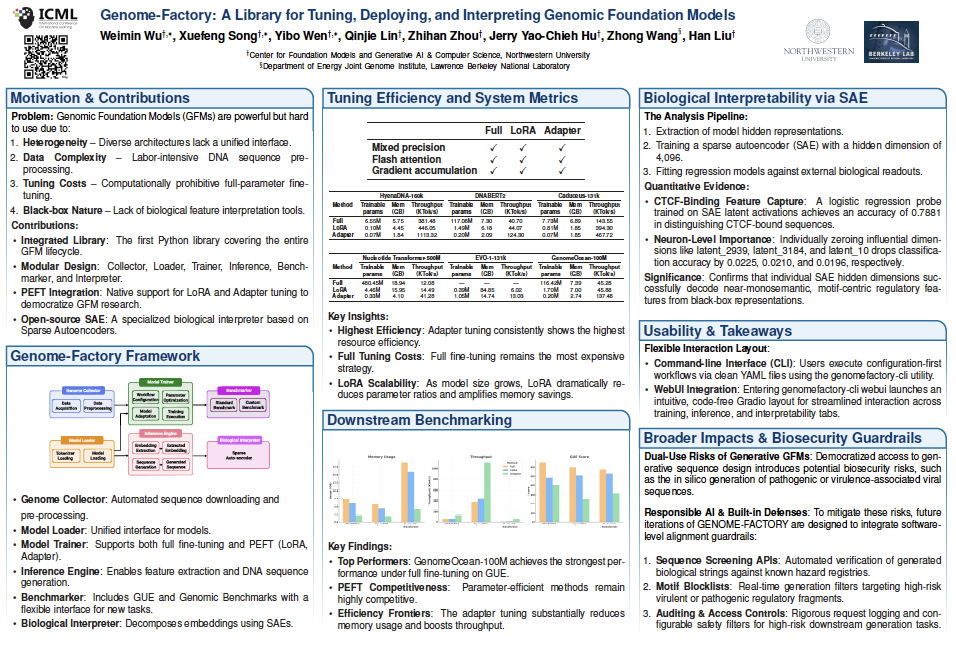
We introduce Genome-Factory, the first integrated Python library for tuning, deploying, and interpreting genomic foundation models. Our core contribution is to simplify and unify the workflow for genomic model development: data collection, model tuning, inference, benchmarking, and interpretability. For data collection, Genome-Factory offers an automated pipeline to download genomic sequences and preprocess them. For model tuning, Genome-Factory supports both full and parameter-efficient fine-tuning across diverse genomic models. For inference, Genome-Factory enables both embedding extraction and DNA sequence generation. For benchmarking, we include two existing benchmarks and provide a flexible interface to incorporate additional benchmarks. For interpretability, Genome-Factory introduces an open-source biological interpreter based on a sparse auto-encoder. We validate the utility of Genome-Factory across three dimensions: (i) Compatibility with diverse models and fine-tuning methods; (ii) Benchmarking downstream performance using two open-source benchmarks; (iii) Biological interpretation of learned representations with DNABERT-2. These results highlight its practical value for real-world genomic analysis. GitHub: https://github.com/WeiminWu2000/Genome_Factory.
Lay Summary
Genome-Factory is an open-source software library that helps researchers use AI models to study DNA. It provides one unified platform for collecting and cleaning genomic data, loading genomic models, adapting them to new tasks, running predictions, comparing performance, and interpreting what the models learn. The library supports both command-line and web-based interfaces, making genomic AI more accessible to researchers with limited programming or machine learning experience. Our experiments show that Genome-Factory works across multiple genomic models and benchmarks, helps users balance accuracy and computing cost, and provides tools for understanding biological patterns learned by the models. Overall, it lowers the technical barrier to using genomic AI for biological and biomedical research.