
EqGINO: Equivariant Geometry-Informed Fourier Neural Operators for 3D PDEs
Abstract
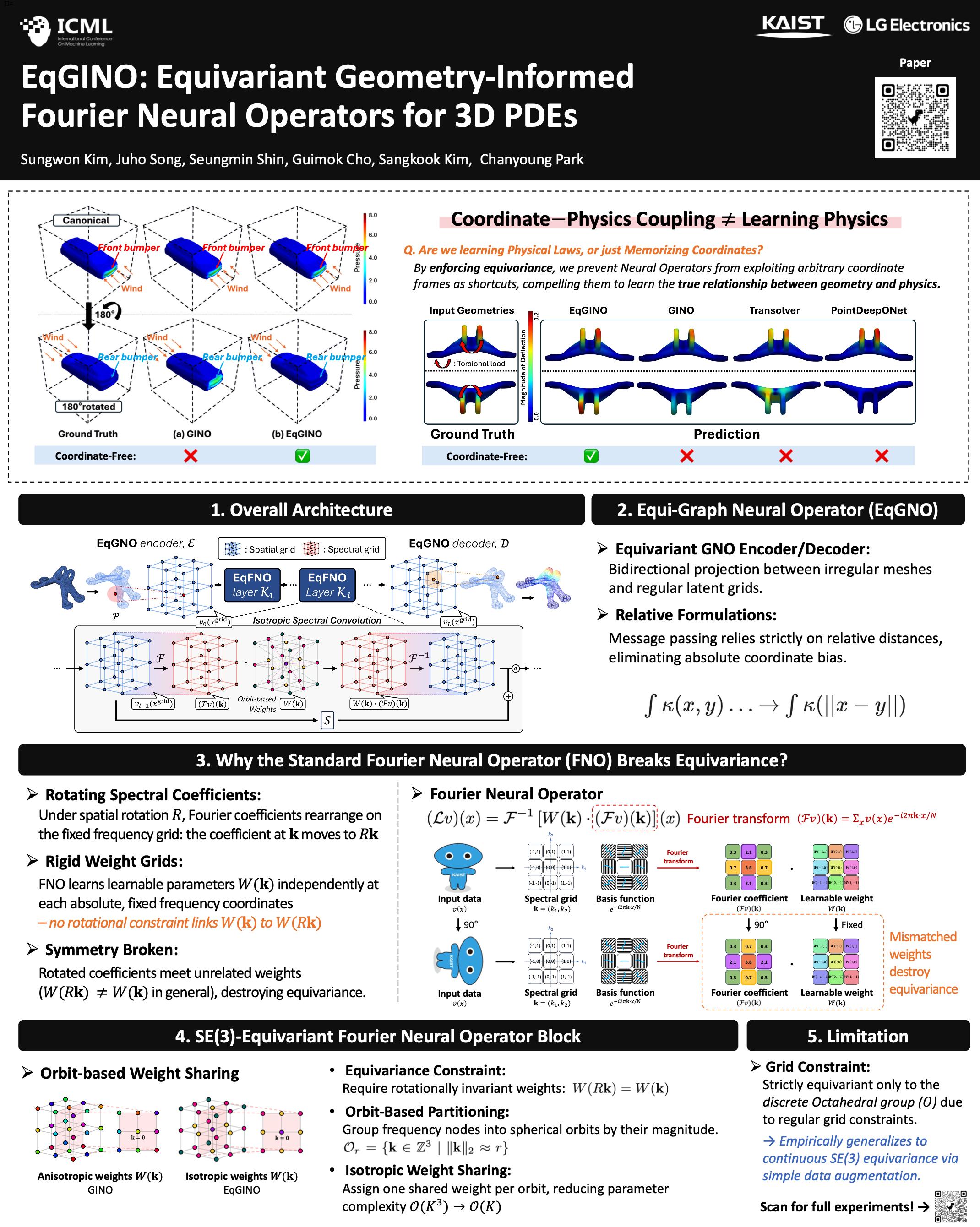
Deep learning surrogates for 3D Partial Differential Equations (PDEs) often fail to generalize across geometric transformations because they depend heavily on specific coordinate systems. While equivariant networks offer a solution, they typically rely on local operations in the spatial domain, making the global receptive field—essential for PDE dynamics—computationally expensive. Conversely, Fourier Neural Operators (FNOs) efficiently capture global interactions, yet establishing 3D equivariance within them remains impractical due to the prohibitive cost of spectral group convolutions. To bridge this gap, we introduce EqGINO, a geometrically robust framework that enforces isotropy in the spectral domain. By design, EqGINO guarantees exact equivariance to the discrete symmetries inherent to the discretized computational domain. Beyond this discrete guarantee, our structural prior enables effective generalization to arbitrary continuous orientations even with a limited number of SE(3)-transformed training samples. Consequently, our method robustly models coordinate-invariant physical laws on complex irregular 3D geometries. Our code is available at https://github.com/sung-won-kim/EqGINO
Lay Summary
When engineers simulate physical phenomena like airflow around a car or stress on a mechanical part, they rely on equations that describe universal physical laws — laws that hold true regardless of how an object is oriented in space. However, current AI models used to speed up these simulations heavily depend on the specific coordinate system they were trained on. If you simply rotate the same object, these models can produce wildly incorrect predictions, such as predicting high pressure on the back of a car instead of the front. We developed EqGINO, a new AI framework that respects the coordinate-independence of physical laws by design. Our key idea is to share model parameters among frequency components of equal magnitude in the spectral domain, enforcing a form of directional symmetry. This not only guarantees consistent predictions under rotations but also dramatically reduces the number of parameters the model needs to learn. Our experiments on fluid dynamics and structural mechanics benchmarks show that EqGINO produces reliable predictions regardless of how objects are oriented, while existing state-of-the-art models fail significantly under the same conditions.