
Constrained Bayesian Experimental Design via Online Planning
Abstract
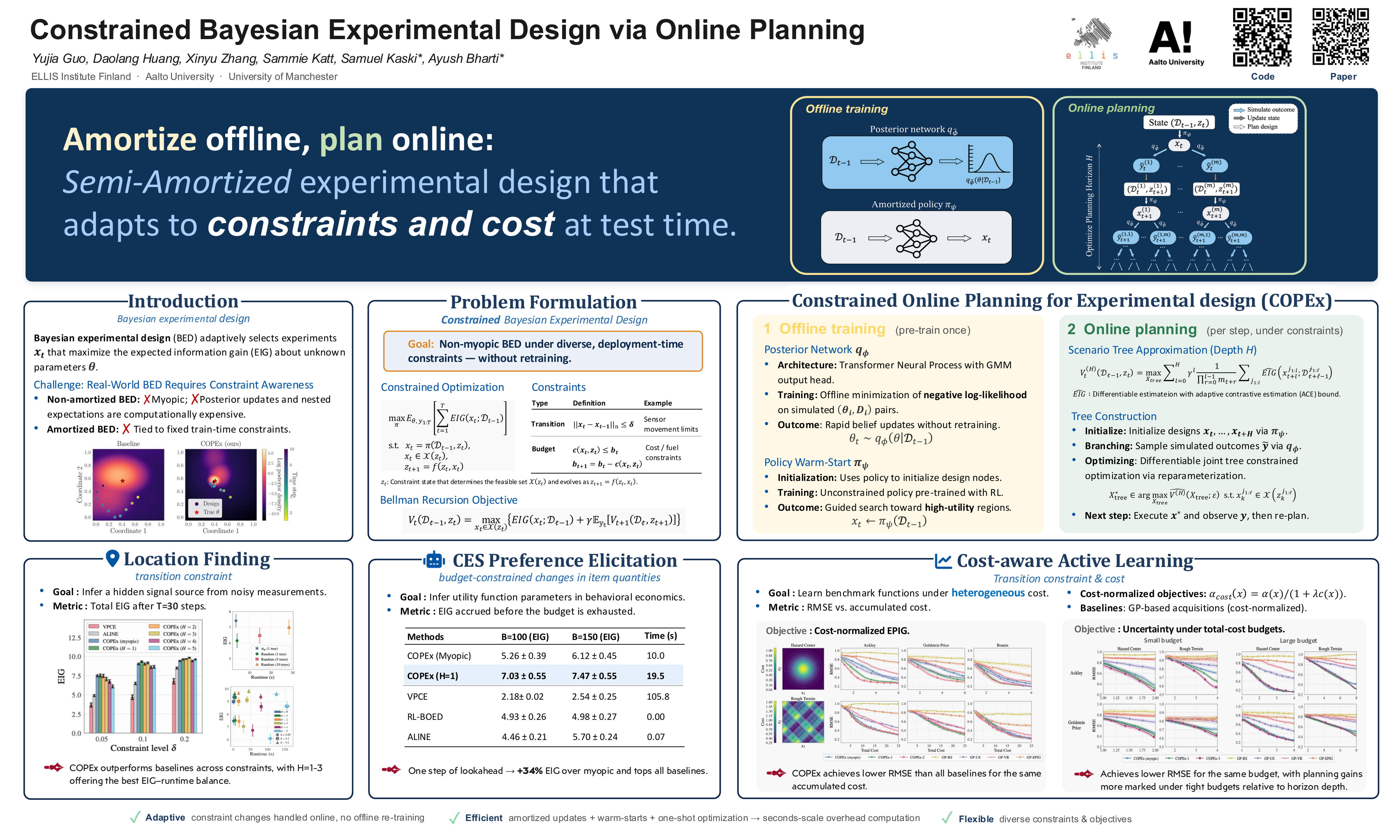
Bayesian experimental design (BED) is a principled framework for data-efficient design of sequential experiments. However, existing BED methods are unable to adapt to dynamic constraints inherent in real-world tasks due to budget limitations, varying costs, or physical constraints that restrict how designs evolve over time. In this paper, we introduce a novel approach to BED that enables constrained optimization of experimental designs by combining offline pre-training of an amortized policy and a posterior network with online multi-step lookahead planning using scenario trees. We empirically demonstrate that our method yields substantially more informative design sequences than existing methods across a range of constrained BED tasks, while incurring only a modest additional computational overhead.
Lay Summary
Many scientific studies learn by running experiments one after another, such as testing candidate molecules, clinical trials, or sensor locations. In practice, however, scientists cannot always choose any experiment they want: some experiments are expensive, budgets may be limited, and physical systems such as robots or sensors can only move gradually. We built COPEx, a method that plans experiments while respecting these real-world limits. Like a chess player thinking several moves ahead, COPEx imagines a tree of likely future outcomes and chooses the experiment that pays off best over the whole sequence — not just the next step. To keep the process fast, COPEx uses pre-trained AI models to quickly predict possible outcomes and suggest promising experiments, rather than recomputing everything from scratch each time. Across several constrained experimental-design and active-learning tasks, COPEx selected more informative experiments than existing methods while adding only modest computation. This can help make sequential experimentation more efficient in dynamic real-world settings where data are costly to collect.