
Domain Adaptive Object Detection via Dynamic Causal Refinement
Abstract
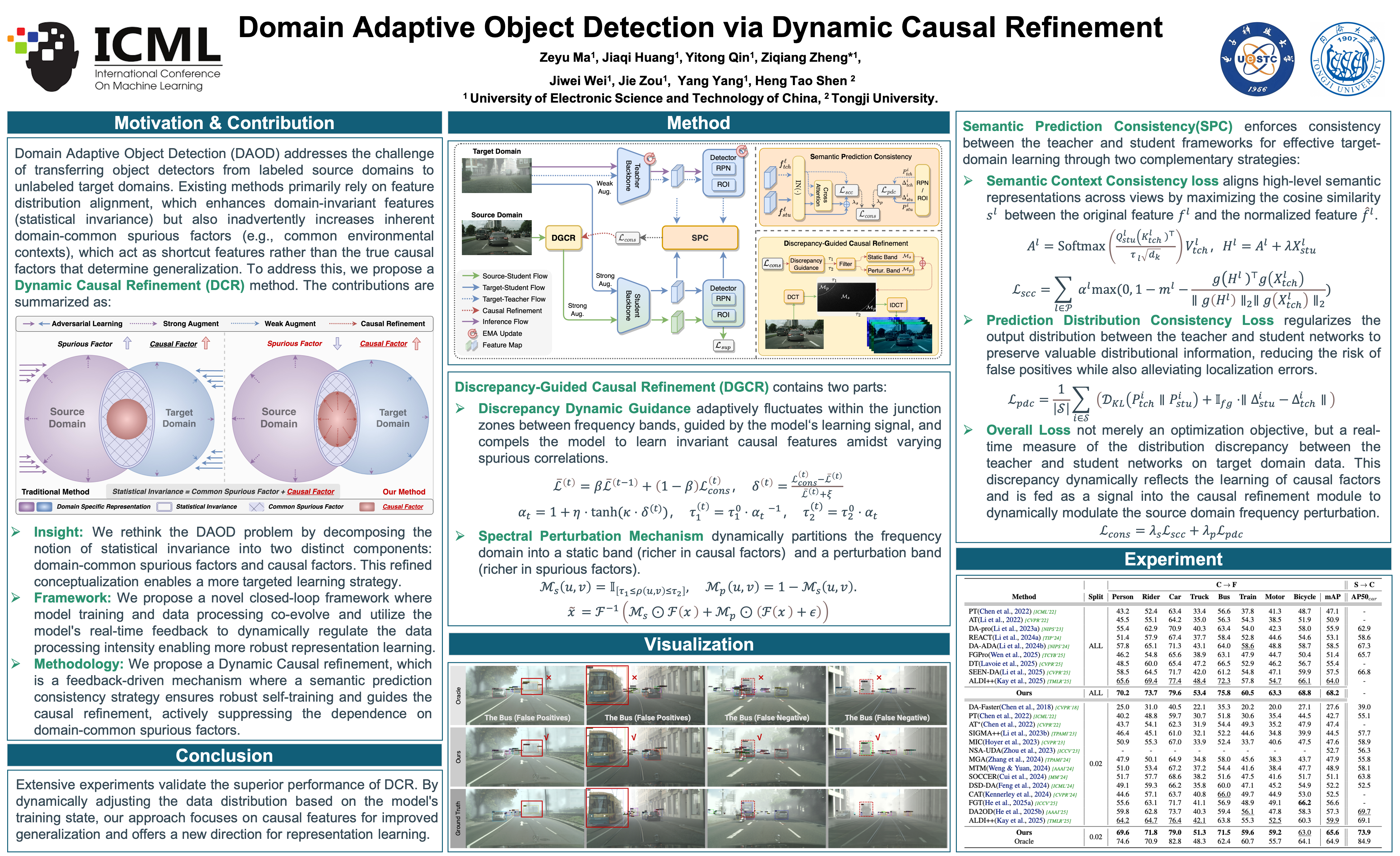
Domain Adaptive Object Detection (DAOD) addresses the challenge of transferring object detectors from labeled source domains to unlabeled target domains. Existing domain adaptation methods primarily rely on feature distribution alignment, which enhances domain-invariant features (statistical invariance) but also inadvertently increases inherent domain-common spurious factors (e.g., common environmental contexts), which act as shortcut features rather than the true causal factors for object classification. We propose Dynamic Causal Refinement (DCR), a novel framework that establishes a closed-loop feedback mechanism between data augmentation and model optimization to progressively refine causal features. Specifically, we design Semantic Prediction Consistency (SPC) to filter domain-specific spurious factors and establish a robust statistical invariance, and Discrepancy-Guided Causal Refinement (DGCR) to actively suppress the dependence on domain-common spurious factors via spectral perturbation for causal refinement. This process encourages the detector to suppress its reliance on shortcut features and instead prioritize semantically meaningful causal representations. Extensive experiments on standard benchmarks demonstrate that our method outperforms state-of-the-art counterparts significantly.
Lay Summary
Problem: Object detectors trained on clear, sunny images often fail in cross-domain weather scenarios such as rain or fog. Existing domain adaptation methods typically aim to learn statistical invariance, but we find that statistical invariance inevitably contains certain domain-common spurious factors, which decrease model generalization. Solution: We propose a framework called Dynamic Causal Refinement (DCR), which actively perturbs the frequency information of images to break the detector's reliance on shortcut features, forcing it to learn the true causal features of objects. Impact: Our method improves detection accuracy by over 5% across multiple benchmark scenarios, outperforming all previous approaches. This brings us one step closer to reliable object detection in real-world conditions, which is critical for autonomous driving, robotics, and surveillance systems that must operate safely under any weather, lighting, or background.