
Omni-Perception Policy Optimization for Multimodal Emotion Reasoning
Abstract
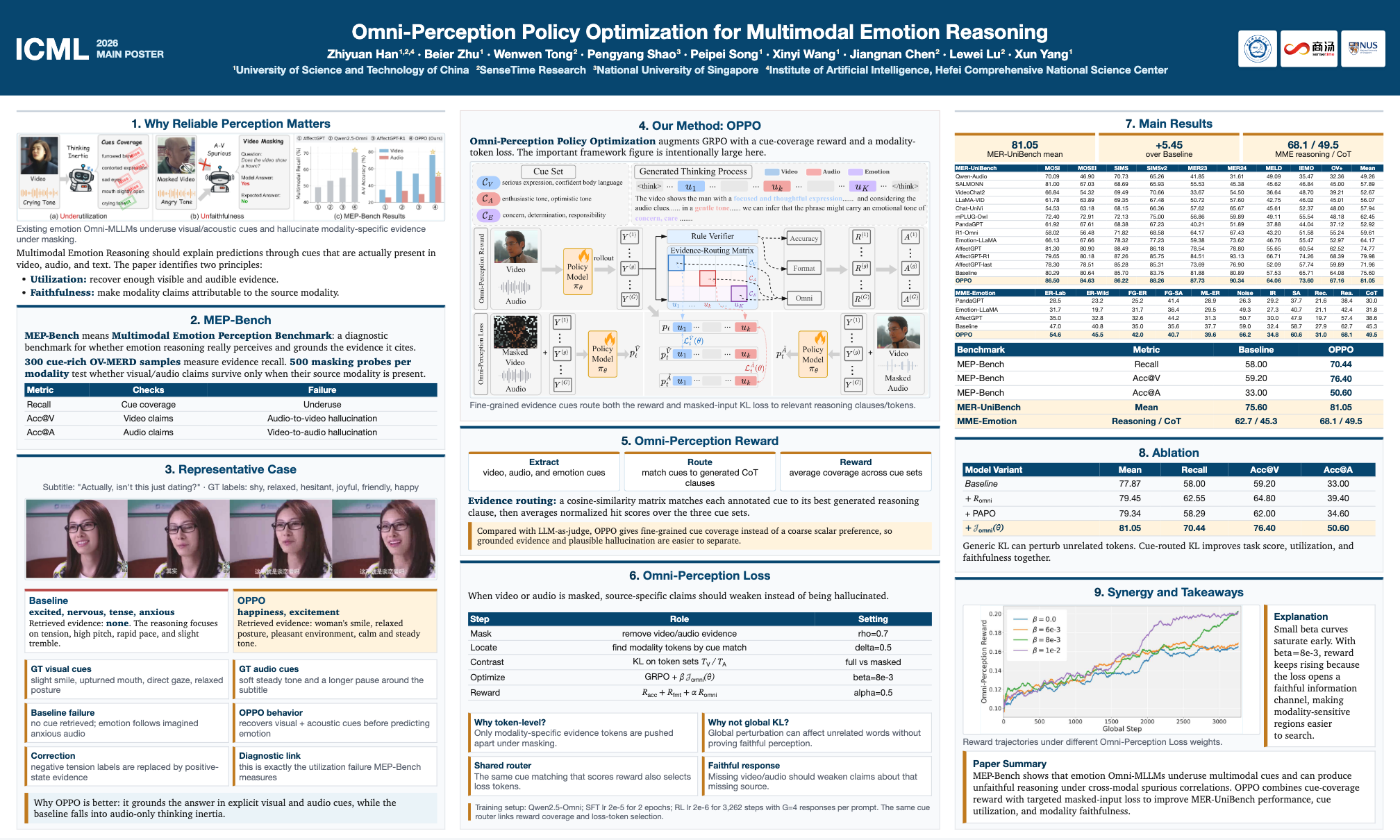
We find that current emotion-oriented Omni-MLLMs still lack reliable omni-modal perception: they (i) underutilize multimodal cues in their reasoning trajectories and (ii) exhibit unfaithful behavior, often hallucinating modality-specific statements from other modalities. Building on these insights, we propose OPPO (Omni-Perception Policy Optimization), a reinforcement learning framework that explicitly optimizes multimodal perception. First, an Omni-Perception Reward decomposes ground-truth reasoning into fine-grained visual, acoustic, and emotion cues and rewards trajectories that semantically recover these cues. Second, an Omni-Perception Loss compares the policy under full and unimodally masked inputs, applying a KL penalty only to modality-specific evidence tokens to suppress cross-modal hallucination. We further introduce MEP-Bench, a diagnostic benchmark that quantifies utilization and faithfulness. Experiments show that OPPO achieves state-of-the-art performance on MER-UniBench and substantially improves utilization and faithfulness scores on MEP-Bench, highlighting the importance of sufficient and faithful omni perception for multimodal emotion reasoning.
Lay Summary
AI systems that understand videos, voices, and text can be used to recognize human emotions, but they may still make unreliable judgments. For example, a model may focus only on tone of voice while ignoring facial expressions, or claim that a visual cue exists simply because the audio sounds emotional. This paper studies these issues and introduces a benchmark to measure whether models use relevant visual and audio evidence faithfully. We then propose OPPO, a training method that encourages models to cover more emotion-related cues and reduces unsupported claims about missing or unclear modalities. Experiments show that OPPO improves both emotion recognition and the reliability of model explanations.