
Semi-Supervised Neural Super-Resolution for Mesh-Based Simulations
Abstract
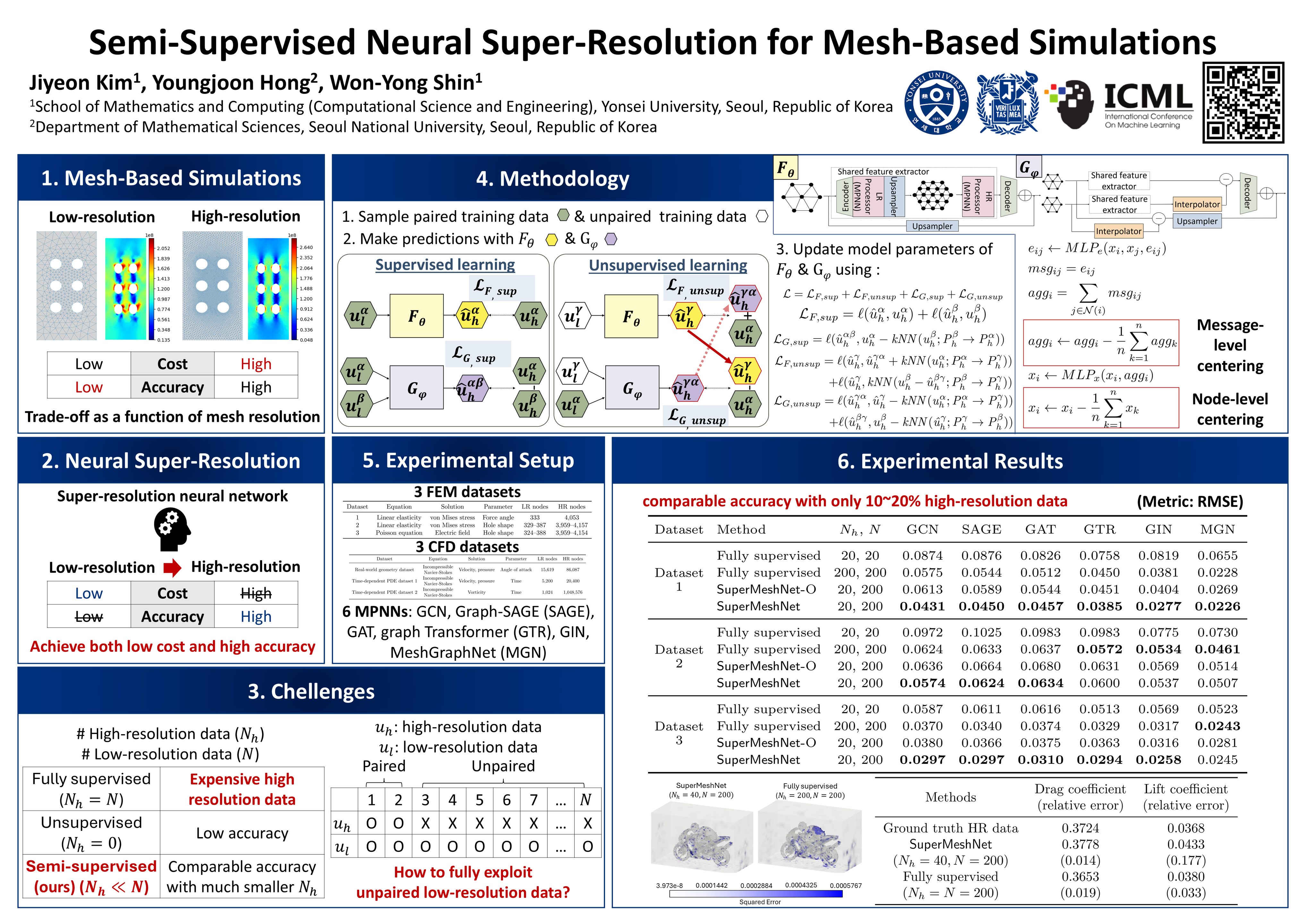
Mesh-based simulations provide high-fidelity solutions to partial differential equations (PDEs), but achieving such accuracy typically requires fine meshes, leading to substantial computational overhead. Super-resolution techniques aim to mitigate this cost by reconstructing high-resolution (HR), high-fidelity solutions from low-cost, low-resolution (LR) counterparts. However, training neural networks for super-resolution often demands large amounts of expensive HR supervision data. To address this challenge, we propose SuperMeshNet, an HR data-efficient super-resolution framework for mesh-based simulations aided by message passing neural networks (MPNNs). At its core, SuperMeshNet introduces complementary learning, a semi-supervised approach that effectively leverages both 1) a small amount of paired LR-HR data and 2) abundant unpaired LR data via two jointly trained, complementary MPNN-based models. Additionally, our model is enriched by inductive biases, which are empirically shown to further improve super-resolution performance. Extensive experiments demonstrate that SuperMeshNet requires 90% less HR data to achieve even lower root mean square error (RMSE) than that of the fully supervised benchmark without the inductive biases. The source code and datasets are available at https://github.com/jykim-git/SuperMeshNet.git.
Lay Summary
Neural networks can enhance coarse, low-resolution simulation results by converting them into more accurate high-resolution ones. However, training such models typically requires a large amount of high-resolution simulation data, which are costly and time-consuming to generate. To address this challenge, we propose a new learning method that combines a small amount of expensive high-resolution data with a large amount of cheaper low-resolution data. Our method achieves performance comparable to that of conventional training methods while requiring far less high-resolution data. By reducing the cost of training data preparation, this approach makes accurate mesh-based simulations more practical for a wide range of scientific and engineering applications.