
Homophily-Heterogeneity Gradient Surgery for Federated Graph Learning
Abstract
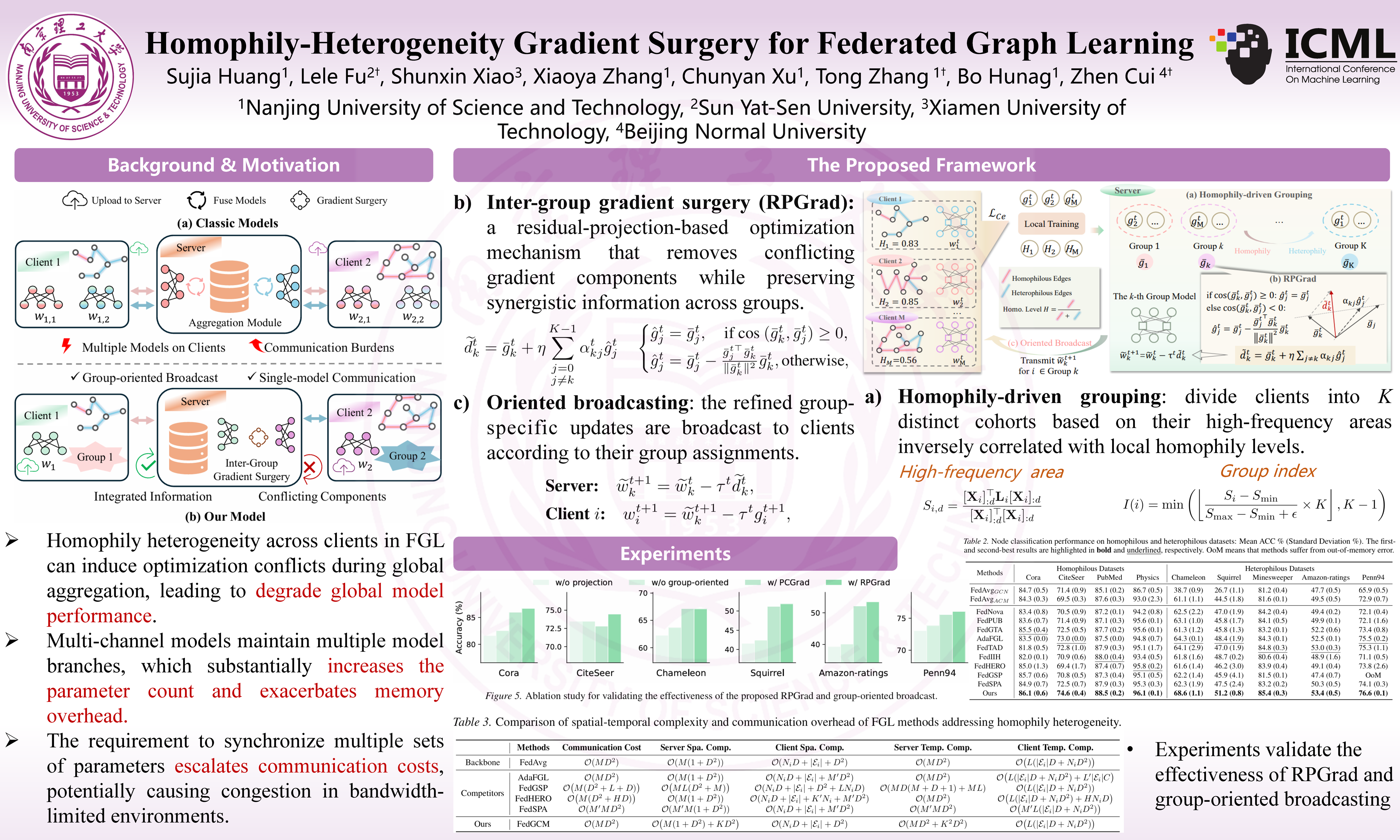
Federated Graph Learning (FGL) facilitates privacy-preserving collaborative training of graph neural networks, yet homophily heterogeneity across subgraphs can induce optimization conflicts that degrade model generalization. Many existing solutions rely on multi-channel architectures to mitigate such conflicts, which increase the burden on edge devices and lack theoretical convergence analysis. To overcome these limitations, we propose FedGCM, a novel FGL framework with Group-oriented Conflict Mitigation, which aligns inconsistent optimization objectives via a tailored gradient surgery. Specifically, FedGCM first divides clients into distinct groups based on their homophily levels, thereby avoiding exhaustive client-to-client conflict assessments. To resolve inter-group interference, we develop RPGrad, a gradient surgery mechanism based on residual projection, which integrates synergistic knowledge while filtering inter-group conflicts. The refined updates are then transmitted in a group-wise fashion, effectively alleviating optimization conflicts induced by homophily heterogeneity without augmenting the client-side burden. Furthermore, we provide a formal theoretical analysis establishing the convergence. Extensive experiments on both homophilous and heterophilous graphs demonstrate that FedGCM consistently achieves superior performance.
Lay Summary
Many real-world data can be represented as networks, such as citation networks and social networks. Such network data may be held by different organizations or devices, and privacy concerns often prevent them from directly sharing their raw data. A common solution is to let these participants train a shared model collaboratively without exposing their private data. However, different participants may have very different connection patterns in their local networks, which can cause model training directions to conflict with each other and hurt the global evaluation. This paper proposes a method called FedGCM to make such collaborative training more effective. It groups participants with similar network patterns and then carefully combines their training updates. It keeps useful shared information while reducing harmful conflicts between different groups. This design improves performance without adding extra computation to local devices. Experiments on various network datasets show that FedGCM achieves superior results.