
Focus-Then-Contact: Speeding Up Robotic Contact-Rich Task Learning with Affordance-Guided Real-World Residual Reinforcement Learning
Abstract
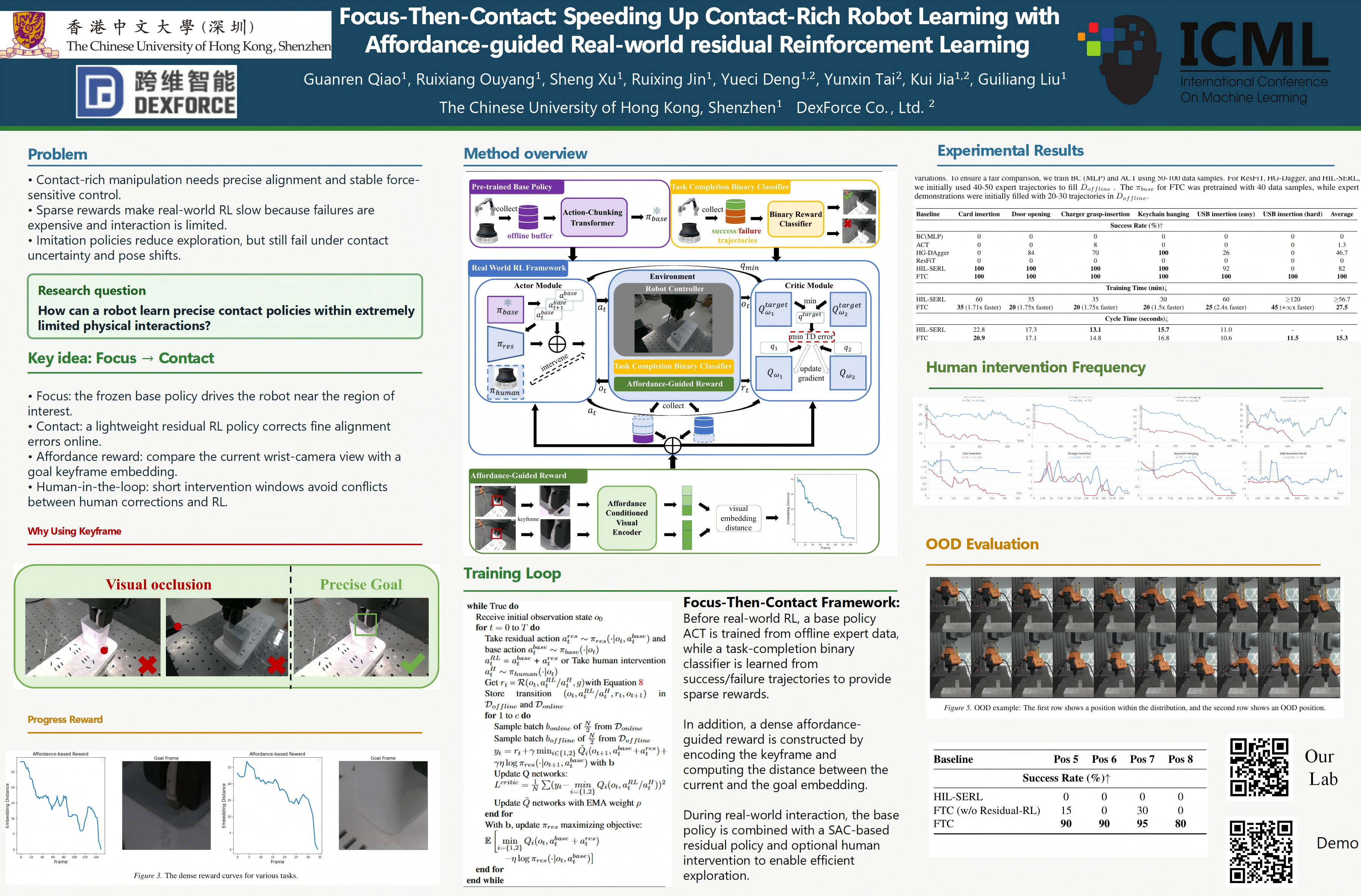
Real-World Reinforcement Learning (RL) has shown significant potential in robotic manipulation tasks. However, many methods still require substantial human-in-the-loop involvement to complete contact-rich tasks, especially when there are disruptions such as visual backgrounds or positional changes. To address this, we propose the Focus Then Contact (FTC), a lightweight and low-cost method to accelerate the convergence of human-in-the-loop real-world RL for contact-rich tasks. FTC leverages residual RL to provide base actions, helping the system quickly reach the target regions and improve sample efficiency. Additionally, FTC integrates an affordance-guided reward that drives the real-world RL system to quickly focus on key regions of interest, making it possible for the robotic arm to continuously engage with these goal areas through force-control feedback. At the same time, we optimize the human-in-the-loop implementation to prevent conflicts with RL over control of the robotic arm. We demonstrate the effectiveness of FTC on 6 contact-rich tasks, where it outperforms baseline methods in achieving high success rates and speeds up robotic contact-rich task learning under a real-world RL setting.
Lay Summary
We present Focus-Then-Contact (FTC), a lightweight and low-cost human-in-the-loop reinforcement learning framework for contact-rich, fine-grained real-world manipulation. By combining keyframe-based affordance-guided rewards with residual RL on top of a base policy, FTC achieves fast convergence, generalization to unseen settings, and a certain degree of robustness under real-world disturbances. Our results show that base policies and affordance-guided rewards are complementary rather than conflicting, jointly enabling efficient and stable learning on real robots. We think FTC provides a practical foundation for scalable real-world RL. The base policy, dense reward, and human intervention tools can all be substituted with alternatives. Future work will explore more contact-rich long-horizon manipulation tasks that go beyond atomic skills.