
UAV$^2$: A Unified and Adaptive Scheduling Framework for UAV Autopilot System with Reinforcement Learning
Abstract
Lay Summary
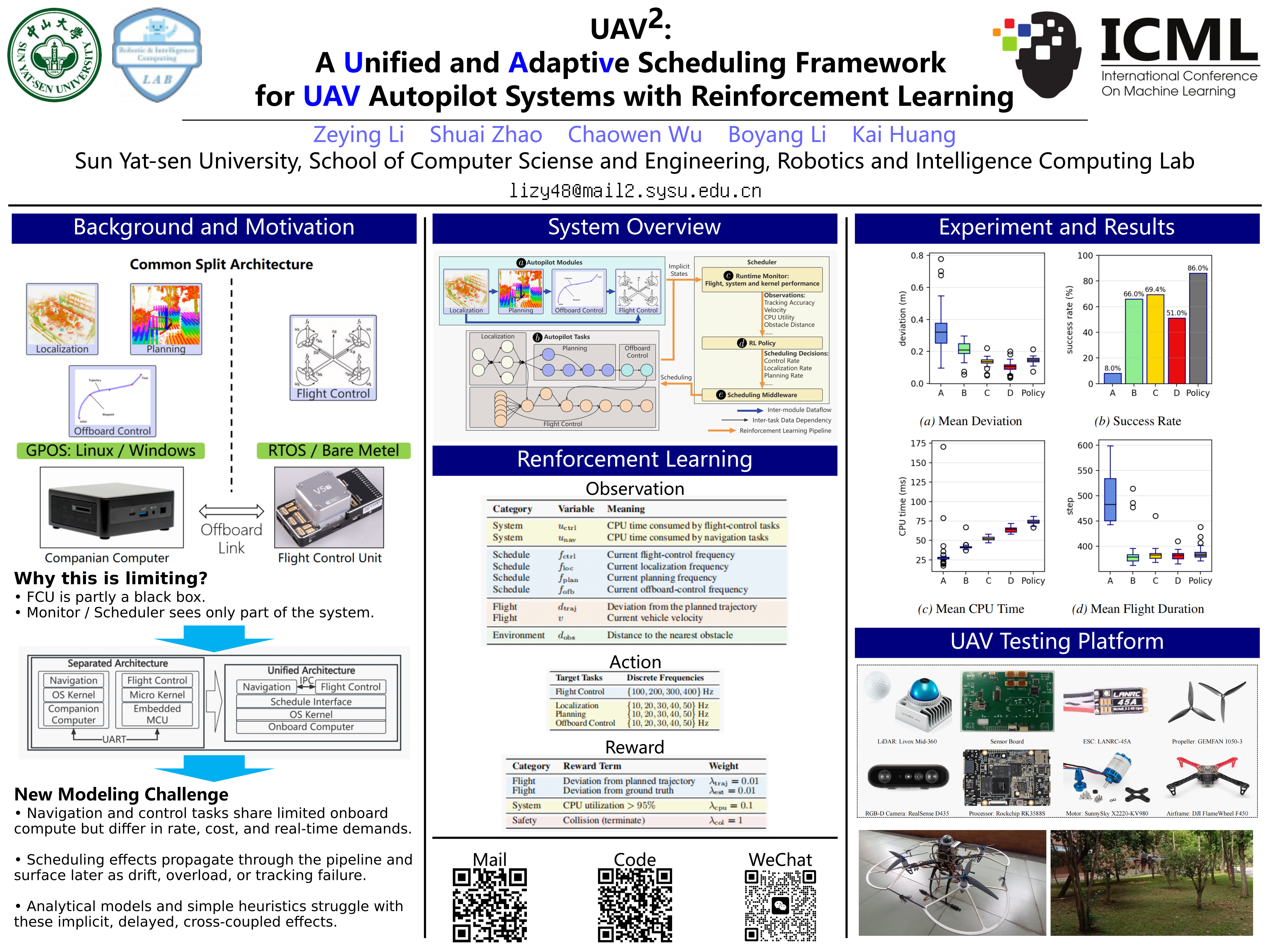
Autonomous drones depend on two tightly linked software components: navigation, which decides where to go, and flight control, which executes those decisions. In most drones today, these two components run on separate computer chips. This split design means the system cannot see the full picture when allocating computing resources, making it difficult to optimize overall flight performance. Moreover, the impact of scheduling decisions — which task gets how much computing time — only becomes apparent after a delay, making it nearly impossible to design effective scheduling rules by hand. This paper introduces a framework that unifies all drone software onto a single onboard computer and treats scheduling as a learning problem. Using a technique called reinforcement learning, the system learns from actual flight experience — much like a pilot improving through practice — to dynamically adjust how computing time is distributed among tasks. The goal is straightforward: fly more accurately and crash less often. The approach was trained and tested in a hardware-in-the-loop simulator, where the drone's software runs on a real embedded computer while its physical motion is simulated with high fidelity. Across challenging obstacle-filled missions, the learned scheduler consistently outperformed traditional fixed-rate strategies, achieving both better trajectory tracking and a higher mission success rate. These results suggest that allowing drones to learn their own scheduling strategies from real execution feedback is a practical and promising direction for making autonomous flight safer and more reliable.