
Geodesic Calculus on Implicitly Defined Latent Manifolds
Abstract
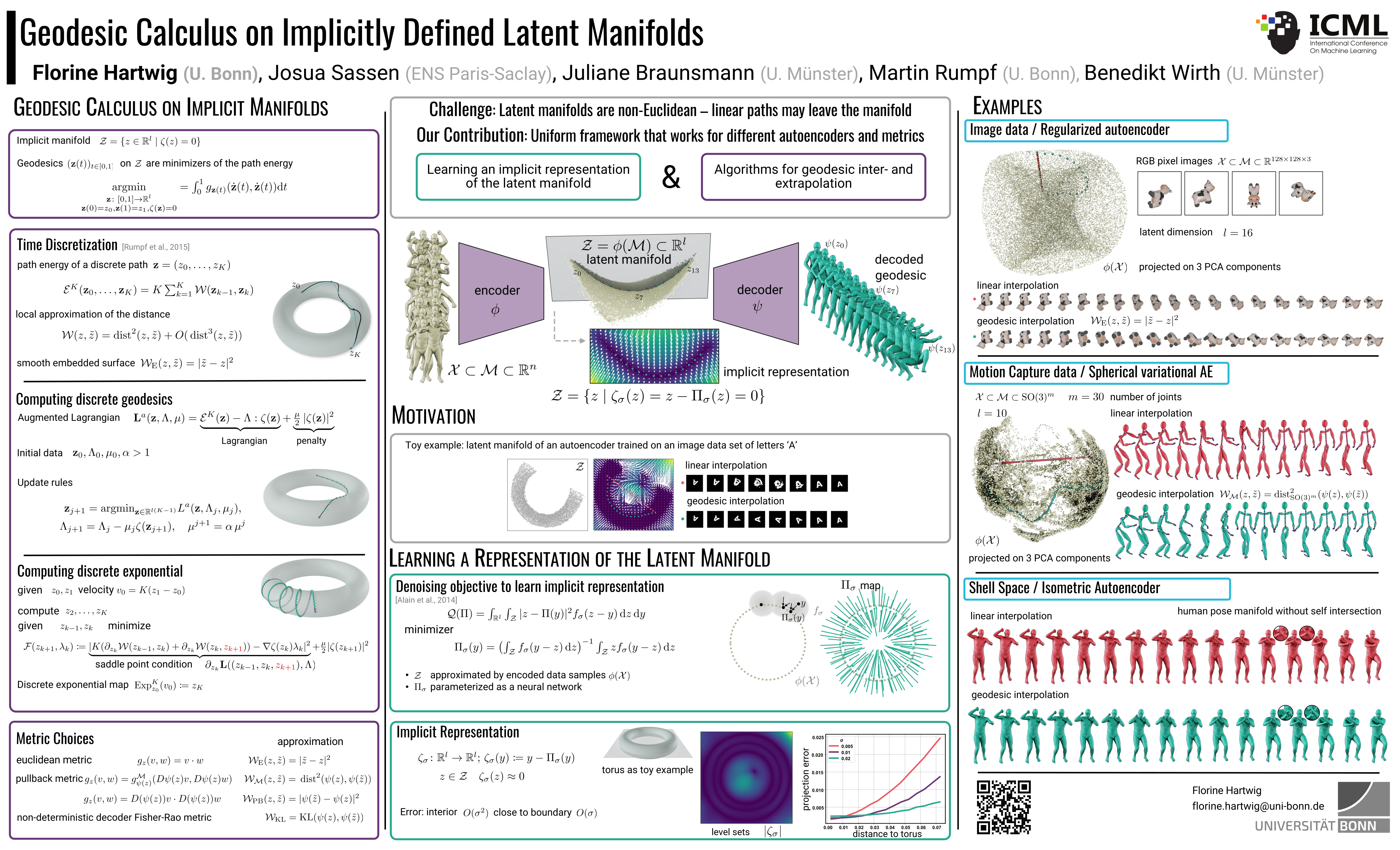
Latent manifolds of autoencoders provide low-dimensional representations of data, which can be studied from a geometric perspective. We propose to describe these latent manifolds as implicit submanifolds of some ambient latent space. Based on this, we develop tools for a discrete Riemannian calculus approximating classical geometric operators. These tools are robust against inaccuracies of the implicit representation often occurring in practical examples. To obtain a suitable implicit representation, we propose to learn an approximate projection onto the latent manifold by minimizing a denoising objective. This approach is independent of the underlying autoencoder and supports the use of different Riemannian geometries on the latent manifolds. The framework in particular enables the computation of geodesic paths connecting given end points and shooting geodesics via the Riemannian exponential maps on latent manifolds. We evaluate our approach on various autoencoders trained on synthetic and real data.
Lay Summary
Autoencoders are neural networks trained to compress and reconstruct data, such as images or 3D shapes. They learn to encode information in a compact low-dimensional representation. This representation usually forms a curved geometric structure called a manifold. The shape of this structure reveals the hidden structure of the actual data. It could allow us to smoothly interpolate or navigate between different data points. However, working with the geometry of these manifolds is challenging because the autoencoder only gives us samples on the manifold instead of a description of its structure. We develop a mathematical framework that treats these curved geometric structures implicitly, and build a corresponding set of algorithms for geometric operations. To find a good implicit description, we train a small additional model to learn a projection onto the manifold. This works with any existing autoencoder, regardless of how it was trained. Our tools allow to compute shortest paths and move along the manifold directly on the internal representations of autoencoders. This opens up new ways to analyze data and to realistically interpolate between data points, for example, producing smooth transitions between shapes or poses.