
MIMO-LP: A Multi-Input Multi-Output Framework for Subgraph-based Link Prediction
Abstract
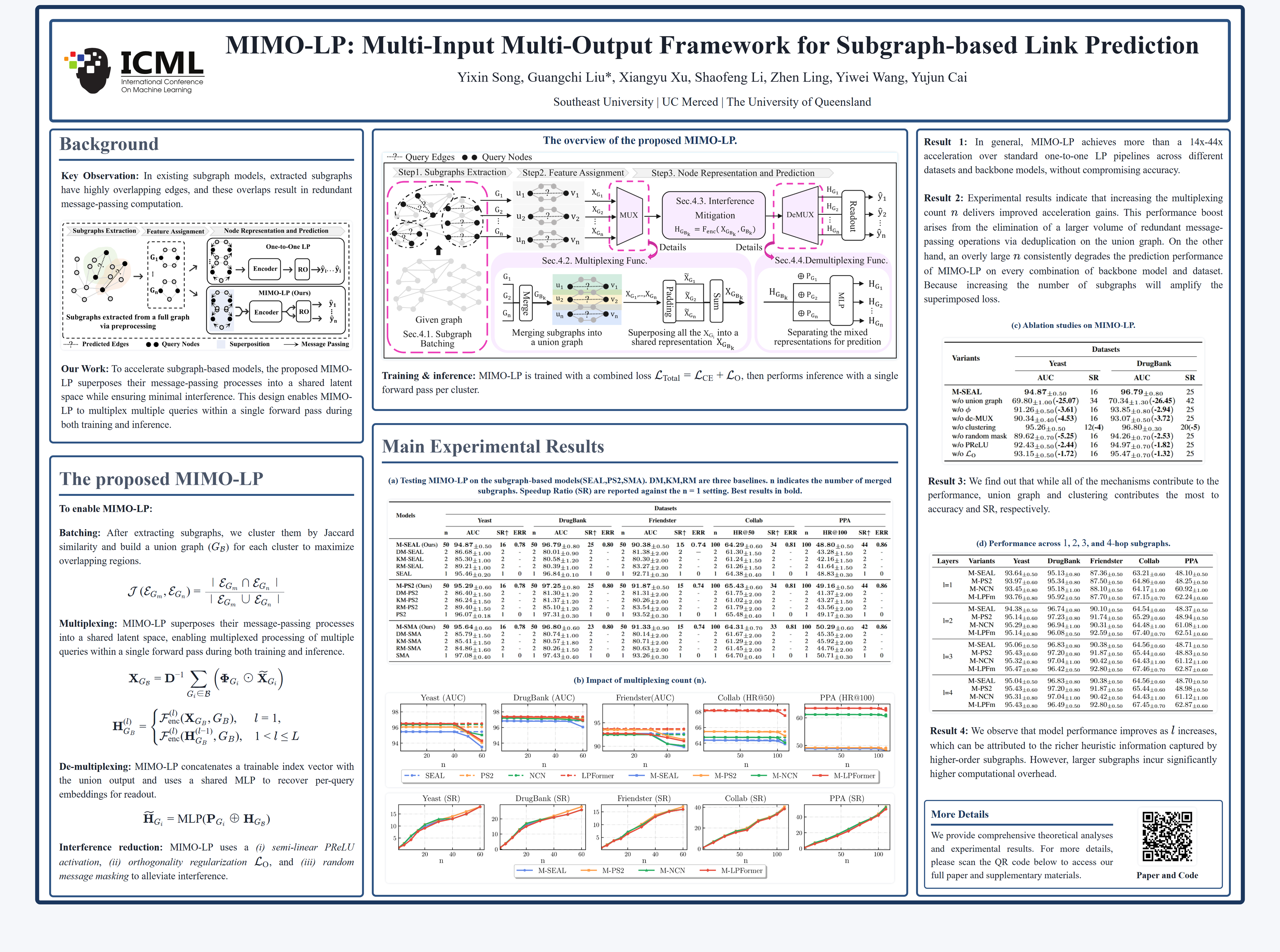
Link prediction (LP) is a fundamental problem in graph learning and can be broadly categorized into node-based and subgraph-based approaches. While subgraph-based LP methods often achieve superior predictive performance by exploiting localized structural information, they suffer from efficiency bottlenecks due to the high computational cost of per-query subgraph message-passing during both training and inference. To address this challenge, we propose MIMO-LP, a Multi-Input Multi-Output (MIMO) framework that accelerates subgraph-based LP. Given a batch of query node pairs and their corresponding subgraphs extracted from a shared full graph, MIMO-LP superposes their message-passing processes into a shared latent space while ensuring minimal interference among them. This design enables MIMO-LP to multiplex multiple queries within a single forward pass during both training and inference, substantially reducing redundant message-passing computations in overlapping subgraph regions. Extensive experiments demonstrate that MIMO-LP achieves a 14x-44x speedup over existing one-to-one subgraph-based methods, while maintaining comparable predictive performance.
Lay Summary
Traditional AI systems predict potential connections between nodes in a network by examining small local subgraphs. While these methods produce accurate results, they are very slow and computationally expensive, because each subgraph must be processed one at a time. We noticed that when predicting multiple relationships, their corresponding subgraphs often share a great deal of overlapping structure. Based on this observation, we developed MIMO-LP, which identifies these overlapping computation paths and removes unnecessary repeated work. As a result, our model can complete many link predictions in a single forward pass, significantly speeding up both training and inference. Our experiments show that MIMO-LP runs 14 to 44 times faster than traditional approaches, without losing prediction accuracy. The method is also flexible and can be easily applied to a wide range of existing link prediction models.