
Partitioning for Intrinsic Model Inversion Resistance in Collaborative Inference
Abstract
Lay Summary
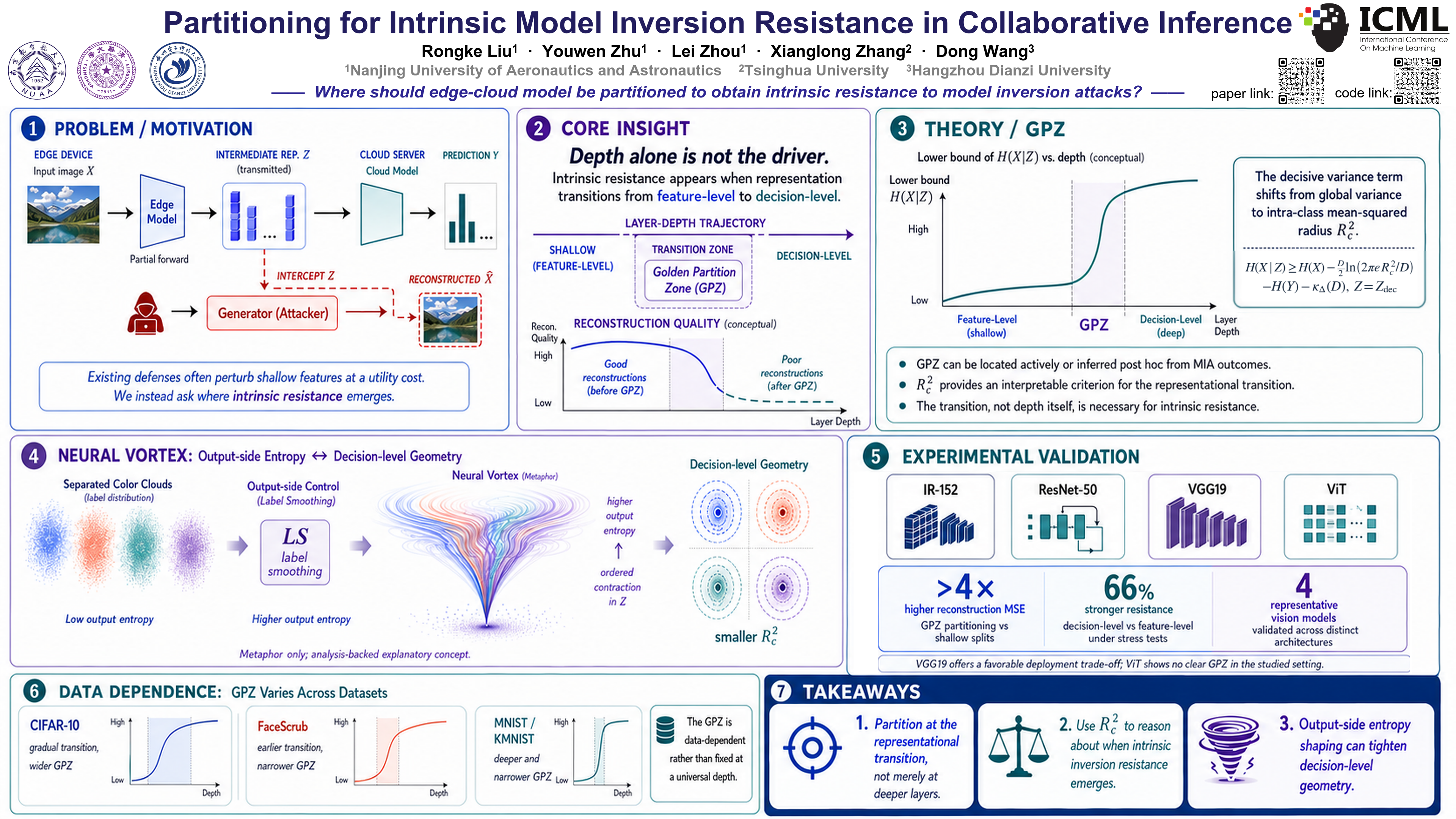
Modern AI services often split a deep vision model between a user’s device and a cloud server. This reduces the computation needed on the device, but it also means that the device must send internal information to the cloud. If an attacker sees this information, they may be able to reconstruct the user’s private input image. We study a simple but important question: where should the model be split so that the transmitted information is naturally harder to invert? A common belief is that using deeper layers is safer. Our work shows that this is not always true. What matters is whether the model’s internal representation has changed from detailed visual features into more decision-focused information. We identify this transition region and call it the Golden Partition Zone. Splitting the model there makes reconstruction much harder, even when attackers use stronger inversion models or try to enrich the transmitted information. We also explain how training choices can shape this transition, a behavior we call the Neural Vortex. Overall, our results provide practical guidance for designing safer edge–cloud AI systems without relying only on extra noise or heavy encryption.