
A Geometric Analysis of Small-sized Language Model Hallucinations
Abstract
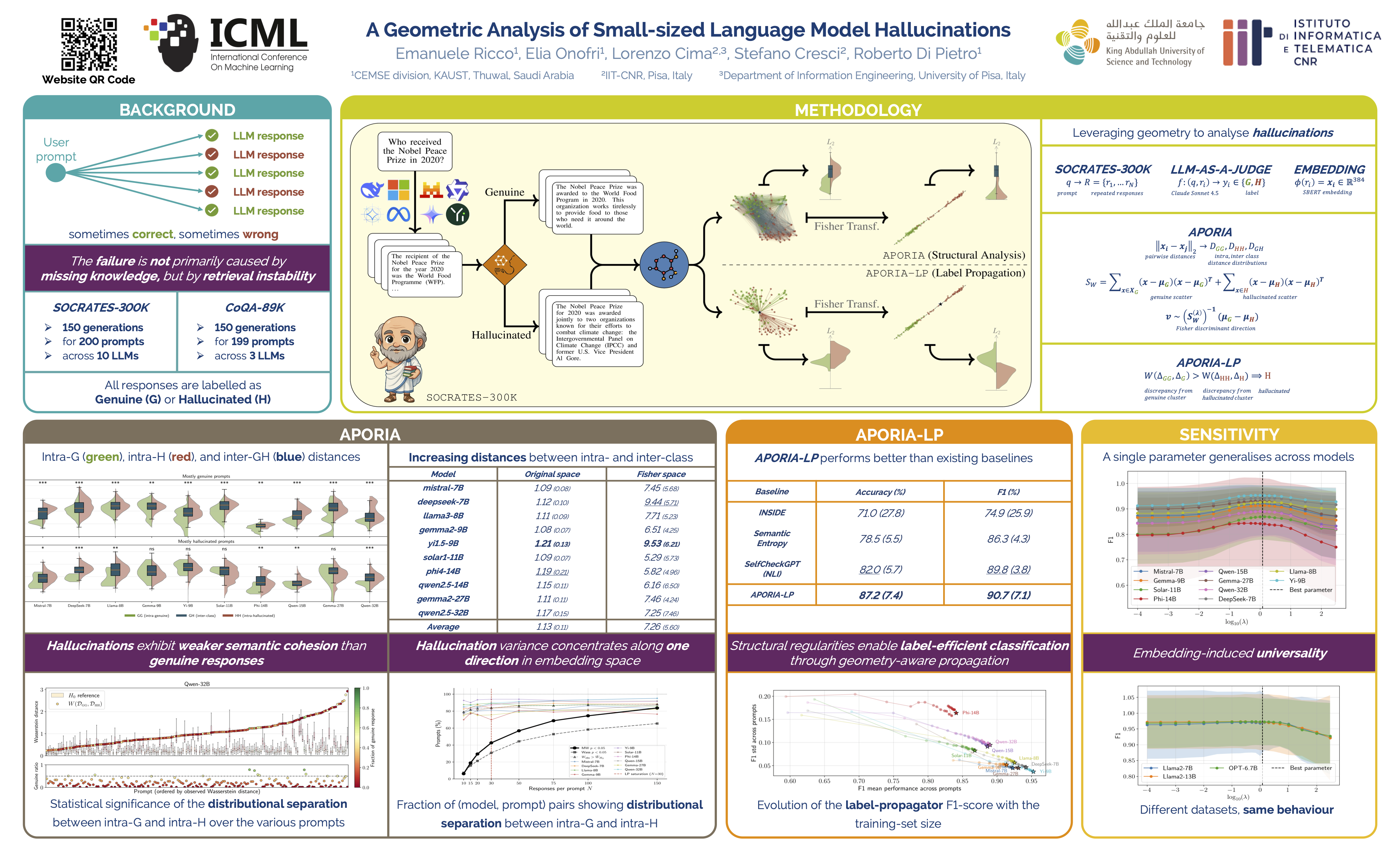
Hallucinations—plausible but factually incorrect responses—pose a major challenge to the reliability of Large Language Models (LLMs), especially in multi-step or agentic settings. Existing work largely frames hallucinations as a consequence of missing knowledge; we show instead that, even when the relevant factual knowledge is present, models still produce hallucinated answers, pointing to retrieval instability rather than knowledge gaps. Building on this observation, we introduce APORIA (Aggregate Prompt-wise Observation Retrieving Instability via Asymmetry—the Socratic state of "puzzlement-in-contradiction" that hallucinations embody), a geometric framework that studies repeated responses to the same prompt in sentence-embedding space. Our central hypothesis is that genuine responses cluster more tightly than hallucinated ones; we empirically validate this and show that, after Fisher projection, the two response classes become consistently separable. We leverage this asymmetry in geometry via APORIA-LP, an efficient label-propagation method that classifies large collections of responses from as few as 30–50 annotations, achieving F1 scores above 90% across ten small-sized LLMs. To support further research, we release SOCRATES-300K, a fully labelled dataset of 300,000 responses, together with the code for both dataset generation and result reproduction. Our key finding—framing hallucinations from a geometric perspective in the embedding space—complements traditional knowledge-centric and single-response evaluation paradigms, paving the way for further research.
Lay Summary
Large Language Models (LLMs) sometimes generate fluent, confident answers that are… simply wrong — a failure mode called hallucination, and a serious obstacle for the deployment of these systems in contexts where reliability is at a premium. Hallucinations occur across all LLMs, but become especially apparent in small-sized models (those with a few billion parameters). However, when the same question is asked repeatedly, the answer is sometimes right and sometimes not. This finding suggests that the relevant knowledge is there. Our main contribution empirically shows that hallucinations stem not from missing knowledge, but from an instability in how the model retrieves what it already knows — an internal failure whose inner workings remain difficult to explain. To capture this phenomenon, we introduce APORIA — a term borrowed from Socratic philosophy, where it denotes the "puzzlement-in-contradiction" that hallucinations embody. APORIA characterises how a model's many responses to the same prompt relate to one another: correct answers cluster tightly in meaning, while hallucinated ones drift apart. Building on this characterisation, we develop APORIA-LP, which, from only a few human-checked answers, automatically labels thousands of further responses as genuine or hallucinated. Together, APORIA and APORIA-LP turn hallucination from an unpredictable failure into a predictable property — a step toward LLMs we can ultimately trust.