
APEX: Approximate-but-exhaustive search for ultra-large combinatorial synthesis libraries
Abstract
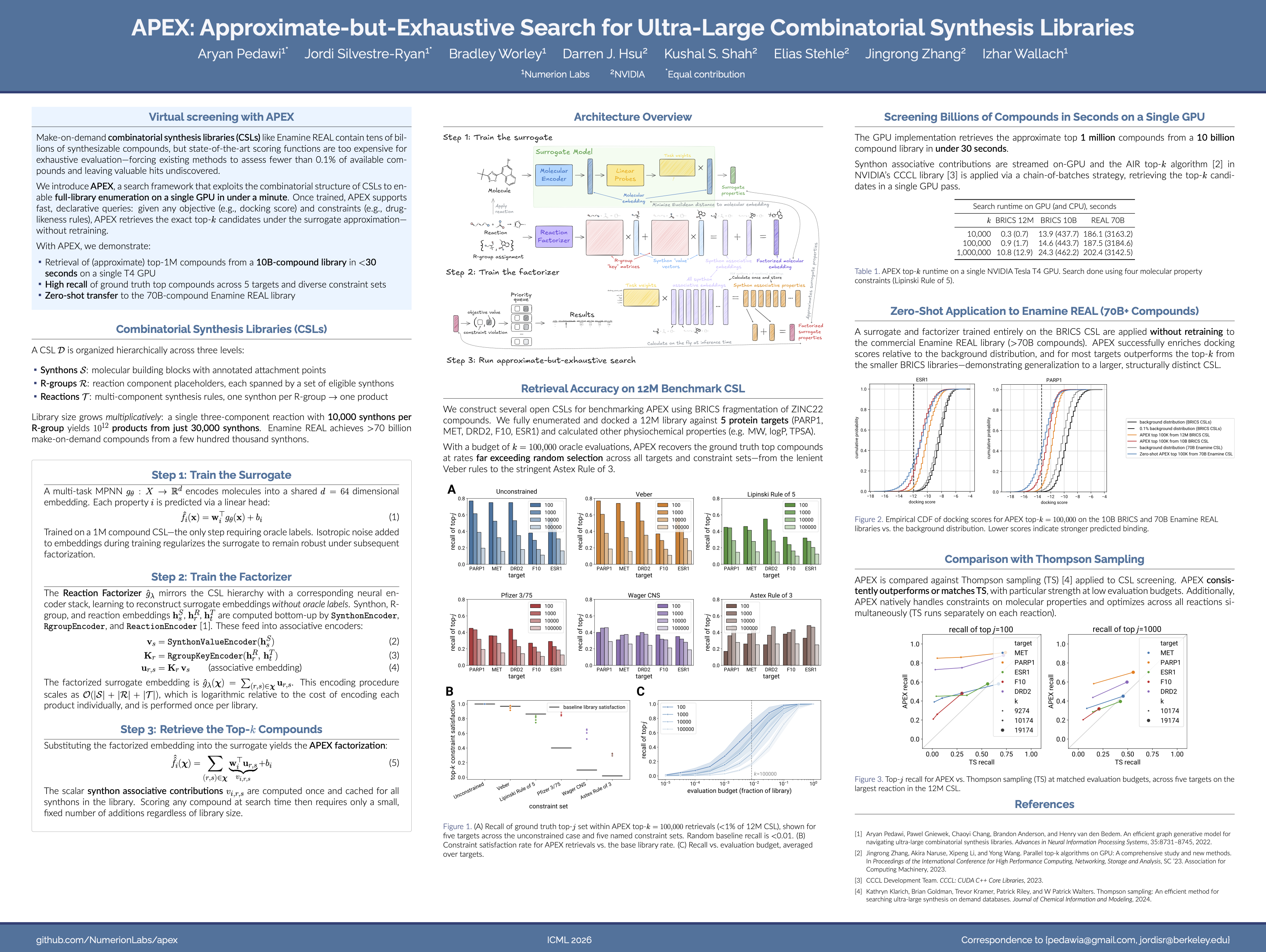
Make-on-demand combinatorial synthesis libraries (CSLs) like Enamine REAL have significantly enabled drug discovery efforts. However, their large size presents a challenge for virtual screening, where the goal is to identify the top compounds in a library according to a computational objective (e.g., optimizing docking score) subject to computational constraints under a limited computational budget. For current library sizes---numbering in the tens of billions of compounds---and scoring functions of interest, a routine virtual screening campaign may be limited to scoring fewer than 0.1% of the available compounds, leaving potentially many high scoring compounds undiscovered. Furthermore, as constraints (and sometimes objectives) change during the course of a virtual screening campaign, existing virtual screening algorithms typically offer little room for amortization. We propose the approximate-but-exhaustive search protocol for CSLs, or APEX. APEX utilizes a neural network surrogate that exploits the structure of CSLs in the prediction of objectives and constraints to make full enumeration on a consumer GPU possible in under a minute, allowing for exact retrieval of approximate top-k sets. To demonstrate APEX's capabilities, we develop a benchmark CSL comprised of more than 10 million compounds, all of which have been annotated with their docking scores on five medically relevant targets along with physicohemical properties measured with RDKit such that, for any objective and set of constraints, the ground truth top-k compounds can be identified and compared against the retrievals from any virtual screening algorithm. We show APEX's consistently strong performance both in retrieval accuracy and runtime compared to alternative methods.
Lay Summary
Finding new medicines requires searching through enormous collections of drug-like molecules to identify ones that might bind to a disease target. Combinatorial synthesis can be used to construct ultra-large virtual libraries of synthetically accessible compounds containing tens of billions of molecules, but computationally evaluating even a fraction of these compounds with modern scoring functions can be prohibitively expensive for routine virtual screening campaigns. We introduce APEX, a search algorithm that makes it possible to exhaustively screen these massive libraries in seconds on a single GPU. The key insight is to exploit the combinatorial structure of the library: APEX learns to predict how well each molecule scores by combining pre-computed contributions from individual building blocks, rather than evaluating every molecule from scratch. This reduces billions of evaluations to a small number of additions per molecule, enabling exhaustive search to be amortized across many queries at negligible cost. Once trained, APEX can efficiently execute search queries, like finding the top-scoring molecules subject to drug-likeness constraints, without any retraining. We show that APEX reliably recovers the true best compounds from libraries of over 10 million molecules, and that screening larger libraries consistently surfaces better candidates than what can be found in smaller libraries.