
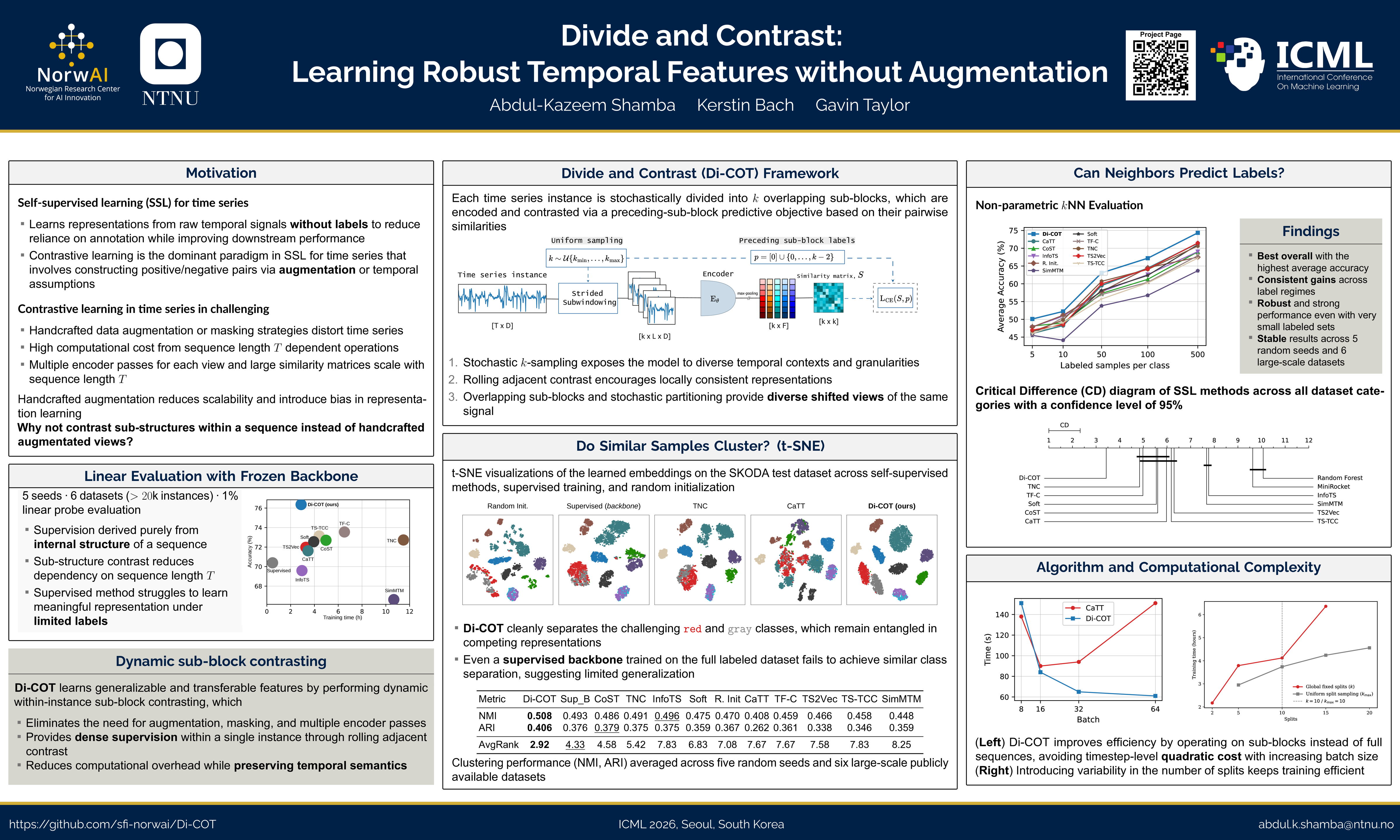
Divide and Contrast: Learning Robust Temporal Features without Augmentation
Abstract
Self-supervised learning for time-series representation aims to reduce reliance on labeled data while maintaining strong downstream performance, yet many existing approaches incur high computational costs or rely on assumptions that do not hold across diverse temporal dynamics. In this work, we introduce Divide and Contrast (Di-COT), an unsupervised framework that avoids data augmentation and multiple encoder passes by contrasting informative substructures within a window rather than individual timesteps. Di-COT stochastically partitions each window into a small number of overlapping sub-blocks per iteration, enabling efficient and meaningful contrast while mitigating false positives during temporal transitions. To further improve scalability, we adopt a contrastive objective whose computation depends on the batch size and the number of sub-blocks, making loss computation independent of sequence length. Extensive experiments on six large-scale real-world datasets, as well as the UCR and UEA benchmarks, demonstrate that Di-COT learns transferable representations while achieving state-of-the-art performance with substantially reduced training time.
Lay Summary
Many real-world systems, such as fitness trackers, hospital monitors, and factory sensors, continuously generate streams of time-stamped data. Making sense of these signals, such as recognizing activities like walking or detecting abnormal heart patterns, typically requires large labeled datasets, which are costly and often require expert knowledge. Recent methods avoid labels by creating augmented versions of the same signal and teaching the computer to treat them as similar. But for time-series data, augmentations can distort meaning, for example, making a normal heartbeat look abnormal. We propose Di-COT, a simple framework for learning from time-series data without labels or data augmentation. Di-COT randomly splits each signal window into a small number of overlapping blocks and learns by contrasting these blocks within the same sequence. The idea is that nearby segments share consistent structure, and capturing this relationship helps the computer to learn useful representations. We evaluate Di-COT across diverse datasets, including human activity recognition, sleep analysis, ECG monitoring, and industrial sensing. It consistently learns strong and transferable representations, achieving competitive or better performance than existing methods while also being significantly faster to train.