
Rethinking Generative Image Pretraining: How Far Are We From Scaling Up Next-Pixel Prediction?
Abstract
Lay Summary
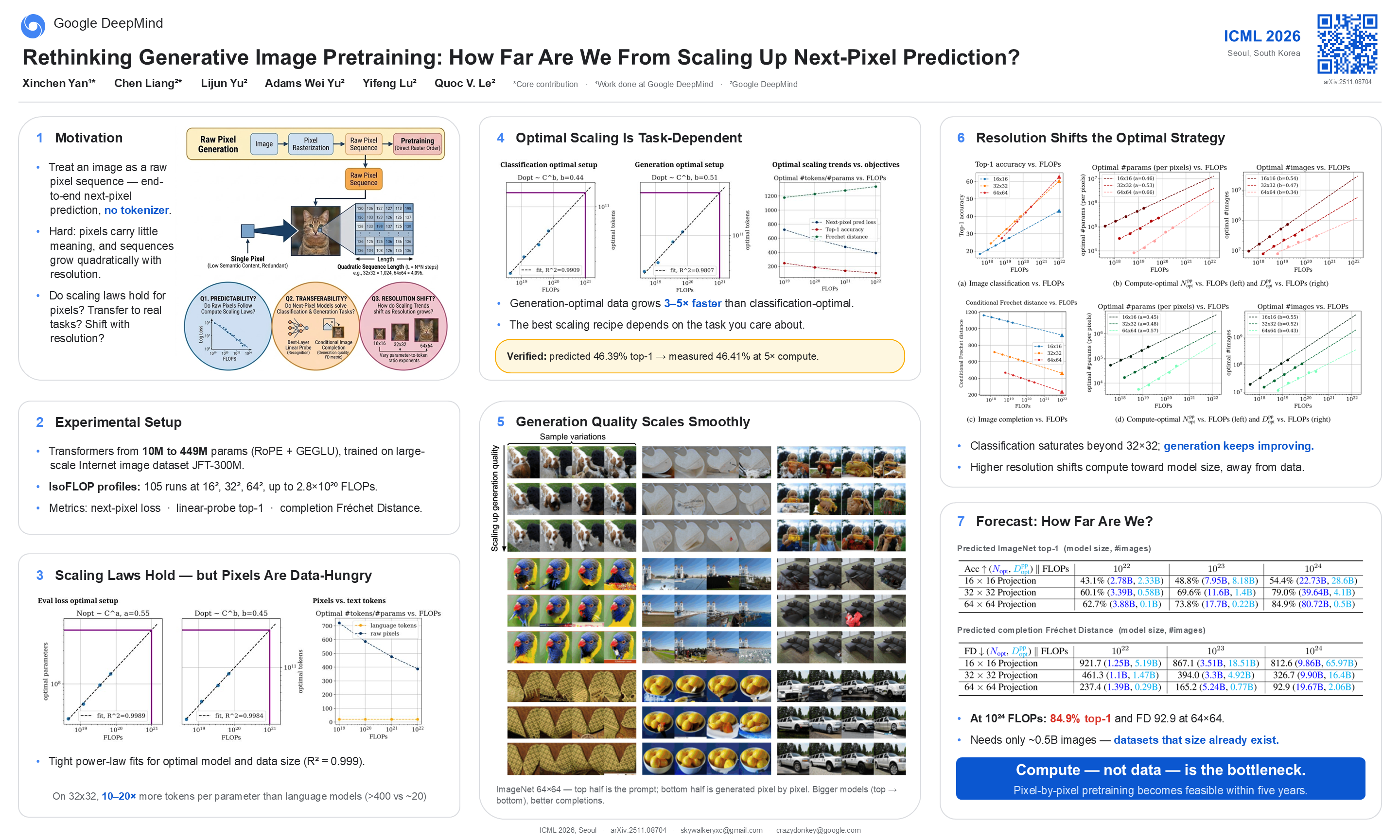
Language models have achieved incredible success by simply predicting the next word in a sequence. While researchers have previously shown that vision models can use this exact same approach—predicting an image one raw pixel at a time —this method became less popular over the years in favor of more compute-efficient shortcuts. This paper asks a crucial unanswered question: what happens if we actually scale up this simple "next-pixel" approach? We conducted extensive experiments to uncover the scaling properties of learning from raw pixels, measuring how a model's performance improves as we add more data and computer power. We discovered three key insights: * Pixels are harder to scale than text: Because a single pixel holds far less meaning than a word, a model requires at least 10 to 20 times more data (tokens per parameter) at low resolution to successfully learn from raw pixels compared to language. * The end goal changes the scaling strategy: The optimal way to allocate resources depends heavily on the target task. Teaching a model to generate images requires the dataset size to grow three to five times faster than if you are teaching it to simply recognize or classify images. * Sharper images require much bigger models: As image resolution increases, simply feeding the model more pictures isn't enough; the model's size must grow much faster than the amount of training data to handle the added complexity. Ultimately, we found that the main roadblock to scaling this simple pixel-by-pixel approach is pure computing power, not a lack of training data. Because available computing power for frontier models continues to rapidly increase four to five times every year, we forecast that training highly capable vision models directly from raw pixels will become a feasible and practical reality within the next five years.