
Dual-Calibration Multi-View Clustering via Compact Anchor Learning
Abstract
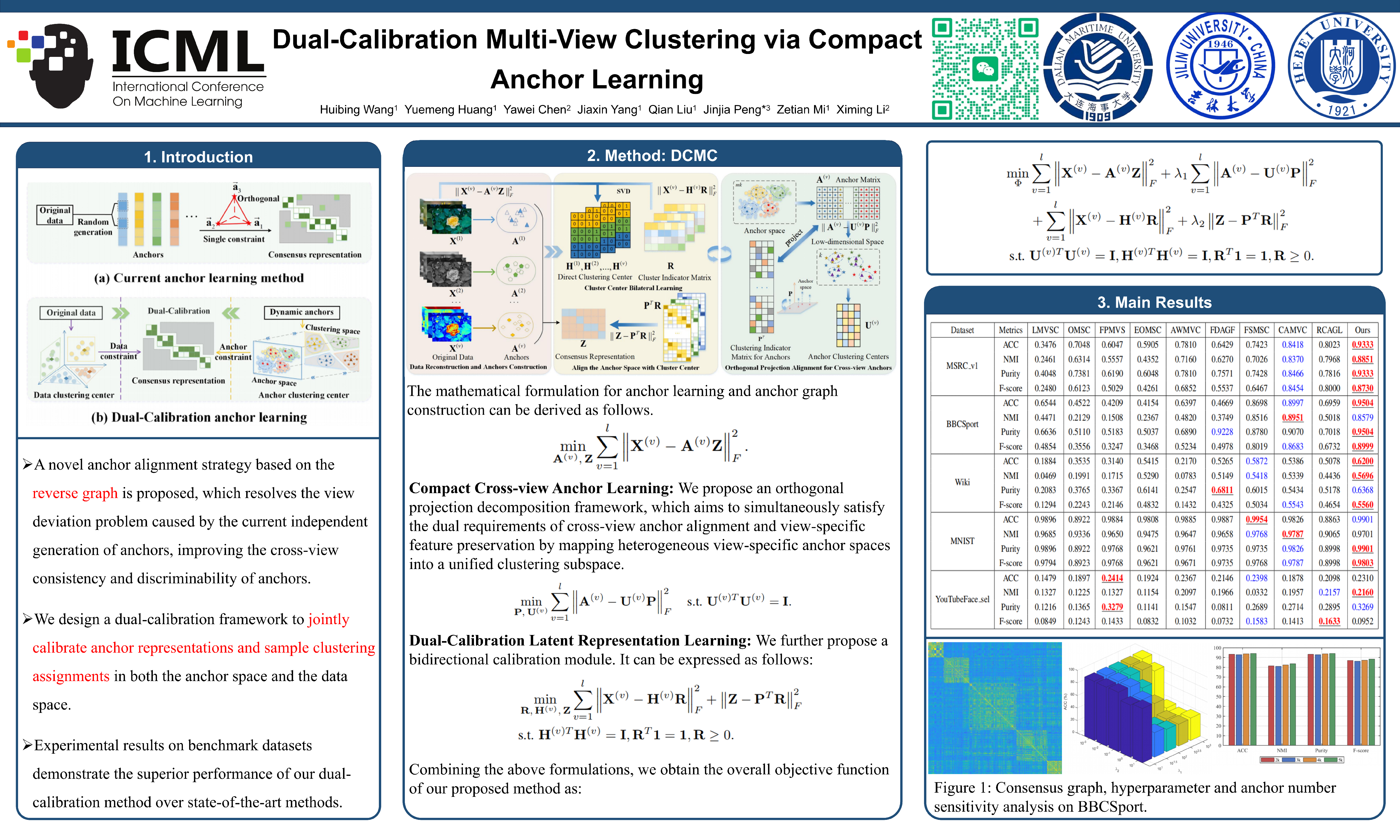
The anchor-based multi-view clustering methods have received extensive attention due to their efficiency and scalability in large-scale data scenarios. Existing anchor-based methods still face challenges in learning compact and semantically discriminative anchors. Current mainstream approaches typically rely on random sampling strategies or orthogonal constraints for anchor selection and learning. However, they often optimize anchor learning and cluster assignment in a relatively separate manner, leaving the clustering semantics in the sample space insufficiently exploited for calibrating the anchor space. As a result, the learned anchors may suffer from redundant coverage and ambiguous cluster boundaries. Unlike existing anchor-based multi-view clustering methods, this paper proposes a Dual-Calibration Multi-view Clustering via Compact Anchor Learning (DCMC), which effectively improves anchor quality through a dual-space alignment mechanism. Specifically, DCMC initializes view-specific anchors to capture the underlying data distribution, and then enforces bidirectional consistency between the anchor space and the clustering space to jointly optimize both the sample-to-anchor assignments and the cluster assignments. The alternating optimization process effectively enhances cross-view semantic consistency while preserving the discriminative characteristics of each view. Experimental results demonstrate that DCMC outperforms state-of-the-art methods across multiple benchmark tests, confirming its effectiveness and reliability.
Lay Summary
Many real-world objects or events can be described from different sources or perspectives. For example, a news article may have text features from different representations, and an image may contain color, texture, or shape information. Multi-view clustering aims to group such data without manual labels by combining these different perspectives. However, existing efficient methods often rely on selected representative points, called anchors, to reduce computational cost. If these anchors are not well chosen or not well aligned across different views, the final groups may become unclear or inaccurate. This paper proposes DCMC, a new method that learns better representative anchors for multi-view clustering. Instead of treating anchor learning and data grouping as two separate steps, DCMC lets them guide each other. The method learns anchors that can both represent the original data and reflect the hidden grouping structure of the samples. In this way, anchors from different views become more consistent and compact to separate into meaningful groups. Experiments on several benchmark datasets show that DCMC achieves better clustering performance than many existing methods, while still keeping good efficiency for large-scale data. This suggests that improving the quality of anchors is an effective way to make multi-view clustering more reliable and scalable.