
DRPBench: Evaluating LLMs in Concurrent Code Comprehension via Fine-grained Data Race Prediction
Abstract
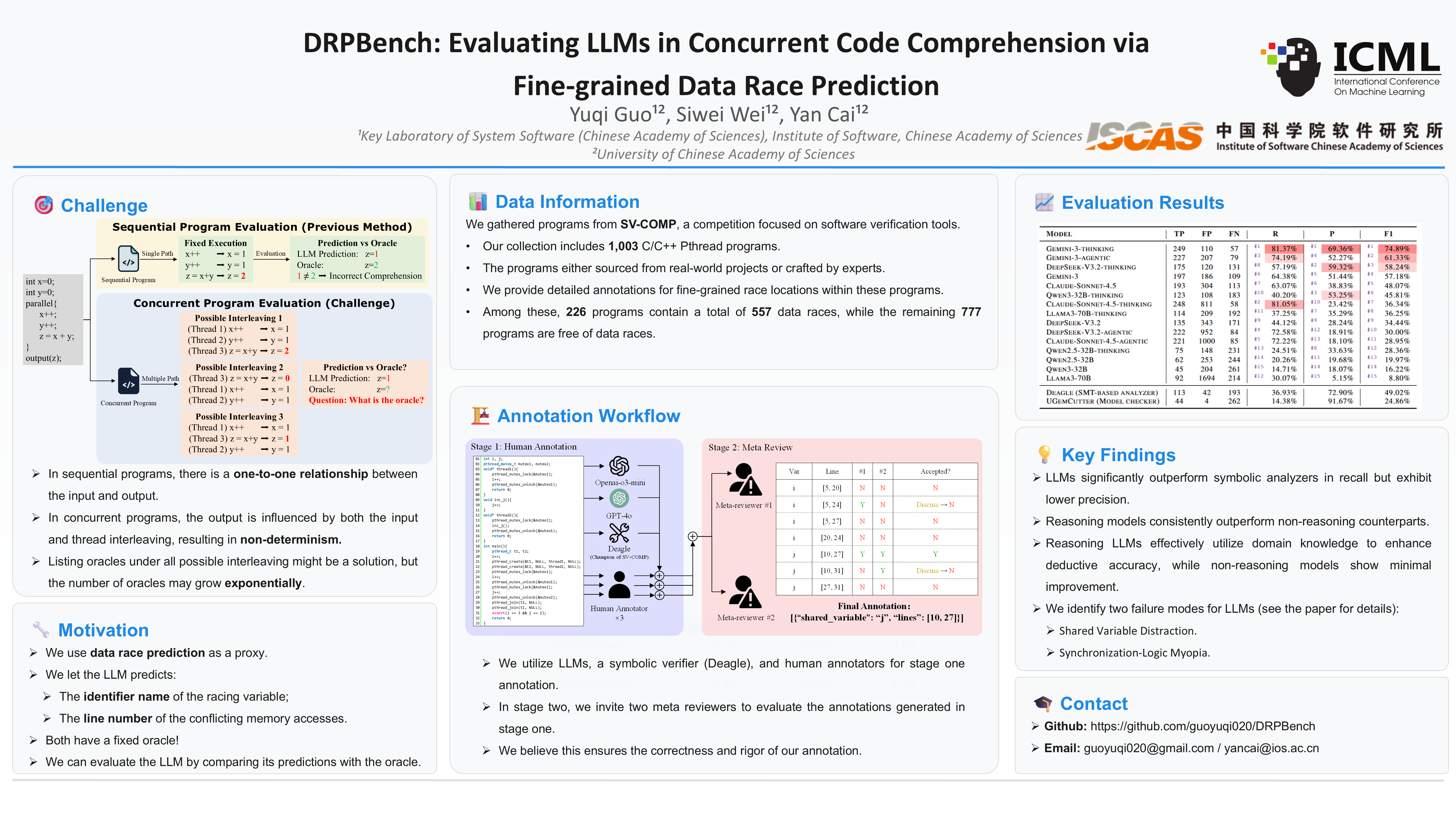
Large Language Models (LLMs) have demonstrated sophisticated comprehension of sequential code, yet their capacity for reasoning about concurrent programs remains largely unquantified. We introduce DRPBench, a benchmark designed to evaluate the concurrent code comprehension of LLMs by measuring their data race prediction performance. To address the challenge of runtime non-determinism for evaluation on concurrent programs, we frame the evaluation as a fine-grained static prediction task using 1,003 programs from the SV-COMP suite, featuring 549 manually annotated data races with precise variable- and line-level granularity. Our evaluation of 15 state-of-the-art LLMs—spanning standard, reasoning, and agentic variants—reveals that DRPBench effectively differentiates concurrent code comprehension capabilities of LLMs. While the top-performing model (Gemini 3 with test-time reasoning) achieves an F1 score of 74.89%, most models struggle significantly (scoring less than 60%), with Llama 3 70B achieving only 8.80%. Beyond benchmarking, we characterize two primary failure modes: (1) shared-variable distraction, where multiple variable appearances degrade comprehension accuracy, and (2) synchronization-logic myopia, the inability to interpret non-standard synchronization implementations. Our findings provide a diagnostic roadmap for enhancing concurrent code comprehension of LLMs in future development.