
Primal-Spectral Generative Modeling: Fast Analytical Generation via Pseudoinverse Lévy Inversion
Abstract
Lay Summary
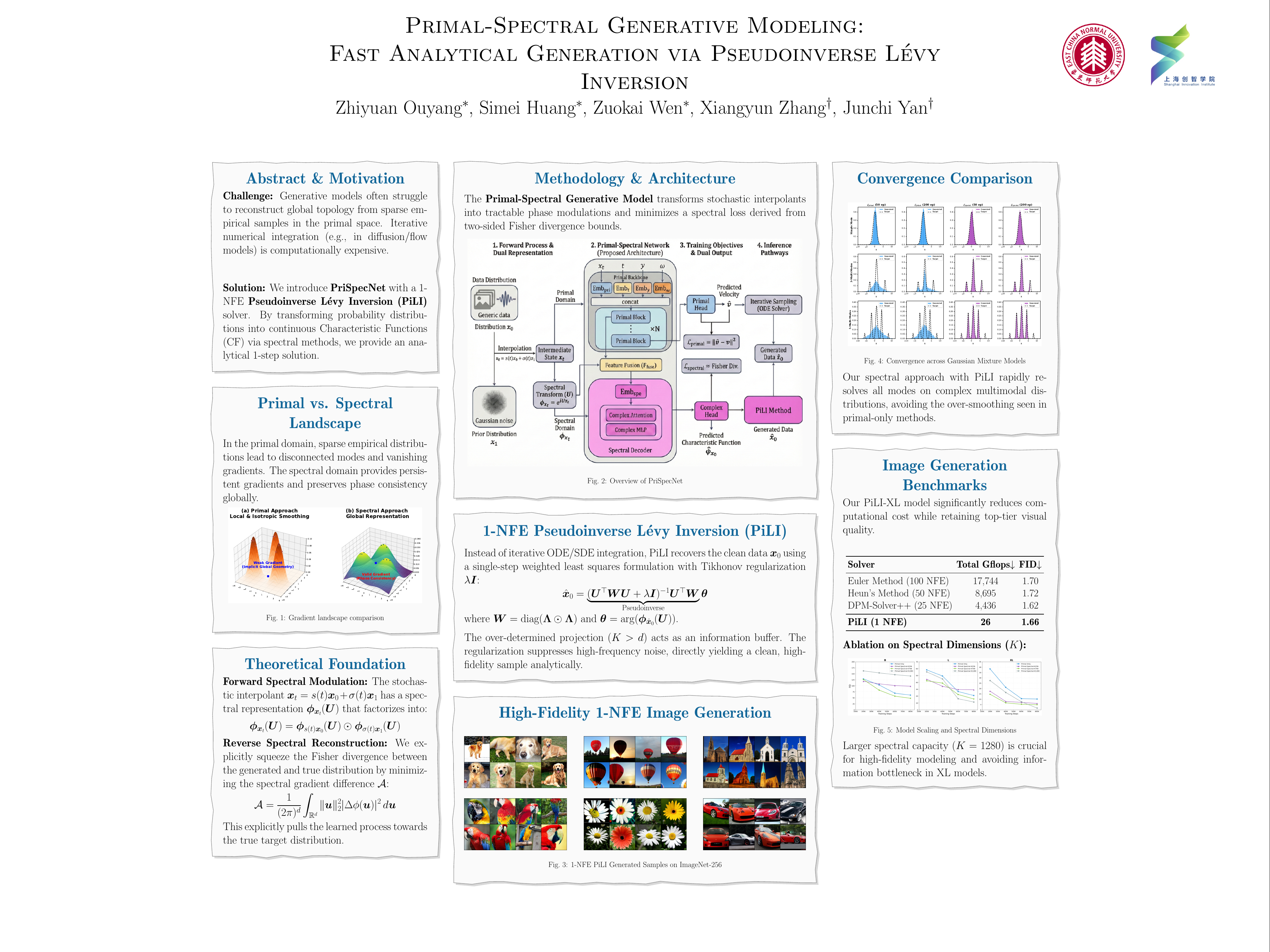
(1) Problem: Artificial intelligence models learn to generate new images or forecast future events by studying examples. However, they often struggle to grasp the "big picture" from limited data. Furthermore, generating this new content usually requires a slow, step-by-step process that consumes massive amounts of computing power. (2) Solution: To solve this, we translated the data into a continuous, wave-like mathematical format. This global view allowed us to develop a new AI system that treats data generation as a direct, solvable equation. Instead of taking dozens of small steps to produce an image or a forecast, our method calculates the final high-quality result in a single, rapid step. (3) Impact: This approach proved highly effective. It significantly reduced errors when predicting complex trends like solar energy output or stock market fluctuations. When generating images, it matched the quality of leading methods while using up to 170 times less computing power. Ultimately, our work makes advanced AI generation much faster, more accurate, and far more energy-efficient.