
Deterministic Differentiable Structured Pruning for Large Language Models
Weiyu Huang ⋅ Pengle Zhang ⋅ Xiaolu Zhang ⋅ JUN ZHOU ⋅ Jun Zhu ⋅ Jianfei Chen
Abstract
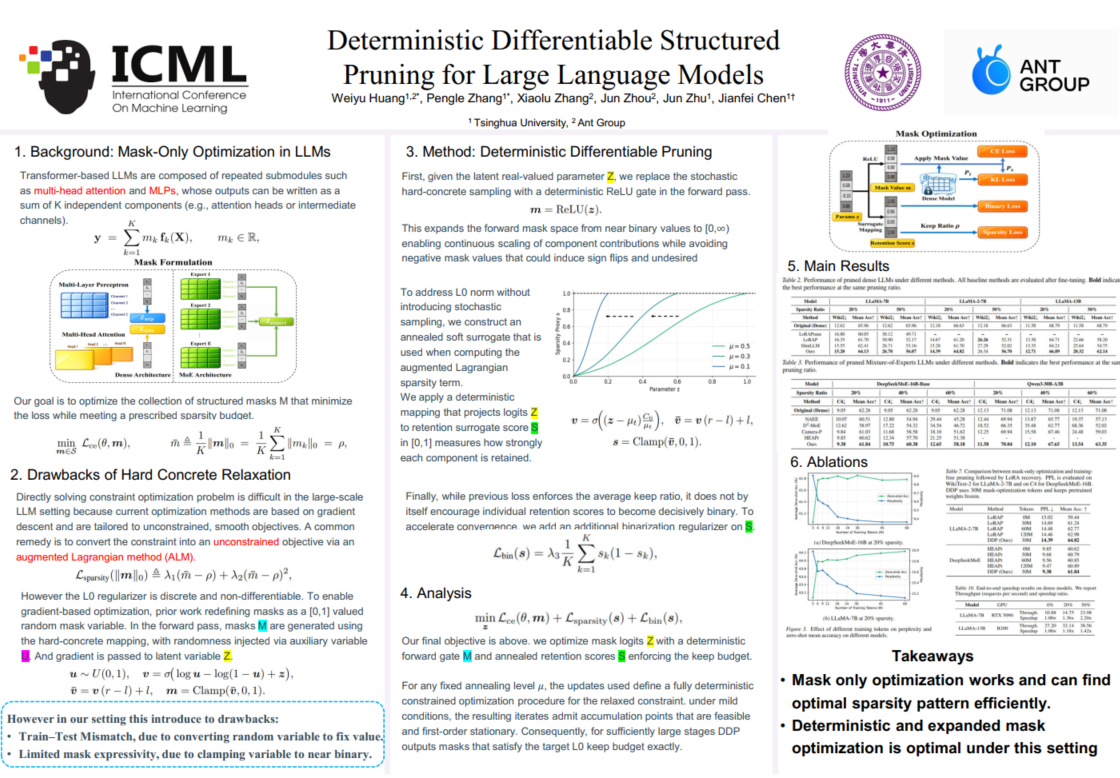
Structured pruning reduces LLM inference cost by removing low-importance architectural components. This can be viewed as learning a multiplicative gate for each component under an $\ell_0$ sparsity constraint. Due to the discreteness of the $\ell_0$ norm, prior work typically adopts stochastic hard-concrete relaxations to enable differentiable optimization; however, this stochasticity can introduce a train--test mismatch when sampled masks are discretized for deployment and restricting masks to a bounded, near-binary range. To address this, we propose Deterministic Differentiable Pruning (DDP), a mask-only optimization method that eliminates stochasticity by directly optimizing a deterministic soft surrogate of the discrete $\ell_0$ objective. Compared with prior approaches, DDP offers greater expressiveness, reduced train--test mismatch, and faster convergence. We apply our method to several dense and MoE models, including Qwen3-32B and Qwen3-30B-A3B, achieving a performance loss as small as 1\% on downstream tasks while outperforming previous methods at 20\% sparsity. We further demonstrate end-to-end inference speedups in realistic deployment settings with vLLM.
Lay Summary
This paper presents a way to make large language models smaller and faster without retraining all of their weights. Instead of guessing which parts of the model to remove, the method learns which parts are actually useful and which can be safely removed. This makes the compressed model more accurate than common pruning methods, especially when a large fraction of the model is removed. The approach is also efficient because it only adjusts small “control switches” rather than the full model. Experiments show that the resulting models keep most of their original performance while running faster in practical serving settings.
Video
Chat is not available.
Successful Page Load