
Learning Global Representation from Queries for Vectorized HD Map Construction
Abstract
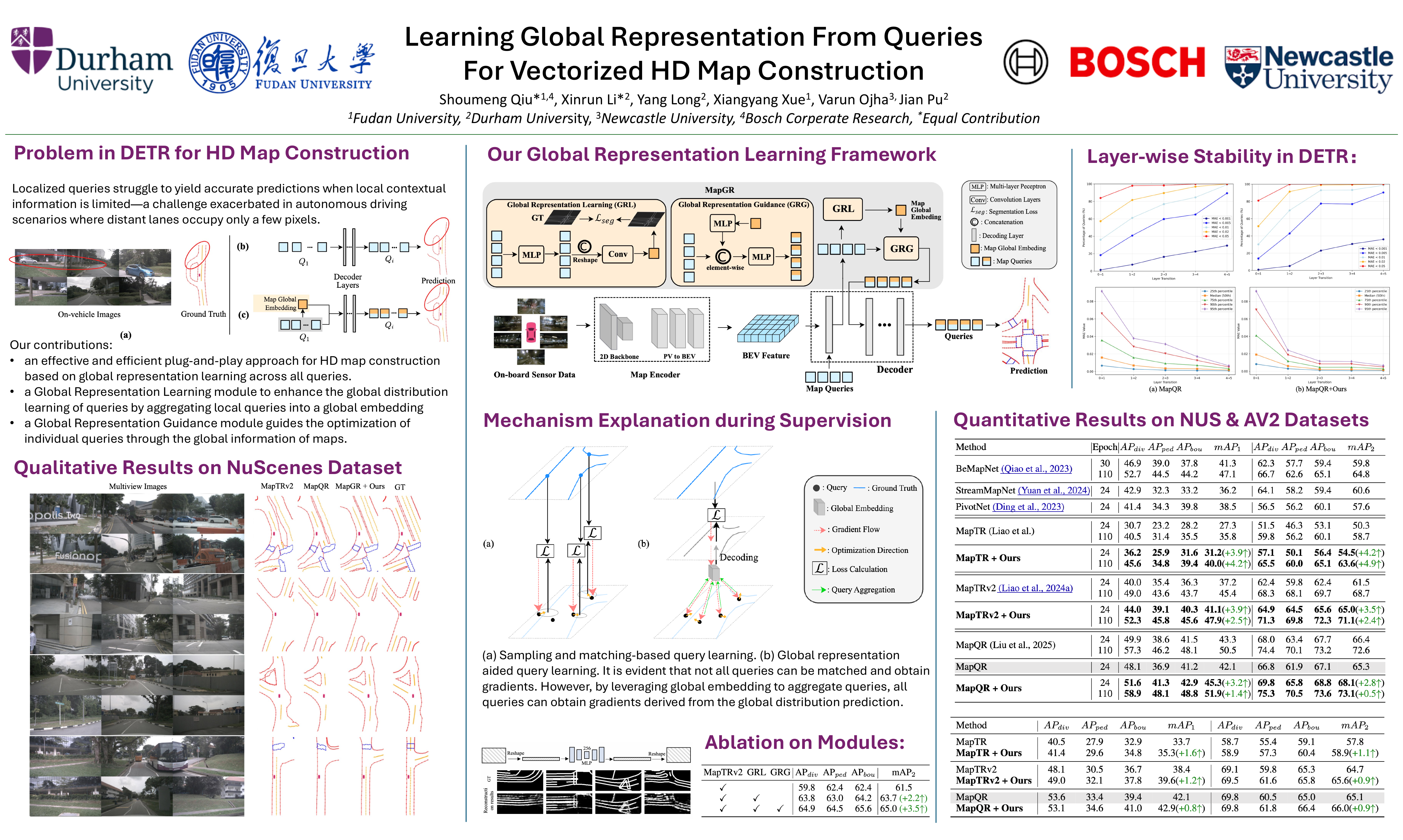
The online construction of vectorized high-definition (HD) maps is a cornerstone of modern autonomous driving systems. State-of-the-art approaches, particularly those based on the DETR framework, formulate this as an instance detection problem. However, their reliance on independent, learnable object queries results in a predominantly local query perspective, neglecting the inherent global representation within HD maps. In this work, we propose \textbf{MapGR} (\textbf{G}lobal \textbf{R}epresentation learning for HD \textbf{Map} construction), an architecture designed to learn and utilize global representations from queries. Our method introduces two synergistic modules: a Global Representation Learning (GRL) module, which encourages the distribution of all queries to better align with the global map through a carefully designed holistic segmentation task, and a Global Representation Guidance (GRG) module, which endows each individual query with explicit, global-level contextual information to facilitate its optimization. Evaluations on the nuScenes and Argoverse2 datasets validate the efficacy of our approach, demonstrating substantial improvements in mean Average Precision (mAP) compared to leading baselines. Code is available at \href{https://github.com/skyshoumeng/MapGR}{\texttt{github.com/skyshoumeng/MapGR}}.
Lay Summary
High-definition (HD) maps are essential digital roadmaps that help self-driving cars understand their surroundings accurately and safely. Constructing these maps quickly and reliably while the car is driving (online map construction) remains a major challenge in autonomous driving. Current state-of-the-art methods treat map construction as an object detection task. They use many independent “queries” (like virtual detectors) to find map elements such as lanes and boundaries. However, because these queries work mostly independently, they lack a global understanding of the overall map structure, limiting their performance. To address this, we propose MapGR (Global Representation Learning for HD Map Construction). Instead of letting each query work in isolation, MapGR teaches the system to develop and use a global understanding of the entire map. Our approach introduces two key components: A Global Representation Learning module that encourages all queries to collectively capture the big-picture structure of the map. A Global Representation Guidance module that provides each individual query with rich global context, helping it make better decisions. Experiments on the nuScenes and Argoverse 2 benchmarks show that MapGR significantly outperforms previous leading methods, achieving substantial improvements in map construction accuracy.