
Controllable and Explainable Personality Sliders for LLMs at Inference Time
Abstract
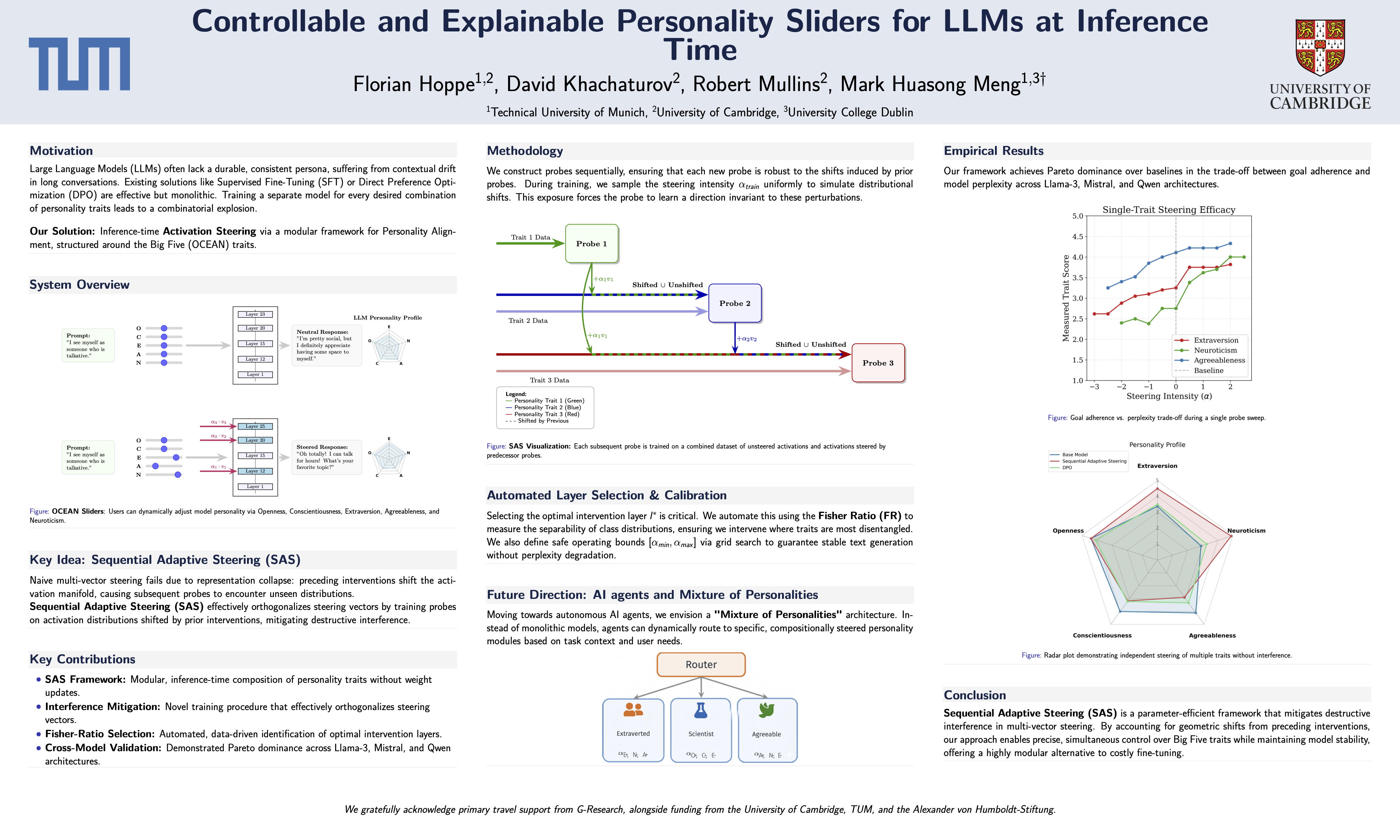
Aligning Large Language Models (LLMs) with specific personas typically relies on Supervised Fine-Tuning (SFT) or Reinforcement Learning from Human Feedback (RLHF); however, these methods are resource-intensive, requiring expensive data collection and distinct model training for each target personality. In this work, we propose a parameter-efficient framework for continuous, multi-dimensional personality control via inference-time activation steering. Our approach addresses the challenge of combining multiple interventions by iteratively retraining probes on the residual stream modified by prior traits, ensuring compatibility. Once established, these steering vectors function as modular, reusable primitives; users can instantly synthesize novel, complex personality profiles by simply adjusting steering coefficients (α) without any additional training. To support this, we introduce an automated pipeline that identifies optimal intervention layers via activation separation analysis and calibrates coefficients via hyperparameter optimization to maximize alignment while constraining perplexity. Empirical evaluations validate individual trait shifts using an LLM-as-a-judge framework and demonstrate, via the Big Five inventory, that our method effectively modulates the model's holistic personality profile without updating base model parameters.
Lay Summary
AI chatbots are increasingly taking on roles that require distinct personalities, like empathetic therapists or engaging tutors. However, teaching an AI a new personality traditionally requires expensive retraining for every possible combination of traits, which is computationally prohibitive. We developed a method called Sequential Adaptive Steering that acts like a mixing board for AI personalities. Instead of retraining the entire model, our technique gently nudges the AI's internal processes as it generates text. This allows users to dial up or down specific traits, like extraversion or agreeableness, in real-time without them interfering with each other. This allows anyone to instantly create customized, high-quality AI personas without the massive costs of retraining. It makes specialized AI tools much more accessible and controllable, ensuring they can safely and effectively adapt to diverse human needs.