
GenDA: Generative Data Assimilation on Complex Urban Areas via Classifier-Free Diffusion Guidance
Abstract
Lay Summary
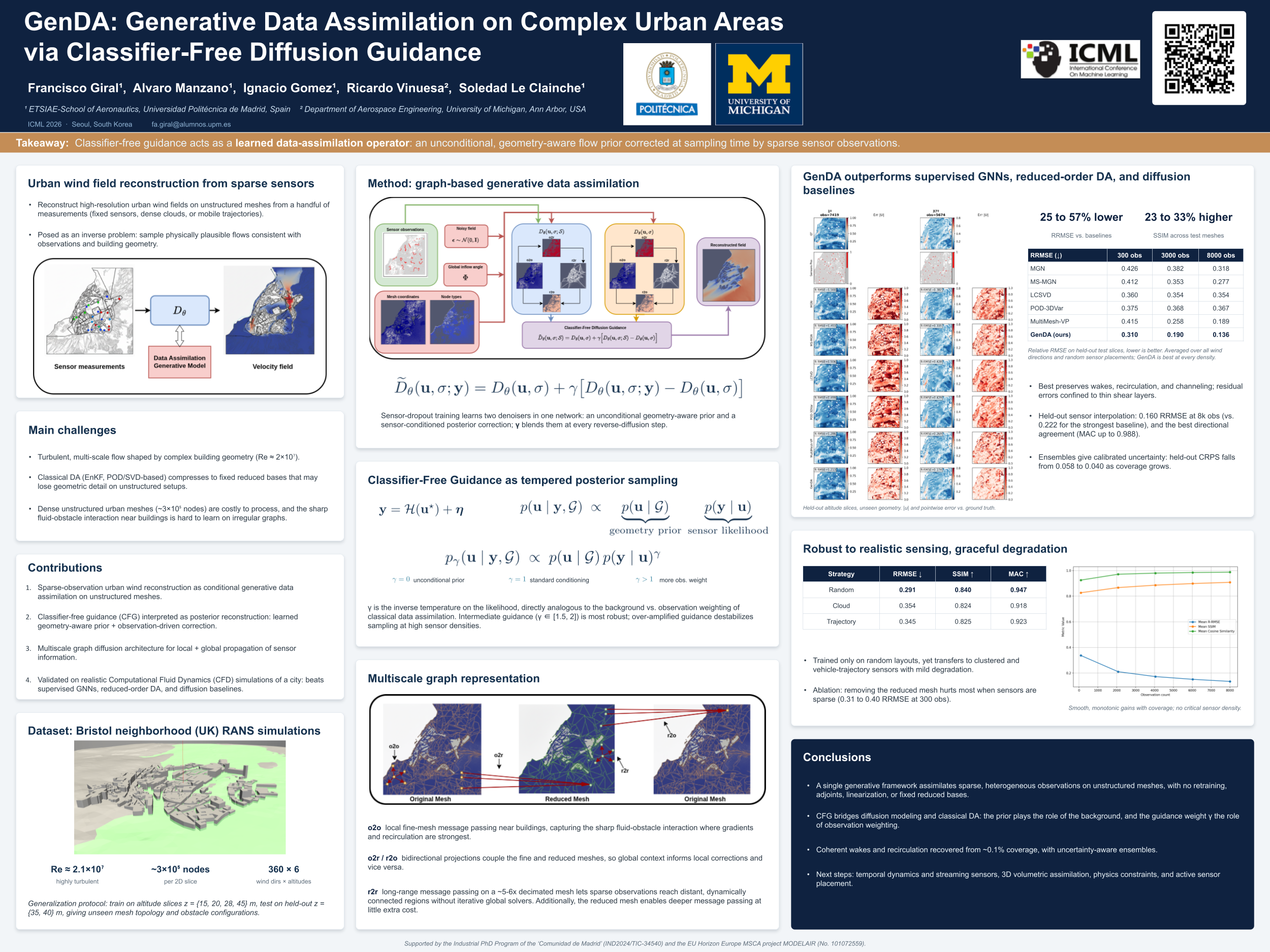
Urban wind patterns affect air quality, heat exposure, pollutant dispersion, and pedestrian comfort, but measuring the full wind field across a city is difficult because sensors are sparse and detailed simulations are expensive. This paper introduces GenDA, a machine-learning method that reconstructs detailed urban wind fields from limited sensor measurements on complex city geometries. GenDA uses a generative diffusion model on unstructured meshes, allowing it to produce physically plausible wind reconstructions that are consistent with the available observations. In experiments on simulated wind flow over a real urban neighborhood, GenDA outperforms graph neural networks, reduced-order data assimilation methods, and other diffusion-based baselines, especially when very few sensors are available. This approach could support future environmental monitoring and urban-planning tools by making high-resolution wind reconstruction more practical from limited measurements.