
MuCO: Generative Peptide Cyclization Empowered by Multi-stage Conformation Optimization
Abstract
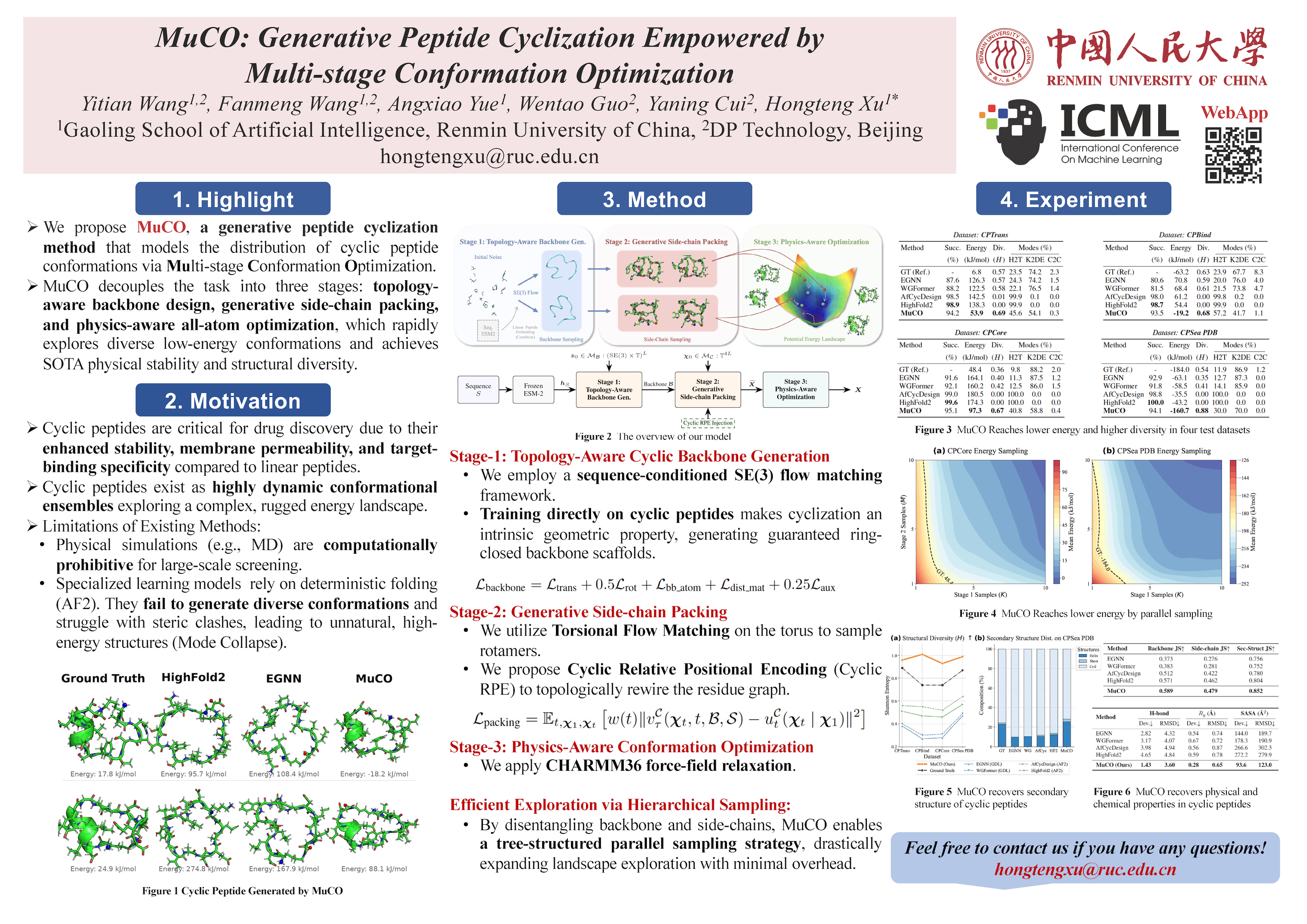
Modeling peptide cyclization is critical for the virtual screening of candidate peptides with desirable physical and pharmaceutical properties. This task is challenging because a cyclic peptide often exhibits diverse, ring-shaped conformations, which cannot be well captured by deterministic prediction models derived from linear peptide folding. In this study, we propose MuCO (Multi-stage Conformation Optimization), a generative peptide cyclization method that models the distribution of cyclic peptide conformations conditioned on the corresponding linear peptide. In principle, MuCO decouples the peptide cyclization task into three stages: topology-aware backbone design, generative side-chain packing, and physics-aware all-atom optimization, thereby generating and optimizing conformations of cyclic peptides in a coarse-to-fine manner. This multi-stage framework enables an efficient parallel sampling strategy for conformation generation and allows for rapid exploration of diverse, low-energy conformations. Experiments on the large-scale CPSea dataset demonstrate that MuCO significantly and consistently outperforms state-of-the-art methods in physical stability, structural diversity, secondary structure recovery, and computational efficiency, making it a promising computational tool for exploring and designing cyclic peptides. The demo of the proposed method can be found at https://github.com/mianqiu00/MuCO.
Lay Summary
Cyclic peptides are ring-shaped molecules with immense potential for creating new medicines, but predicting their exact 3D shapes is difficult due to their complex flexibility. In this paper, we introduce MuCO, an AI-powered tool that accurately generates realistic and diverse 3D structures of these molecules by breaking the prediction process into three steps. Unlike previous methods that often produce physically impossible shapes or fail to capture the full range of molecular folding, our approach combines generative AI with physics-based rules to ensure the predicted structures are both stable and biologically meaningful. By providing a fast and reliable way to explore how these complex molecules fold, MuCO can promote the discovery and design of highly effective new drugs.