
FedUSD: Unbiased Synthetic Data for Federated Learning
Abstract
Lay Summary
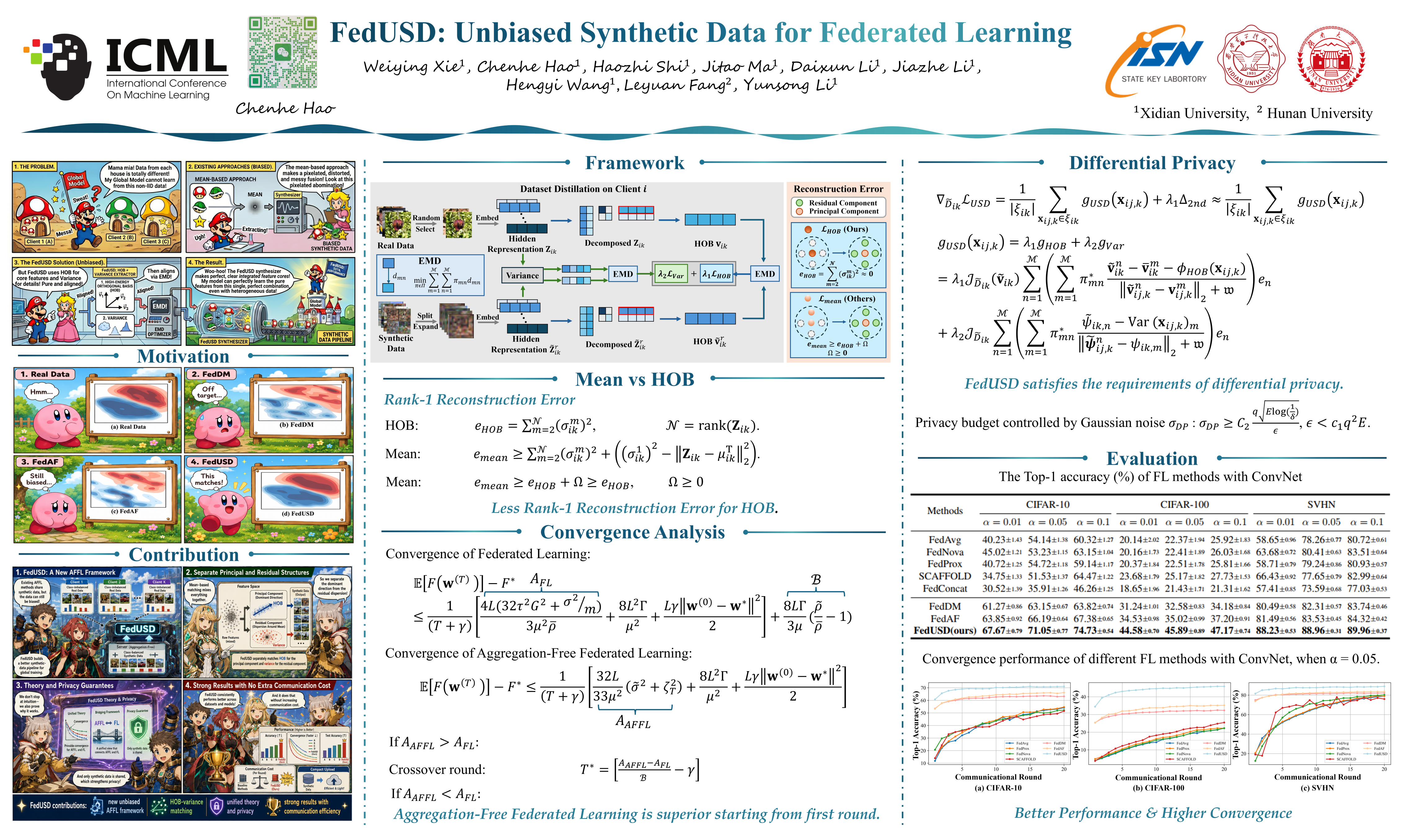
Many organizations and devices collect useful data, but they often cannot share it directly because of privacy, ownership, or communication concerns. Federated learning is a way to train a shared AI model while keeping the original data on each client. However, many federated learning methods still require clients to send model updates, and they may work poorly when different clients have very different data. A newer approach is to let each client create a small set of artificial examples and send only these examples to the server. The server then uses them to train the shared model. The main difficulty is that these artificial examples must accurately represent the original data. If they miss important patterns or fail to preserve natural variation, the final model can become biased and less accurate. In this paper, we propose FedUSD, a method for creating better artificial data in this setting. FedUSD separately preserves the main patterns of the data and the remaining variations among samples. In this way, the artificial data can better reflect the real data from different clients. Our experiments show that FedUSD improves the accuracy of the final shared model compared with existing methods under the same communication cost. The improvement is especially clear when clients have very different data distributions.