
On the Identifiability of Poisson Branching Structural Causal Model Under Latent Confounding
Abstract
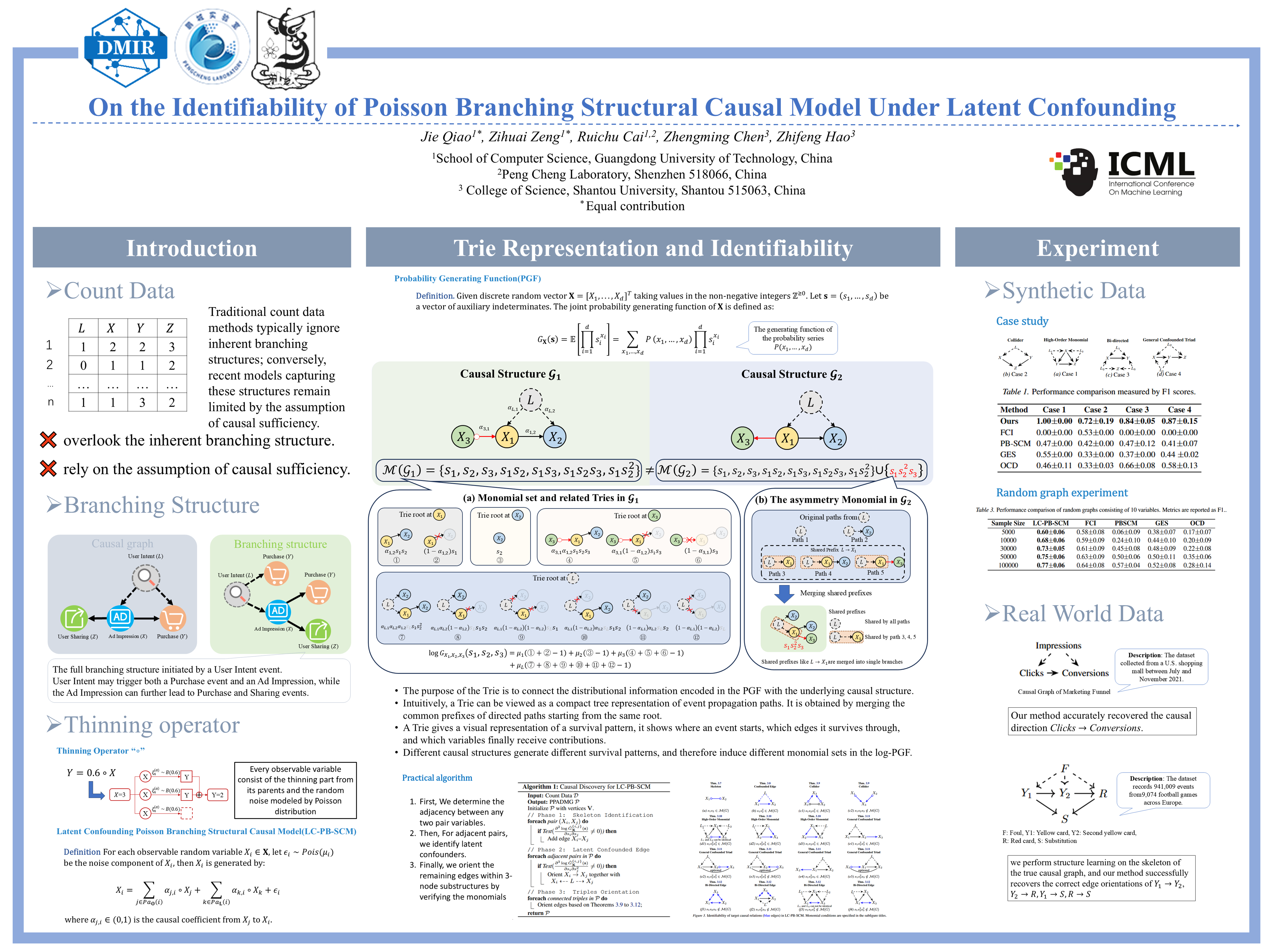
Causal discovery from observational count data poses unique challenges, particularly when the data exhibit inherent branching structures, e.g., an upstream event (e.g., an ad impression) triggers a downstream event (e.g., a purchase) with a certain probability. Such branching dynamics are naturally captured by thinning operators (for the branching structure) and an independent Poisson distribution (for exogenous noise), constituting the Poisson Branching Structural Causal Model (PB-SCM). However, existing approaches based on PB-SCM rely on the restrictive assumption of causal sufficiency, failing to account for ubiquitous latent confounders that can bias estimation. In this work, we propose the Latent Confounding Poisson Branching Structural Causal Model (LC-PB-SCM) to bridge this gap. We leverage Probability Generating Functions (PGFs) to characterize the complex dependencies introduced by latent confounding. Then, we establish a Trie representation theorem that maps the branching causal mechanisms to the algebraic properties of PGF monomials. Based on local PGFs, we establish a complete identifiability condition for local 3-variables that covers all causal patterns distinguishable up to monomial equivalence. Finally, we propose a practical algorithm to learn causal structures under latent confounding and demonstrate its effectiveness through experiments on both synthetic and real-world datasets.