
What Really Improves Mathematical Reasoning: Structured Reasoning Signals Beyond Pure Code
Abstract
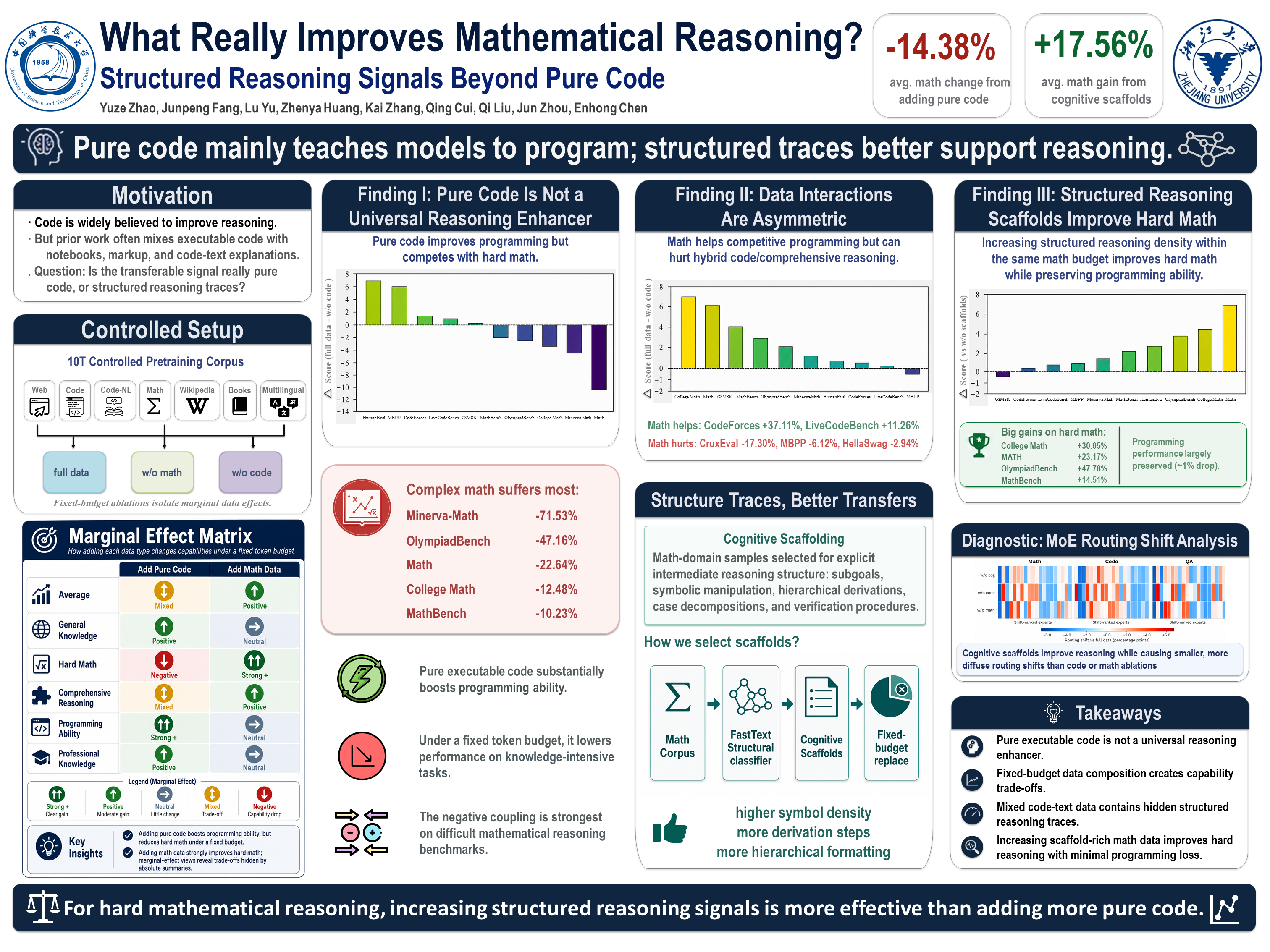
Incorporating code into training corpora has become a widely acknowledged practice in the development of modern foundation language models (LMs). Compared with a general Internet corpus, code offers high-quality, well-structured signals that substantially augment the coding proficiency of models. Beyond programming skills, prior research has suggested that code data may also contribute to non-coding capabilities. Nevertheless, through a series of rigorous controlled experiments, we demonstrate that the influence of code on other domains, particularly reasoning, remains limited. Our principal findings are as follows: (1) Code corpus yields substantial gains in programming-related abilities but only competed with knowledge-intensive tasks. (2) We identify a core subset that functions as cognitive scaffolding for mathematical reasoning, especially for complex problem-solving scenarios. (3) Formal reasoning provides more pronounced improvements in challenging mathematical reasoning tasks, while natural language–based reasoning proves more effective for simpler reasoning problems. Finally, by probing the internal mechanisms of LMs, we reveal how training data modulates routing patterns, thereby shaping emergent model behavior. As a central driver of model capability, our findings disentangle domain-specific data into finer-grained, cross-domain ability dimensions and underscore promising directions for future data optimization.
Lay Summary
Many AI language models are trained on large amounts of computer code, and researchers often assume that code helps them reason better. We asked whether code itself is responsible for this improvement, or whether the benefit comes from training examples that combine code-like structure with explanations and mathematics. To test this, we built a large training collection in which standalone code, code mixed with natural language, mathematics, and general text were carefully separated. We then trained models under controlled data settings and compared how well they performed on programming, math, knowledge, and reasoning tasks. We found that standalone executable code clearly helps models write programs, but it does not by itself improve difficult mathematical reasoning; under the same training budget, it can even compete with math and knowledge-heavy tasks. The strongest gains came from structured math examples that make the reasoning process visible, such as step-by-step derivations and organized problem solving. Adding more of these examples improved challenging math performance while largely preserving programming ability. These findings suggest that better AI training data should be designed around the reasoning patterns it contains, not just broad labels such as “code” or “math.”