
iLoRA: Bayesian Low-Rank Adaptation with Latent Interaction Graphs for Microbiome Diagnosis
Abstract
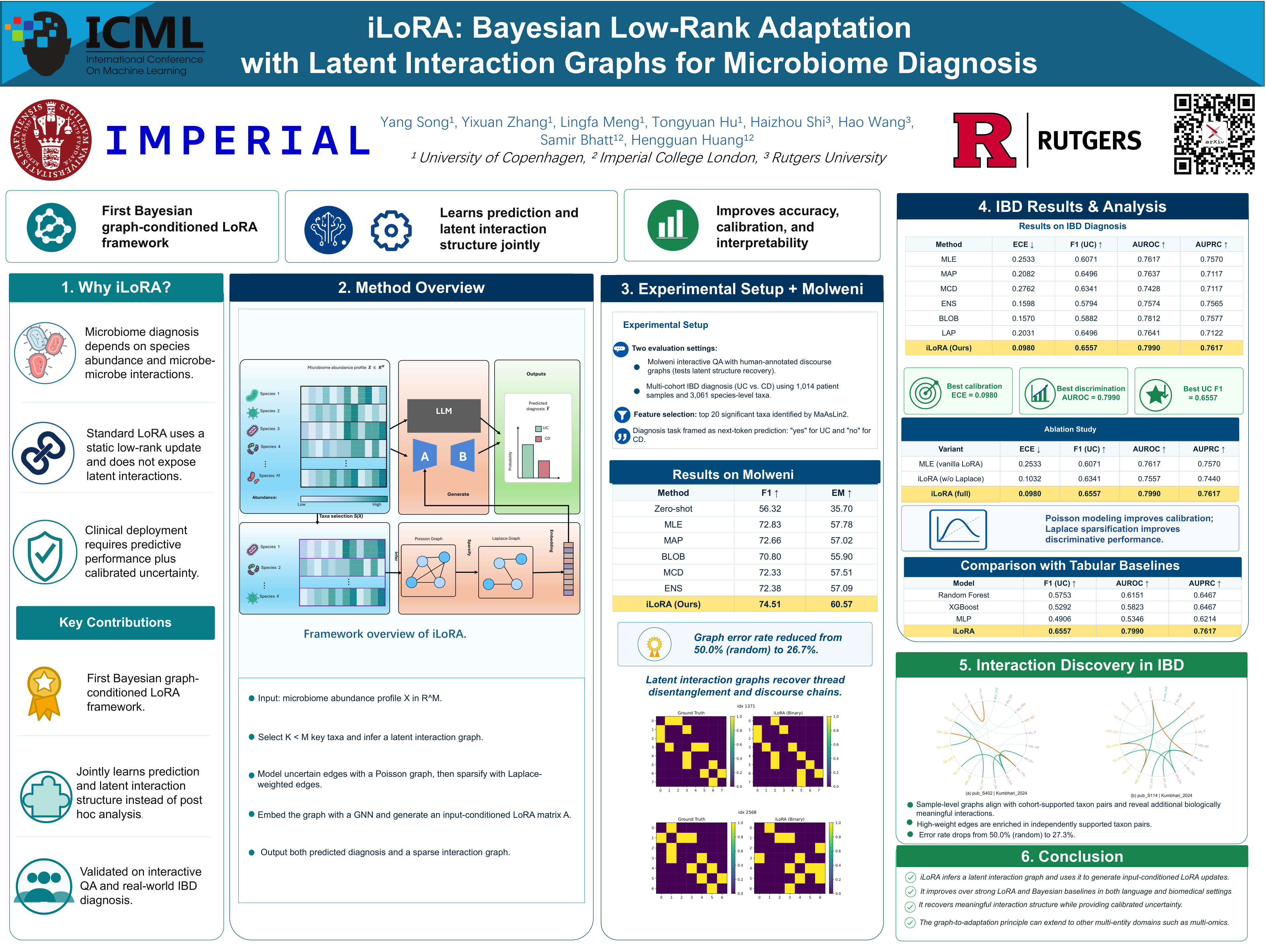
Parameter-efficient adaptation has made LLMs practical for domain prediction, but standard LoRA still relies on a static low-rank update and does not expose the latent interactions that often drive scientific labels. We introduce iLoRA. To our knowledge, it is the first Bayesian graph-conditioned LoRA framework. It infers a latent interaction graph from the input and uses it to generate input-conditioned LoRA updates. As a result, iLoRA learns prediction and latent interaction structure jointly, rather than training a predictor and applying interaction analysis only post hoc. We instantiate this idea for microbiome diagnosis, where disease state can depend on both species-level abundance and microbe–microbe cross-talk, and evaluate it in two complementary settings: interactive QA with human-annotated graphs, which tests latent structure recovery, and multi-cohort IBD diagnosis, which tests biomedical utility. Across both settings, iLoRA improves over strong LoRA and Bayesian adaptation baselines, recovers graphs aligned with human annotations and cohort-level microbiome associations, and provides calibrated uncertainty with moderate graph-branch overhead.
Lay Summary
Many health conditions, including inflammatory bowel disease (IBD), are linked to the gut microbiome—the community of microbes living in our digestive system. But these microbes do not act alone: like people in a conversation, they influence one another, and these interactions can be important for diagnosis. Today’s AI models can be adapted to medical data efficiently, but they often make predictions without showing which hidden relationships in the data helped them decide. We introduce iLoRA, a method that lets a large language model adapt itself differently for each patient sample by first estimating a small graph of likely microbe–microbe interactions. The model treats this graph as uncertain, keeps only the most useful connections, and uses it to guide the prediction rather than adding explanations afterward. We tested the same idea on dialogue data, where the true relationships between utterances are known, and on multi-cohort microbiome data for distinguishing ulcerative colitis from Crohn’s disease. iLoRA improved prediction performance, produced better-calibrated confidence, and recovered relationships that aligned with human annotations or known microbiome associations. This suggests a path toward AI systems that are not only more accurate, but also better at showing the interaction patterns behind their decisions.