
RECTOR: Masked Region-Channel-Temporal Modeling for Affective and Cognitive Representation Learning
Abstract
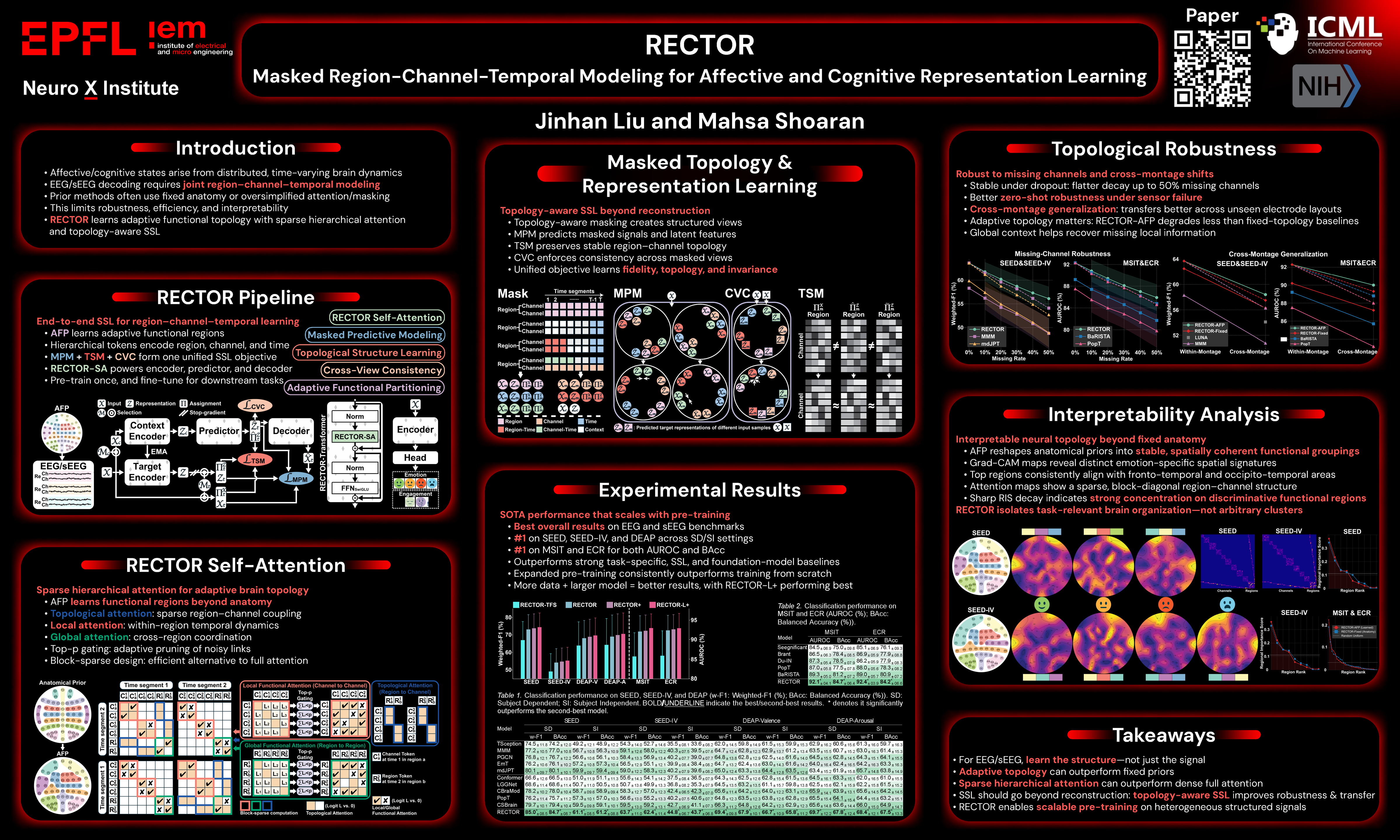
Affective and cognitive disorders manifest as distributed, time-varying brain network dynamics across regions, channels, and time, challenging robust representation learning from EEG/sEEG for clinical diagnosis. We propose RECTOR (Masked Region–Channel–Temporal Modeling), an end-to-end self-supervised framework that unifies joint region-channel-temporal representation learning beyond fixed anatomical priors. At its core, RECTOR-SA is a hierarchical, block-sparse self-attention induced by Adaptive Functional Partitioning that evolves region structures from static anatomical definitions to adaptive functional regions. The self-supervision is driven by Masked Topology and Representation Learning, which jointly optimizes three complementary objectives: Masked Predictive Modeling, Topological Structure Modeling, and Cross-View Consistency. Across diverse benchmarks, RECTOR sets a new state-of-the-art in EEG emotion recognition and sEEG task-engagement classification. Crucially, its strong robustness to missing channels and cross-montage generalization underscores its potential for large-scale pre-training on heterogeneous EEG/sEEG, providing interpretable insights at both region and channel levels.
Lay Summary
Mental health and cognitive disorders are still often assessed using interviews and behavior, which can be subjective and may delay diagnosis. Brain recordings such as EEG and sEEG could provide more objective markers, but these signals are complex because brain activity changes across time, recording channels, and brain regions. Many existing AI models either use fixed anatomical groupings or treat all channels too uniformly, which can make them brittle when sensors are missing or when electrode layouts change. We developed RECTOR, a self-supervised learning method that learns from raw brain recordings without needing many labels. Instead of relying on fixed brain regions, RECTOR learns adaptive functional groupings of electrodes and uses them to focus on the most informative interactions across regions, channels, and time. It also trains itself with several complementary learning objectives so that the resulting representations are robust and informative. Across multiple EEG and sEEG benchmarks, RECTOR achieved state-of-the-art performance. It also remained more reliable under missing channels and cross-montage transfer, suggesting stronger potential for real-world clinical use and large-scale pre-training on heterogeneous neurophysiological data.