
Controlled SDEs for Long-Horizon Motion Generation under Latent Decision Uncertainty
Abstract
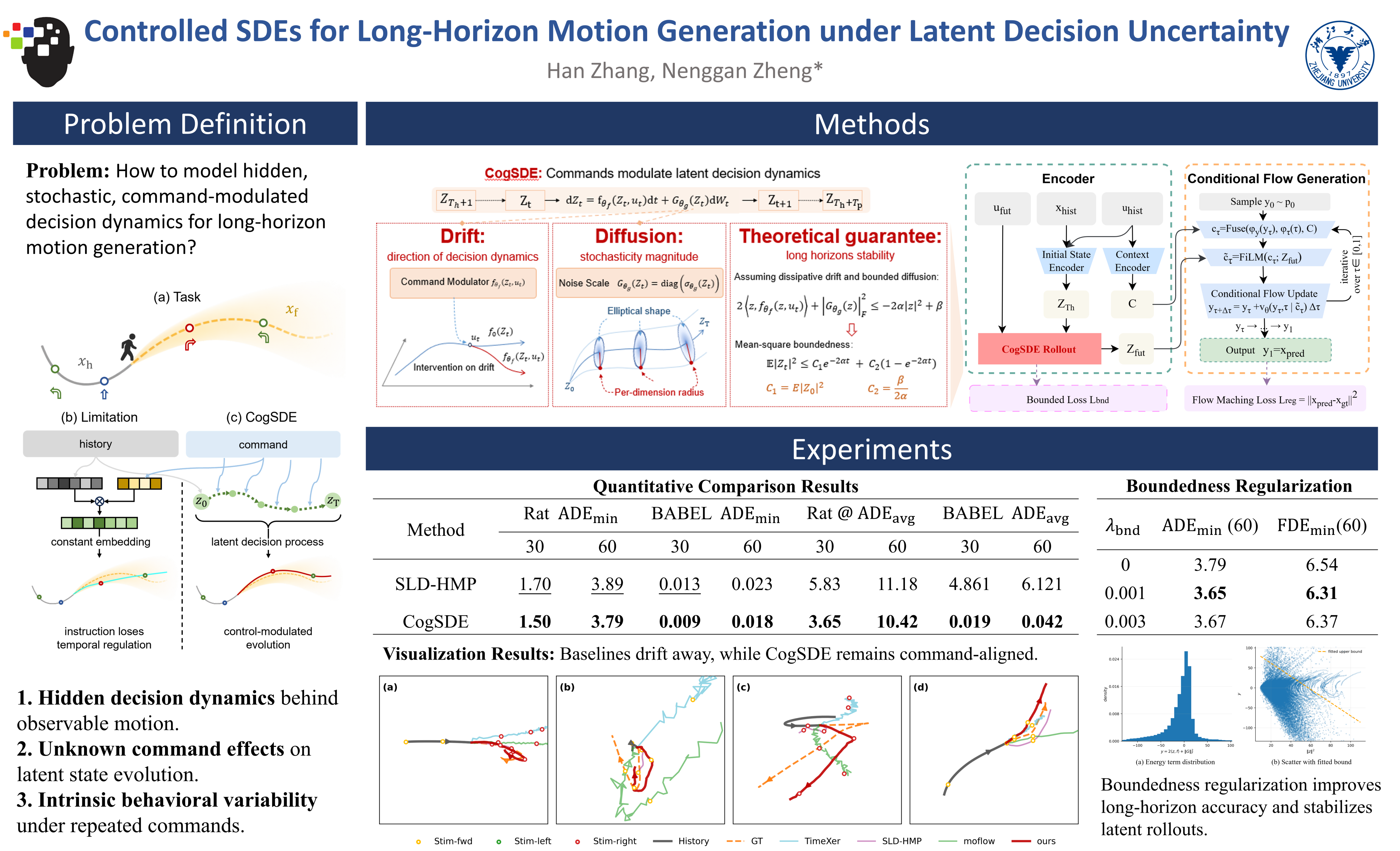
Long-horizon motion prediction under external commands is challenged by latent decision uncertainty, where the internal states governing future behavior are unobservable and evolve stochastically over time. This issue is particularly pronounced in biological agents, whose motion trajectories reflect decision-making processes rooted in underlying cognitive states. To address these challenges, we propose CogSDE, a formulation of a controlled stochastic differential equation (SDE) for modeling instruction-driven latent decision dynamics. The drift term in the SDE incorporates a dual-channel control modulation mechanism, enabling external commands to modulate the evolution of latent states. The diffusion term employs a state-dependent operator to model intrinsic uncertainty in latent decision dynamics. Furthermore, we establish dissipativity-based mean-square boundedness for the latent decision dynamics. Experiments demonstrate that CogSDE consistently improves predictive accuracy in long-horizon motion generation. Importantly, predicted trajectories remain well aligned with control commands over extended horizons, a property widely recognized as challenging in long-horizon motion prediction.
Lay Summary
Predicting how an animal or other moving agent will behave far into the future is difficult, especially when it receives external instructions. The same instruction may lead to different actions because the agent’s internal decision process cannot be directly observed and may change over time. This paper proposes CogSDE, a method for predicting future movement by modeling these hidden decision changes under instructions. Instead of assuming that future motion follows a fixed pattern, CogSDE allows the predicted internal state to evolve gradually and uncertainly, while still being guided by the given commands. It also includes a mechanism to prevent the hidden state from becoming unstable during long predictions. Experiments show that CogSDE produces more accurate long-term motion predictions than existing methods. More importantly, the predicted trajectories remain consistent with the intended commands over longer time periods, which is a major challenge in instruction-driven motion prediction.