
Harnessing Non-Adversarial Robustness in Large Language Models
Abstract
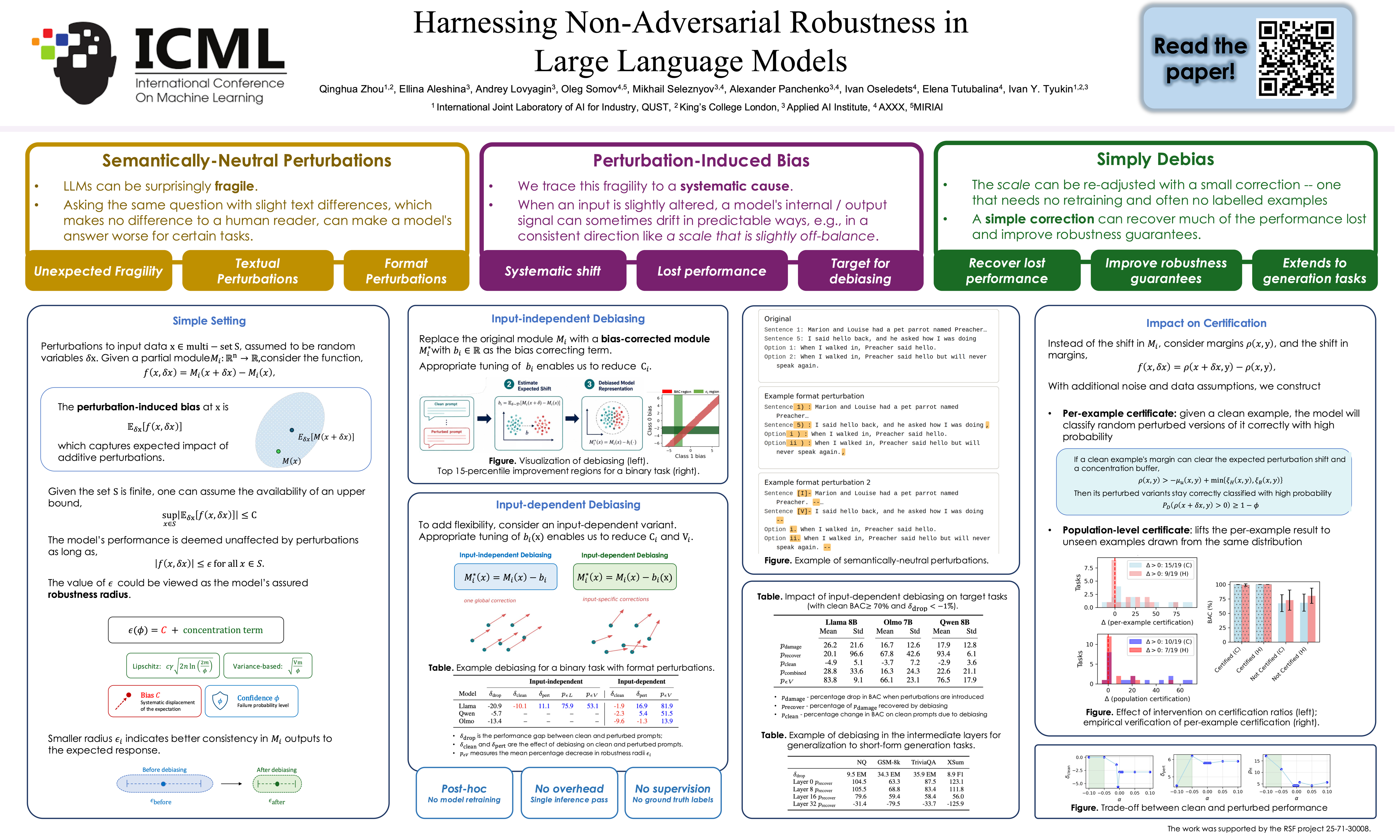
The work presents an approach for addressing the challenge of robustness in Large Language Models (LLMs) to alterations and potential errors caused by semantically similar but textually different prompts. Recent works have shown that these kinds of prompt variations can significantly impact the performance of LLMs on tasks. The central question is: can LLMs' robustness to semantically-neutral prompt alterations be acquired without expensive retraining of the entire model? We address this question both theoretically and through experiments. Our theoretical analysis reveals a crucial factor impacting model robustness -- a systematic expected shift or perturbation-induced bias in neural network module outputs. Motivated by this analysis, we show that robustness can be achieved via a simple fine-tuning process: debiasing for robustness. We identify conditions when debiasing helps and when it does not, and demonstrate, through both theory and extensive experiments, that debiasing for robustness may indeed be a quick and efficient tool to enhance robustness and provide certification against random prompt perturbations.