
$\mathbb{R}^{2k}$ is Theoretically Large Enough for Embedding-based Top-$k$ Retrieval
Zihao Wang ⋅ Hang Yin ⋅ Lihui Liu ⋅ Hanghang Tong ⋅ Yangqiu Song ⋅ Ginny Wong ⋅ Simon See
Abstract
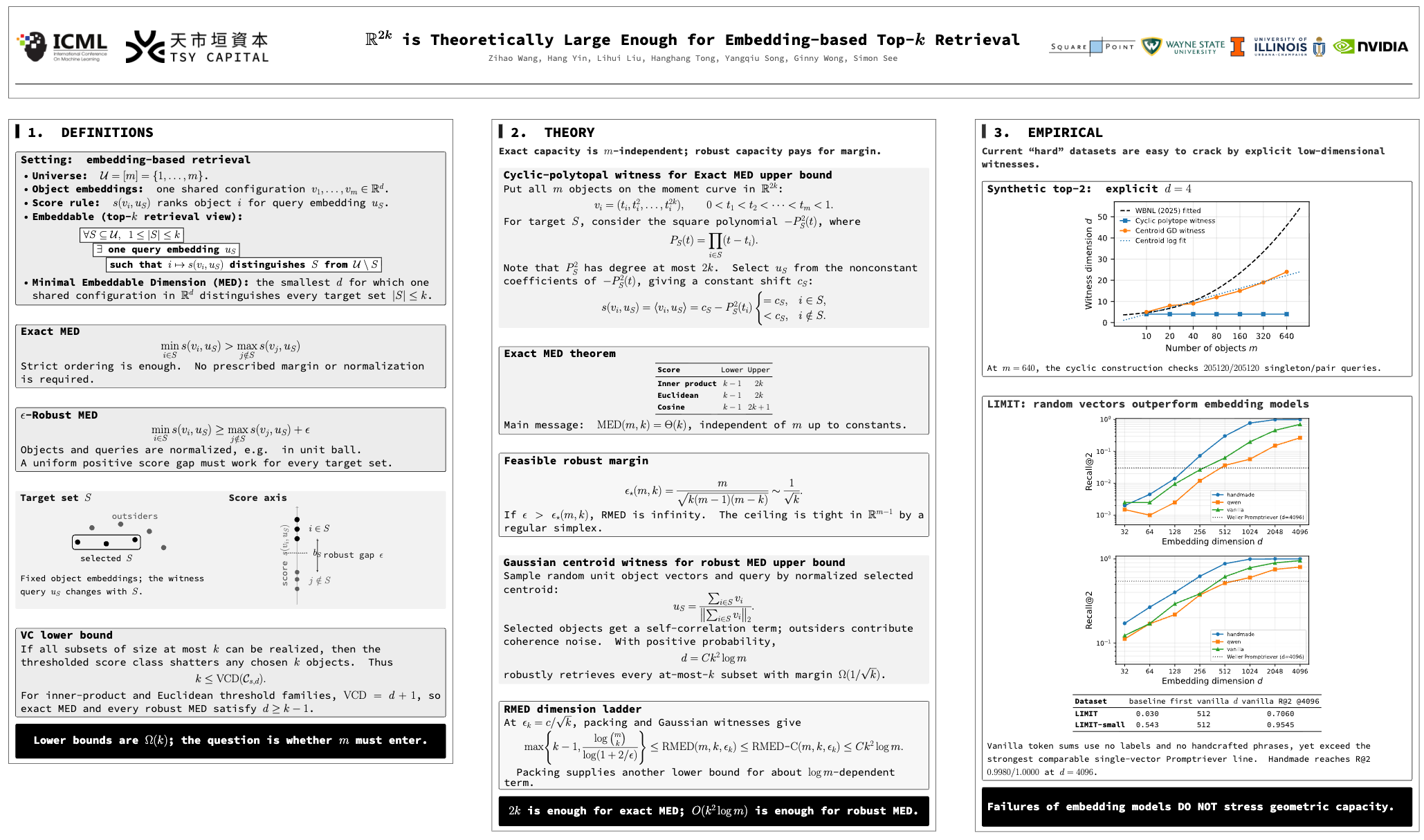
This paper studies the Minimal Embeddable Dimension (MED): the least dimension in which there exists a configuration of $m$ object vectors so that every subset of size at most $k$ is exactly retrieved by score comparison. Our result shows MED is $\Theta(k)$, independent of $m$, for inner product, Euclidean distance, and cosine similarity. We then consider Robust MED (RMED), where all vectors are unit normed and an $\epsilon$ gap of scores is required. We derive the $m$-dependent feasibility ceiling $\epsilon_\star(m,k)=m/\sqrt{k(m-1)(m-k)}$, which approaches $1/\sqrt{k}$ when $m\gg k$, and a Gaussian centroid construction gives a robust witness upper bound in the feasible margin regime. Numerical simulation on synthetic top-$2$ retrieval with cyclic polytope and centroid query optimization confirmed our theoretical claims. Experiments on LIMIT and LIMIT-small datasets also show that simple embedding-based retrieval baselines can overfit and outperform the reported single-vector LLM embedding baseline. Both theoretical and empirical findings rule out the lack of exact geometric capacity as the obstruction.
Lay Summary
We show that vector spaces are large enough for retrieval empirically and theoretically.
Video
Chat is not available.
Successful Page Load