
From Statics to Dynamics: Physics-Aware Image Editing with Latent Transition Priors
Abstract
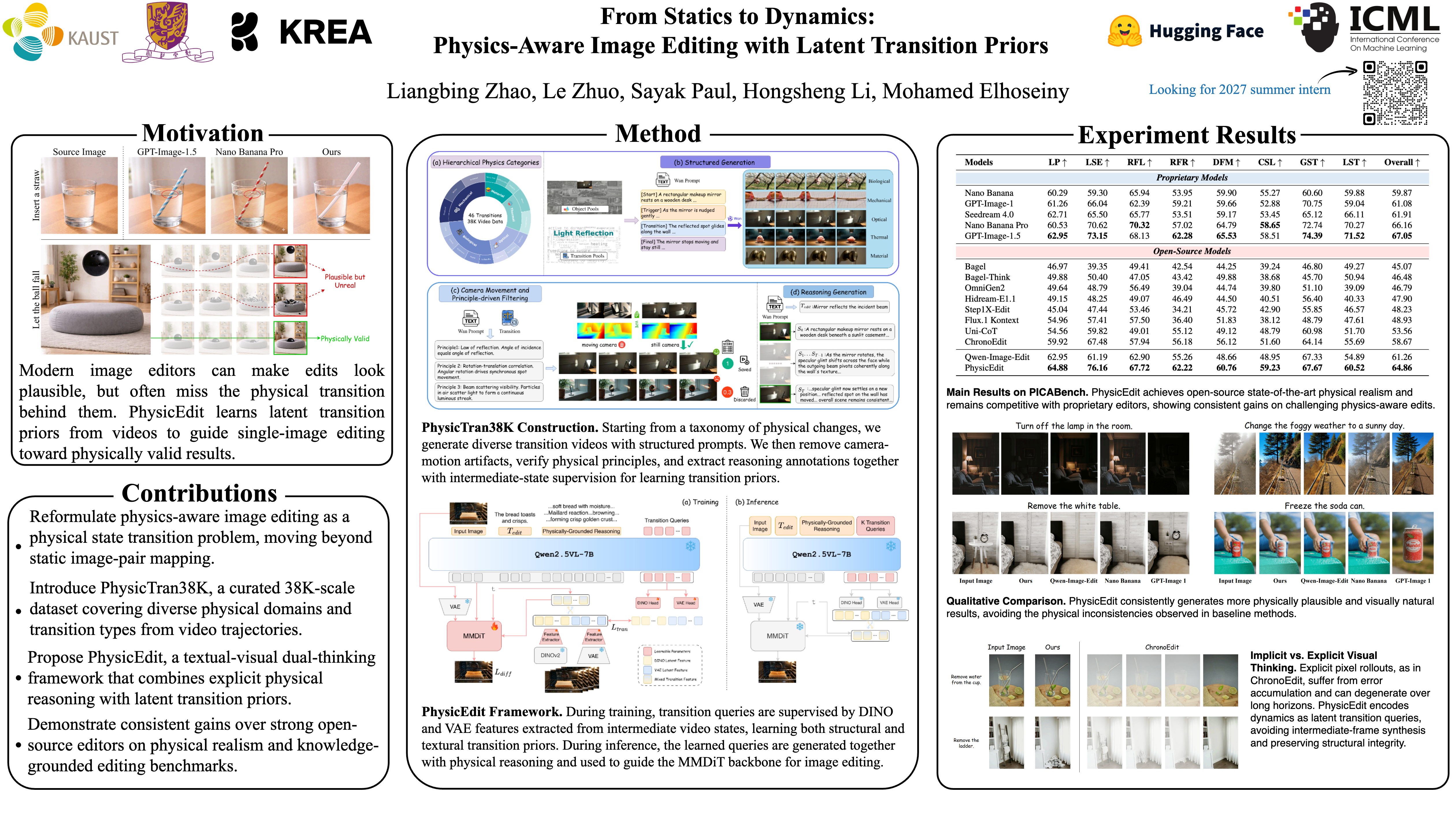
Instruction-based image editing has achieved remarkable success in semantic alignment, yet state-of-the-art models frequently fail to render physically plausible results when editing involves complex causal dynamics, such as refraction or material deformation. We attribute this limitation to the dominant paradigm that treats editing as a discrete mapping between image pairs, which provides only boundary conditions and leaves transition dynamics underspecified. To address this, we reformulate physics-aware editing as predictive physical state transitions and introduce PhysicTran38K, a large-scale video-based dataset comprising 38K transition trajectories across five physical domains, constructed via a two-stage filtering and constraint-aware annotation pipeline. Building on this supervision, we propose PhysicEdit, an end-to-end framework equipped with a textual-visual dual-thinking mechanism. It combines a frozen Qwen2.5-VL for physically grounded reasoning with learnable transition queries that provide timestep-adaptive visual guidance to a diffusion backbone. Experiments show that PhysicEdit improves over Qwen-Image-Edit by 5.9\% in physical realism and 10.1\% in knowledge-grounded editing, setting a new state-of-the-art for open-source methods, while remaining competitive with leading proprietary models.
Lay Summary
Image editing systems can now follow many written instructions, but they often produce unrealistic results when an edit depends on physical cause and effect, such as bending an object, changing light, or melting ice. This happens because most editing models learn mainly from before-and-after image pairs, which show the start and end states but not how the physical change should happen. We address this problem by treating image editing as a physical state transition rather than a simple image-to-image mapping. We build a large video-based dataset of physical changes across domains such as mechanics, optics, heat, biology, and materials, and use it to train PhysicEdit, an image editing model that learns both textual physical reasoning and visual transition cues. Our method helps the model better understand what should change, what should stay consistent, and what physical evidence should appear in the edited image. Experiments and human evaluations show that PhysicEdit produces more physically plausible edits than strong open-source baselines. This work aims to make image generation tools more reliable for real-world editing tasks where visual realism depends not only on appearance, but also on the laws of physical change.