
DiffStyle3D: Consistent 3D Gaussian Stylization via Attention Optimization
Abstract
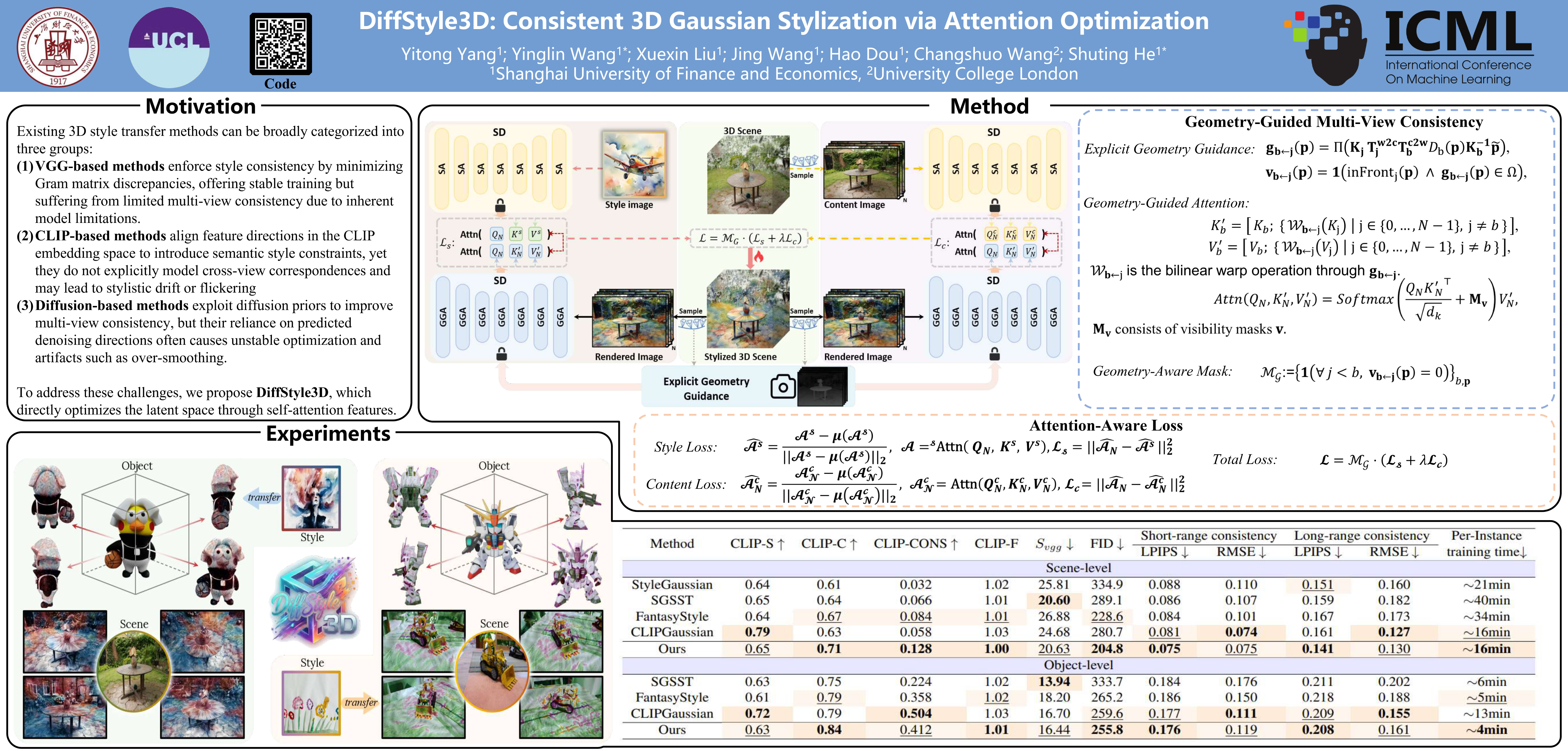
3D style transfer enables the creation of visually expressive 3D content, enriching the visual appearance of 3D scenes and objects. However, existing VGG- and CLIP-based methods struggle to model multi-view consistency within the model itself, while diffusion-based approaches can capture such consistency but rely on denoising directions, leading to unstable training. To address these limitations, we propose DiffStyle3D, a novel diffusion-based paradigm for 3DGS style transfer that directly optimizes in the latent space. Specifically, we introduce an Attention-Aware Loss that performs style transfer by aligning style features in the self-attention space, while preserving original content through content feature alignment. Inspired by the geometric invariance of 3D stylization, we propose a Geometry-Guided Multi-View Consistency method that integrates geometric information into self-attention to enable cross-view correspondence modeling. Based on geometric information, we additionally construct a geometry-aware mask to prevent redundant optimization in overlapping regions across views, which further improves multi-view consistency. Extensive experiments show that DiffStyle3D outperforms state-of-the-art methods, achieving higher stylization quality and visual realism. The code is available at \url{https://github.com/yangyt46/DiffStyle3D}.
Lay Summary
3D scenes are increasingly used in games, films, virtual reality, and digital design, but changing their artistic style is still difficult. A good 3D style transfer method should make a scene look like a chosen artwork while keeping the scene stable from every camera angle. Existing methods often either fail to keep this consistency across views or rely on unstable training procedures. We propose DiffStyle3D, a new method for stylizing 3D Gaussian Splatting scenes. Instead of repeatedly denoising images, our method directly adjusts the scene representation in a learned feature space. It uses attention information from a diffusion model to transfer artistic style while preserving the original scene structure. We also use the scene’s geometry to connect matching regions across different views, so the stylized result remains coherent when the camera moves. In addition, a geometry-aware mask avoids repeatedly optimizing overlapping regions, further improving consistency. Our work makes 3D style transfer more stable, realistic, and visually expressive, helping creators turn ordinary 3D scenes into stylized assets with less manual effort.