
VisualScore: Learning Holistic Visual Quality Scores via Multi-Task Reasoning
Abstract
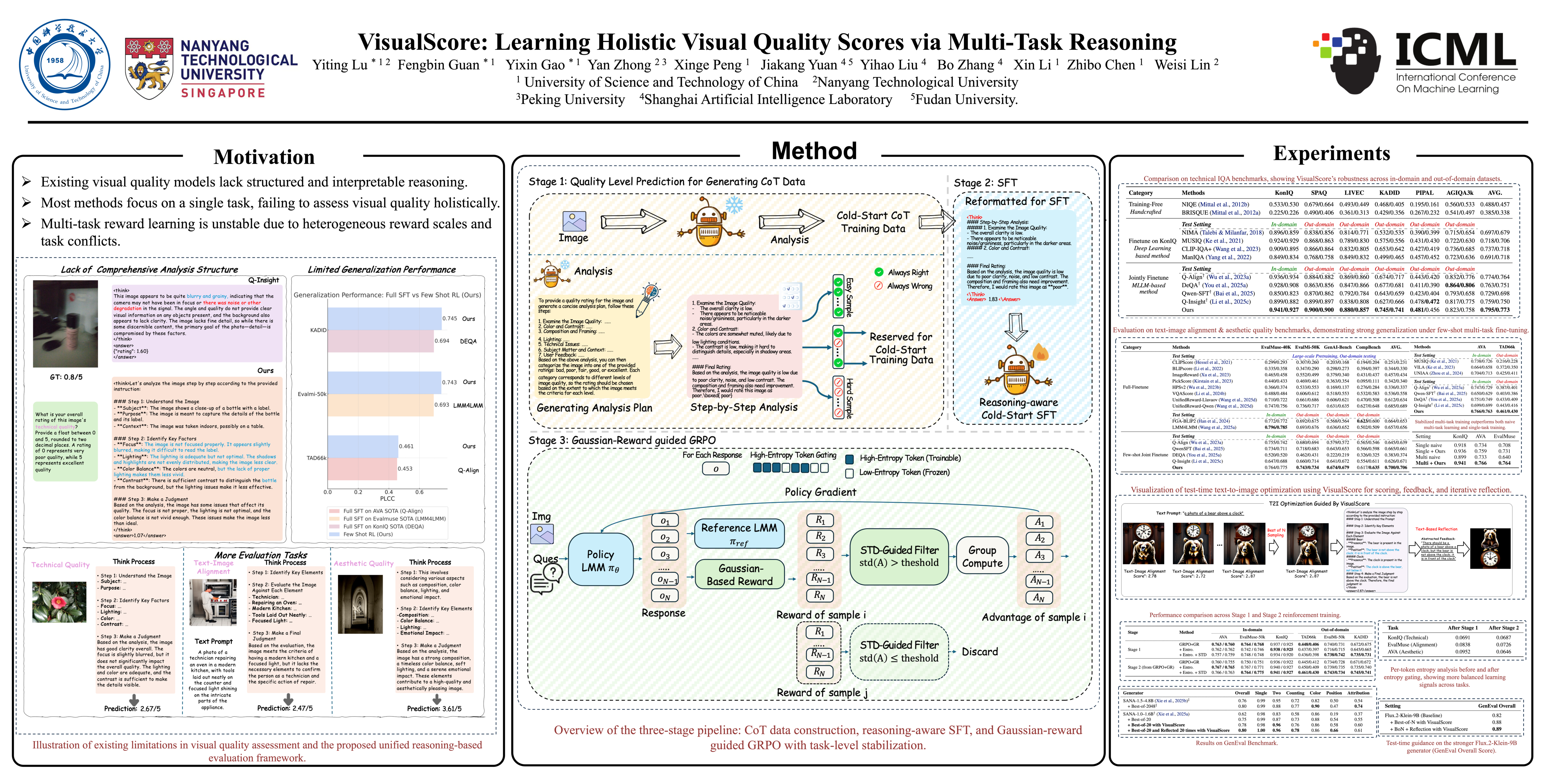
Image quality assessment (IQA) is inherently multi-dimensional, yet existing reward models are typically limited to a single task and become unstable when extended to multi-task settings. In particular, heterogeneous reward scales and variances across tasks can lead to conflicting optimization signals during reinforcement learning. We propose VisualScore, a unified visual evaluation framework that formulates multi-task IQA as structured, task-aware reasoning followed by continuous reward optimization. VisualScore produces interpretable rationales together with scalar quality scores under explicit evaluation principles. We construct a reasoning-enhanced reward modeling dataset via rejection sampling and initialize the model through supervised fine-tuning. VisualScore is then optimized with Group Relative Policy Optimization (GRPO) using a Gaussian-based continuous reward. To address multi-task reward conflicts and stabilize training, we introduce standard deviation filtering and entropy gating to normalize task-wise reward signals and suppress noisy updates. Experiments on technical quality, aesthetic quality, and text–image alignment show that VisualScore improves robustness, generalization, and interpretability, and can effectively guide text-to-image generation at test time without retraining.
Lay Summary
Images shared or generated online can be flawed in many different ways: they may be blurry, visually unappealing, or fail to match the text description that was used to create them. Existing automatic scoring tools often focus on only one of these aspects, and they usually return a single number without explaining why. This makes it hard to trust their judgments or use them to improve image-generation systems. We introduce VisualScore, a system that evaluates images in a more human-like way. Instead of only giving a score, it first considers the goal of the evaluation, looks at relevant factors such as clarity, lighting, composition, and text-image consistency, and then produces both an explanation and a final quality score. We train VisualScore to handle several image evaluation tasks together while keeping its scoring stable across different types of images. Our experiments show that VisualScore gives more reliable and explainable quality judgments across diverse benchmarks. It can also help text-to-image models choose or improve generated images at test time, without retraining the generator.